Feeble-minded in Ontario : eighth report for the year 1913.
- MacMurchy, Helen, 1862-1953.
- Date:
- 1914
Licence: In copyright
Credit: Feeble-minded in Ontario : eighth report for the year 1913. Source: Wellcome Collection.
Provider: This material has been provided by The Royal College of Surgeons of England. The original may be consulted at The Royal College of Surgeons of England.
5/32
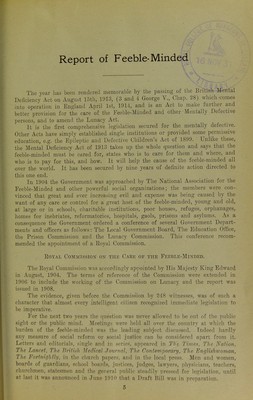
![Report of Feeble-Minded The year has been rendered memorable by the passing of the British Mental Deficiency Act on August 15th, 1913, (3 and 4 George V., Chap. 28) which-comes into operation in England April 1st, 1914, and is an Act to make further and better provision for the care of the Feeble-Minded and other Mentally Defective persons, and to amend the Lunacy Act. It is the first comprehensive legislation secured for the mentally defective. Other Acts have simply established single institutions or provided some permissive education, e.g. the Epileptic and Defective Children s Act of 1899. Unlike these, the Mental Deficiency Act of 1913 takes up the whole question and says that the feeble-minded must be cared for, states who is to care for them and where, and who is to pay for this, and how. It will help the cause of the feeble-minded all over the world. It has been secured by nine years of definite action directed to this one end. In 1904 the Government was approached by The National Association for the Feeble-Minded and other powerful social organizations; the members were con-^ vinced that great and ever increasing evil and expense was being caused by the want of any care or control for a great host of the feeble-minded, young and old, at large or in schools, charitable institutions, poor houses, refuges, orphanages, homes for inebriates, reformatories, hospitals, gaols, prisons and asylums. As a consequence the Government ordered a conference of several Government Depart- ments and officers as follows: The Local Government Board, The Education Office, the Prison Commission and the Lunacy Commission. This conference recom- mended the appointment of a Royal Commission. Royal CoviMissioisr on the Care oe the Feeble-Minded. The Royal Commission was accordingly appointed by His Majesty King Edward in August, 1904. The terms of reference of the Commission were extended in 1906 to include the working of the Commission on Lunacy and the report was issued in 1908. The evidence, given before the Commission by 248 witnesses, was of such a character that almost every intelligent citizen recognized immediate legislation to be imperative. For the next two years the question was never allowed to be out of the public sight or the public mind. Meetings were held all over the country at which the burden of the feeble-minded was the leading subject discussed. Indeed hardly any measure of social reform or social justice can be considered apart from it. Letters and editorials, single and in series, appeared in The The Nation, The Lancet, The British, Hfedical Journal, The Contemporary, The Englishwoman, The Fortnightly, in the church papers, and in the local press. Mon and women, boards of guardians, school boarcls, jinstices, judges, lawyers, physicians, teachers, churchmen, statesmen anr] the general public steadil}^ pressed for legislation, until at last it was announced in June 1910 that a Draft Bill was in preparation.](https://iiif.wellcomecollection.org/image/b22469527_0007.jp2/full/800%2C/0/default.jpg)