Information to help you plan and prepare for your visit to the exhibition.
Introduction to The Coming of Age
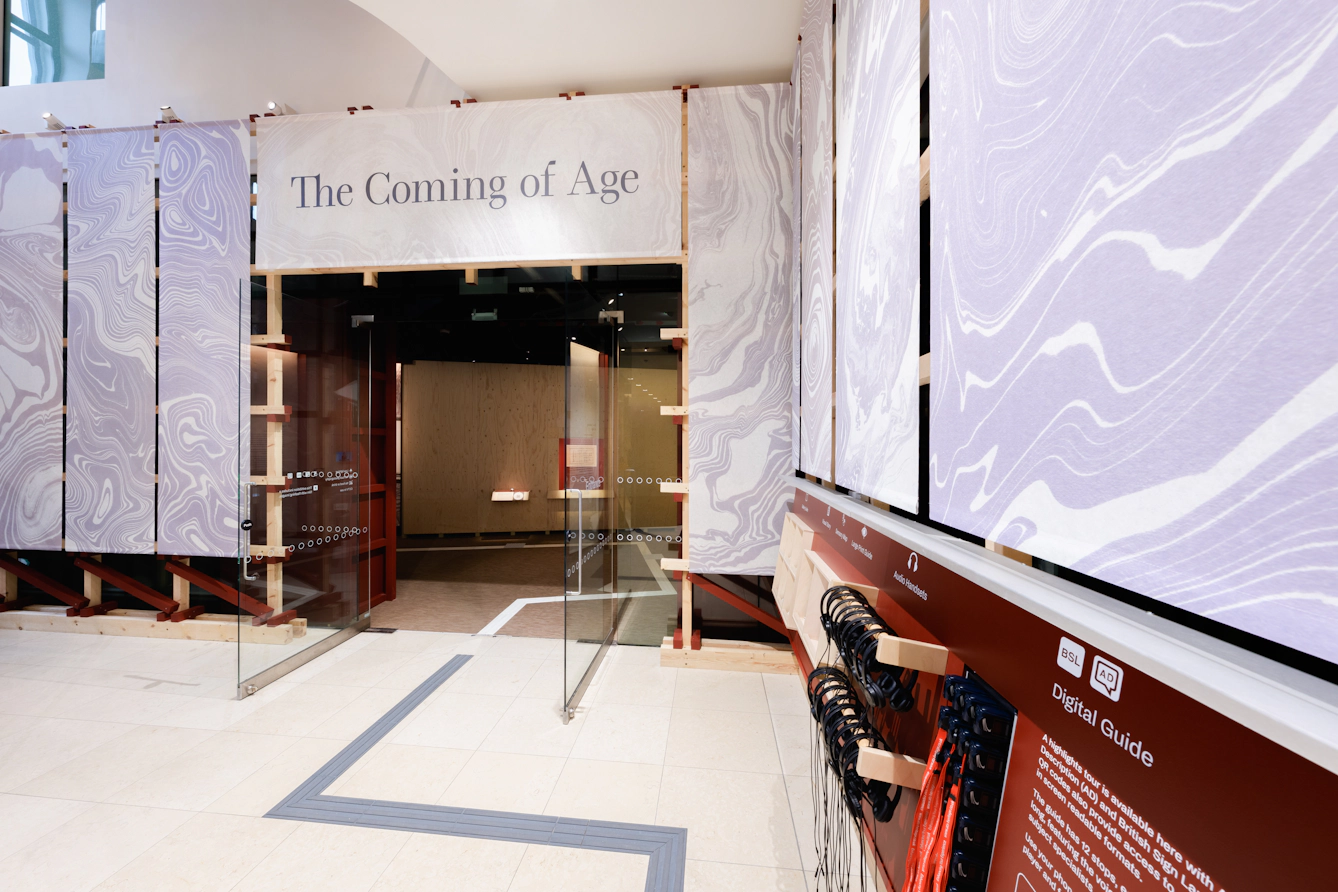
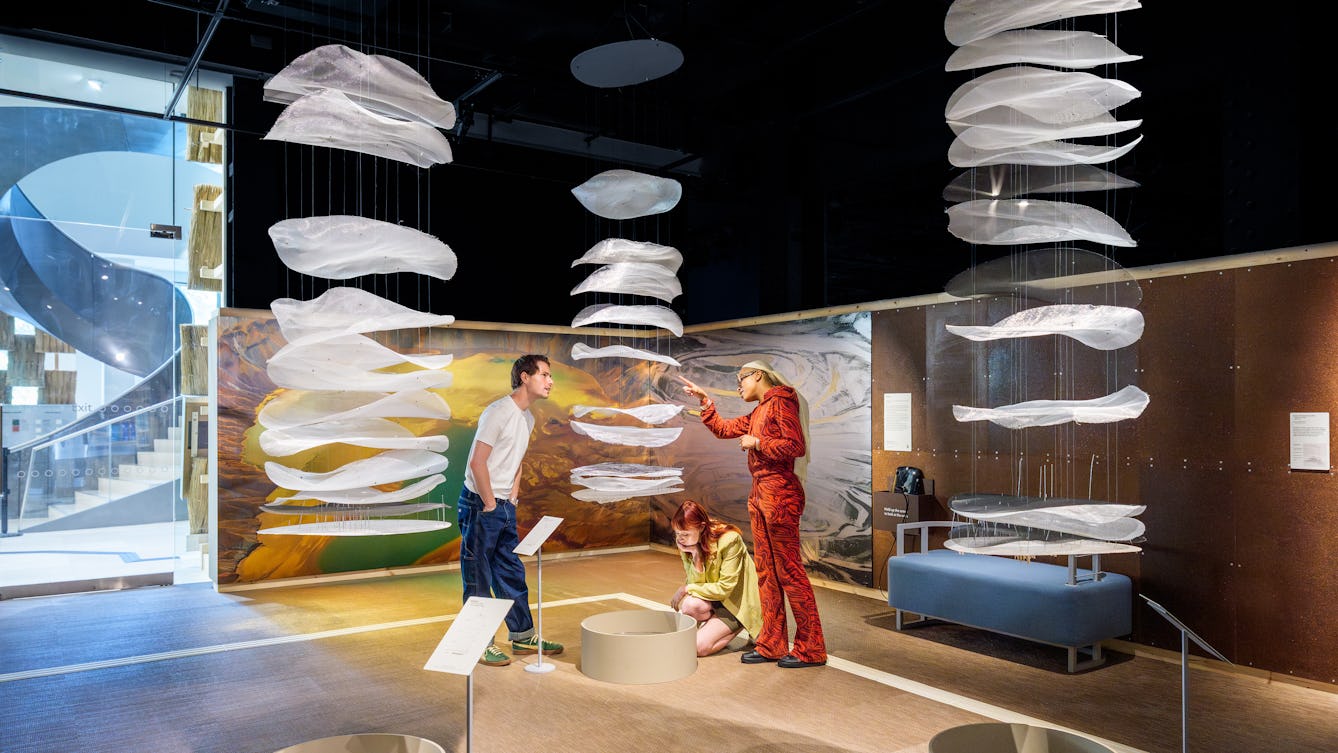
‘The Coming of Age’ exhibition at Wellcome Collection, Gallery Photo: Steven Pocock. Source: Wellcome Collection. Attribution-NonCommercial 4.0 International (CC BY-NC 4.0).
This exhibition is called ‘The Coming of Age’.
An exhibition is a collection of things to look at and learn about.
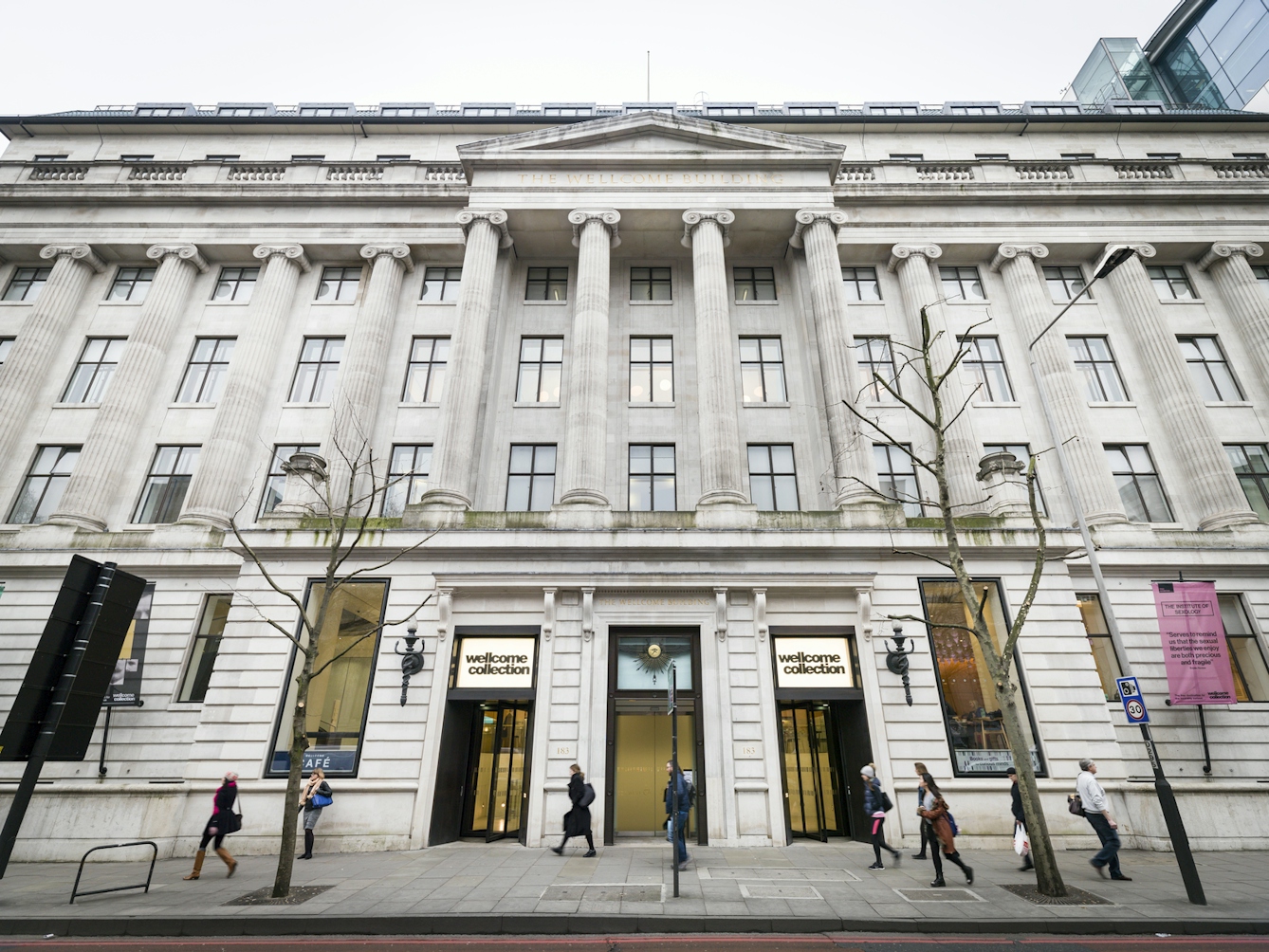
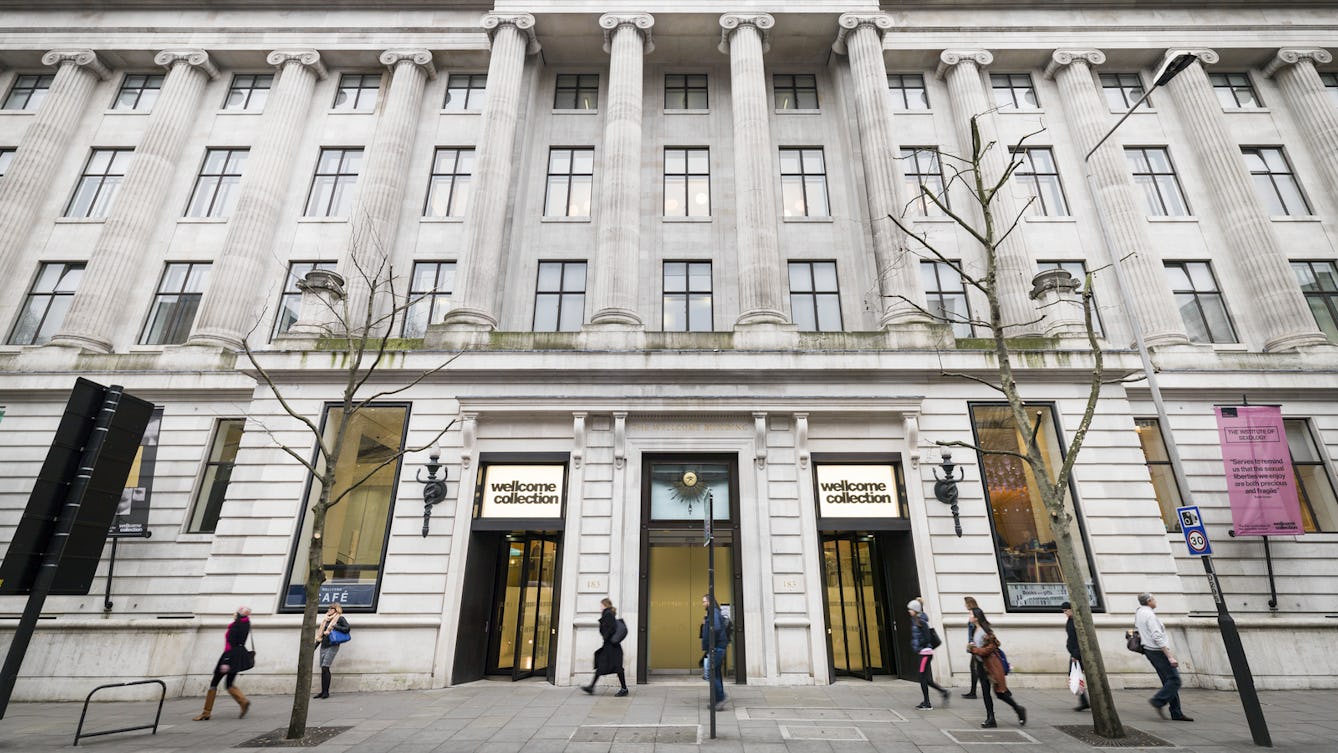
Wellcome Collection building. © Wellcome Collection.
The exhibition is at Wellcome Collection.
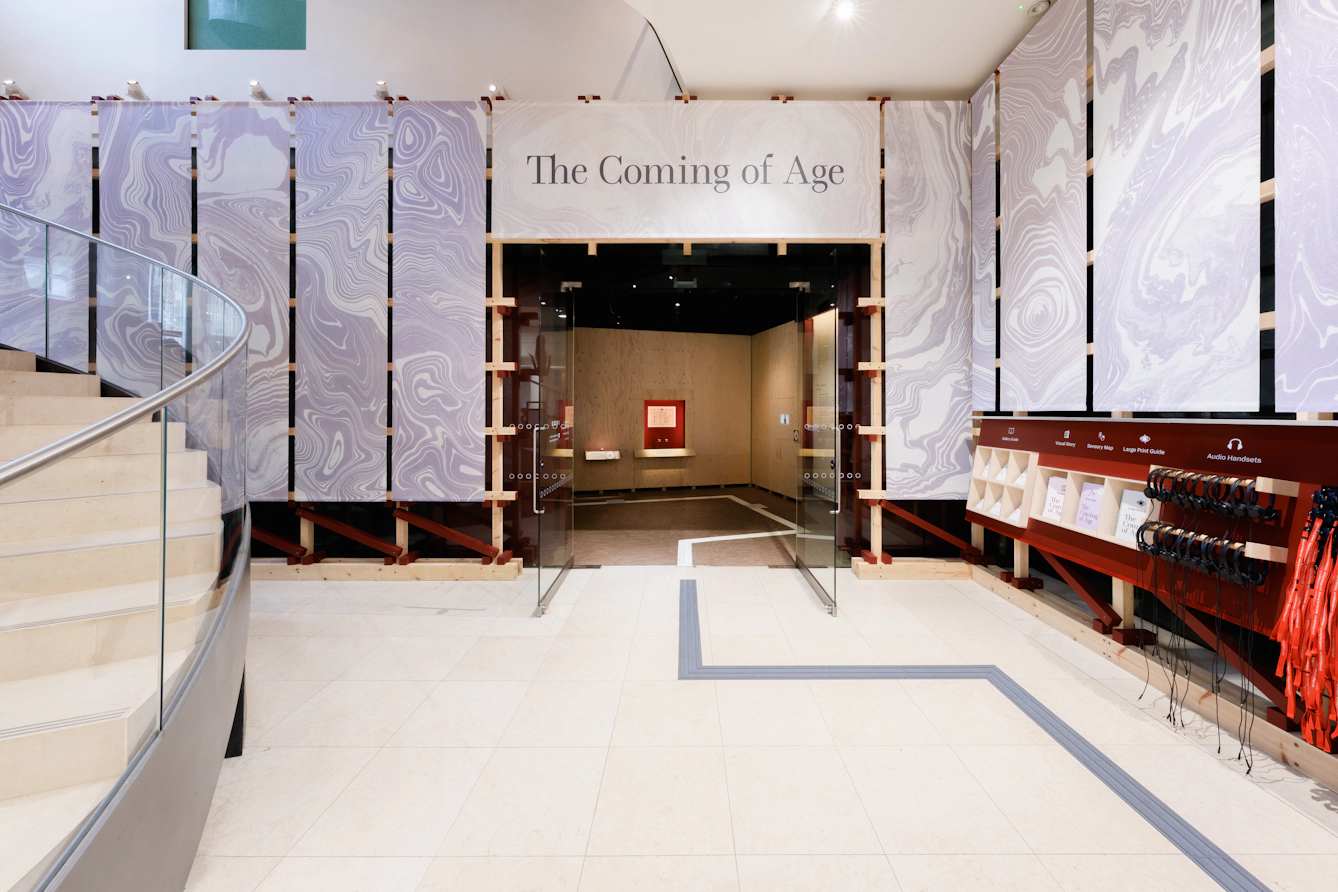
‘The Coming of Age’ exhibition at Wellcome Collection, Gallery Photo: Steven Pocock. Source: Wellcome Collection. Attribution-NonCommercial 4.0 International (CC BY-NC 4.0).
The exhibition is in Gallery 1 on level 0 of our building.

The exhibition starts on Thursday 26 March 2026.

The exhibition ends on Sunday 29 November 2026.

You do not have to pay to visit the exhibition.

You do not need to book a ticket. Just turn up.
Visiting Wellcome Collection
For more information about:
- opening times
- accessibility
- travel
click on this link: Visiting Wellcome Collection visual story.
About the exhibition
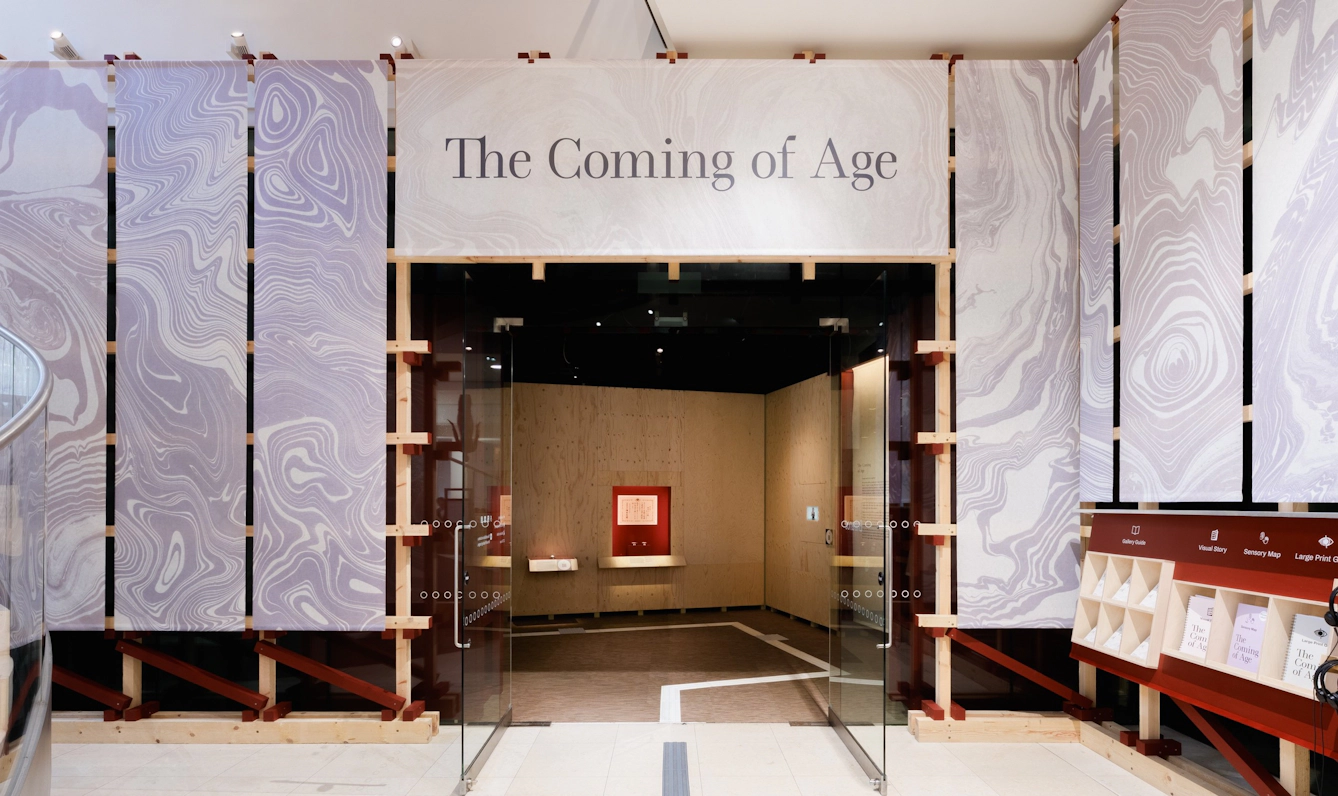
‘The Coming of Age’ exhibition at Wellcome Collection, Gallery Photo: Steven Pocock. Source: Wellcome Collection. Attribution-NonCommercial 4.0 International (CC BY-NC 4.0).
‘The Coming of Age’ is an exhibition about people’s experiences of ageing.
Ageing means living longer and getting older.
This exhibition looks at:
- what happens to our bodies and minds when we get older
- how people might feel about getting older.
What is in the exhibition
There are different things to look at, listen to and touch in the exhibition. These include:
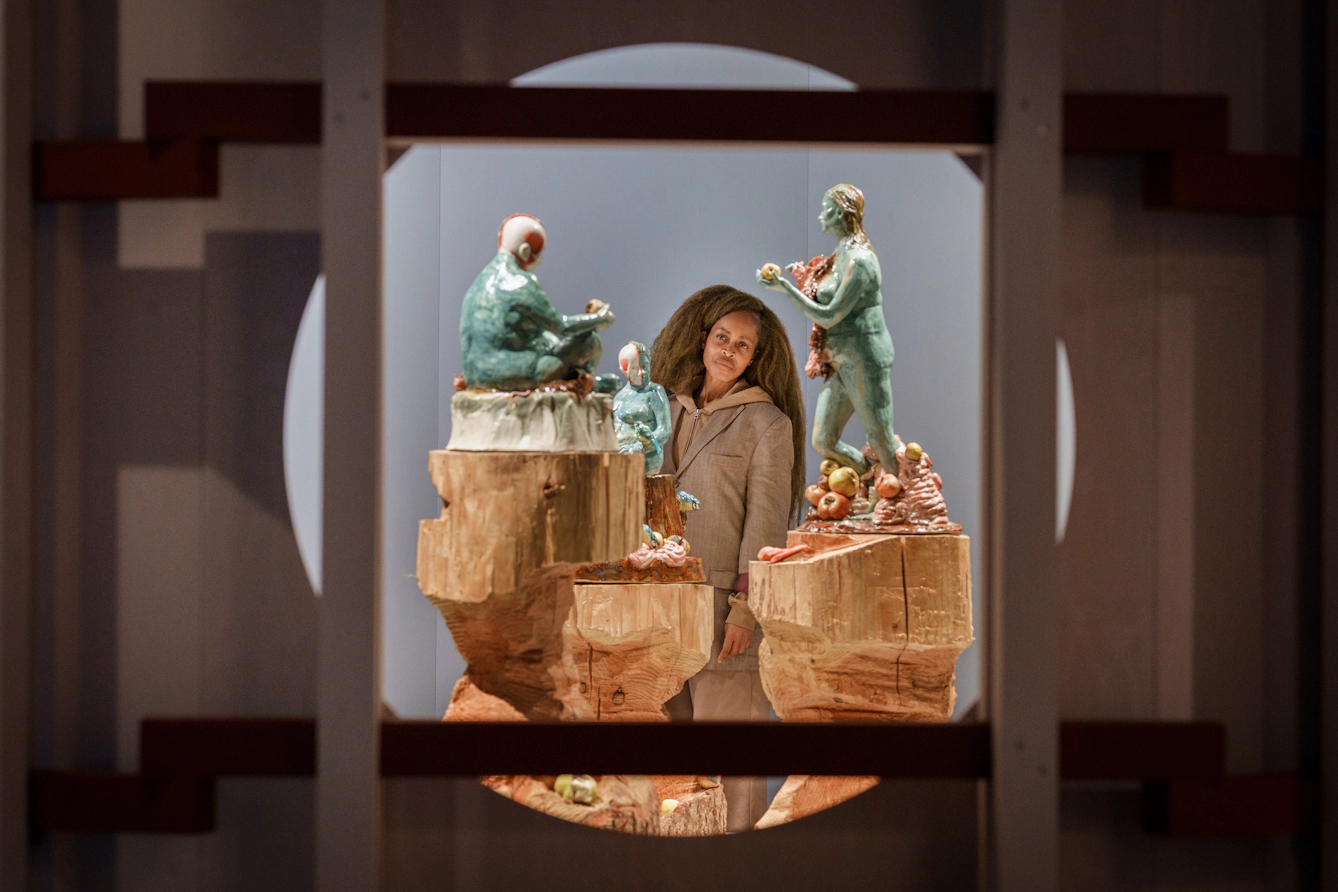
‘Wild Apples’, Serena Korda, 2024, Courtesy of Cooke Latham Gallery. ’The Coming of Age’ exhibition at Wellcome Collection, Gallery Photo: Steven Pocock. Source: Wellcome Collection. Attribution-NonCommercial 4.0 International (CC BY-NC 4.0).
- objects from the past
- everyday objects
- photographs
- paintings and drawings
- sculptures
- films
- sound works.

Some of the things in this exhibition are about:
- Death. Death is when a living body stops working and life ends.
- Illness. An illness is when a person feels unwell. Illness can affect the body or the mind. Illness can be for a short time or a long time.
- Discrimination. Discrimination is when someone is treated unfairly because of who they are. For example, because of their age, disability, race or gender.
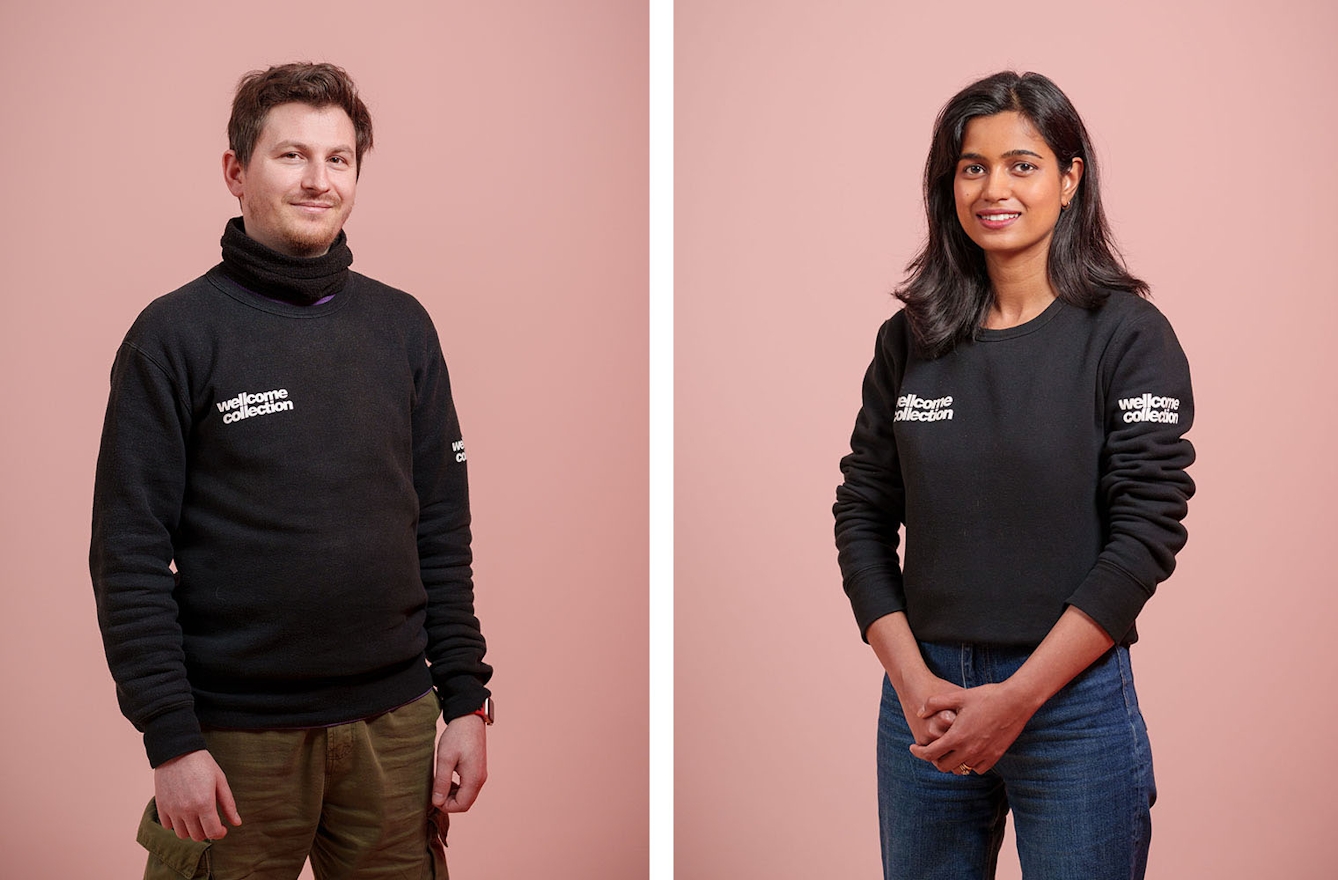
Visitor Experience Assistants. Source: Wellcome Collection. Attribution-NonCommercial 4.0 International (CC BY-NC 4.0).
If you need any help, you can speak to a member of our team.
Sensory information

You cannot eat or drink in the exhibition.

But you can breastfeed or bottle-feed babies.
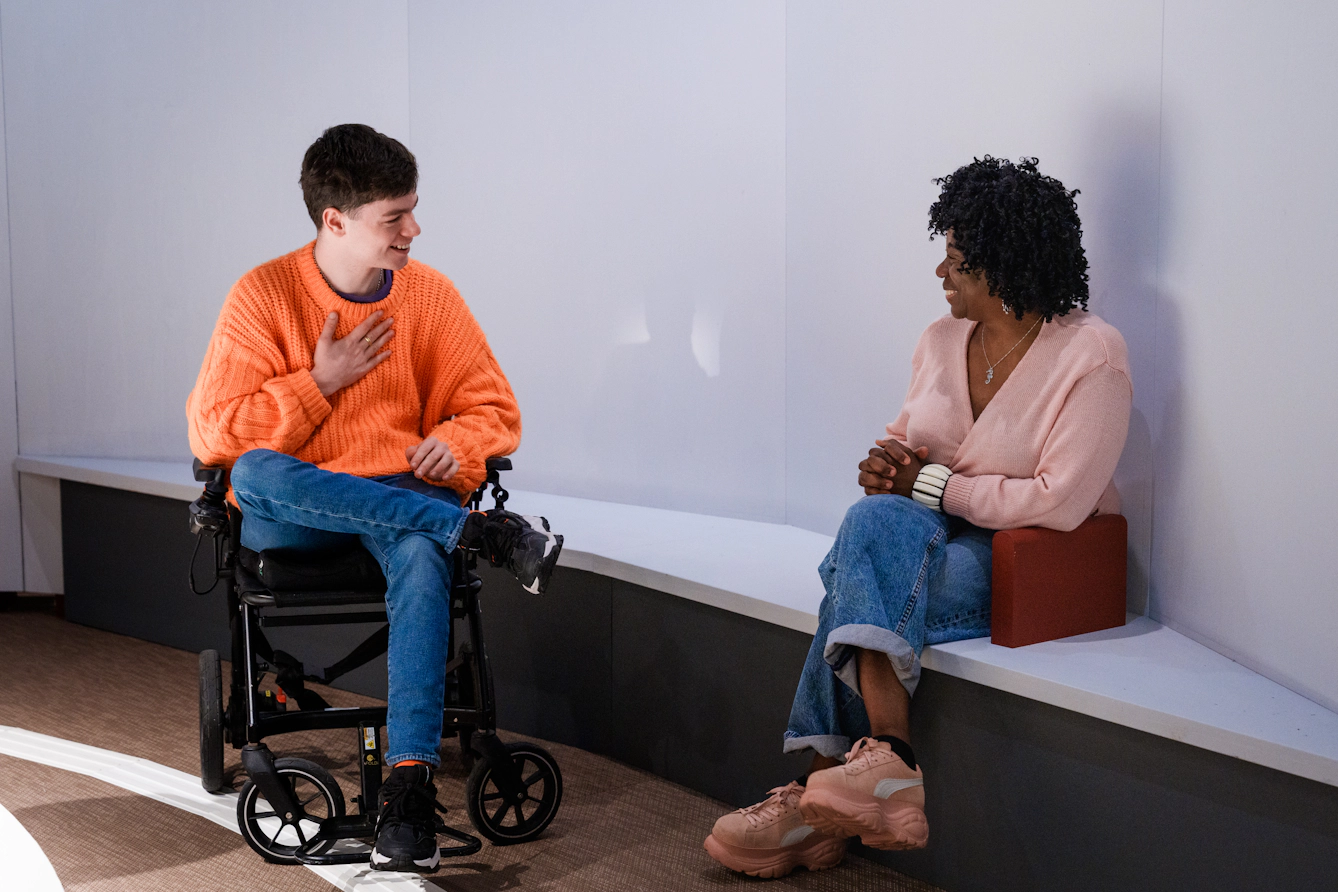
‘The Coming of Age’ exhibition at Wellcome Collection, Gallery Photo: Steven Pocock. Source: Wellcome Collection. Attribution-NonCommercial 4.0 International (CC BY-NC 4.0).
People sometimes speak quietly at an exhibition. But you do not have to speak quietly.

The lights are not very bright in the exhibition. This is to protect the artworks.
This exhibition includes:

- Works you can touch. These have a picture of a hand on the label or next to the object.


- Objects with sound. This sound can be out loud or on headphones.
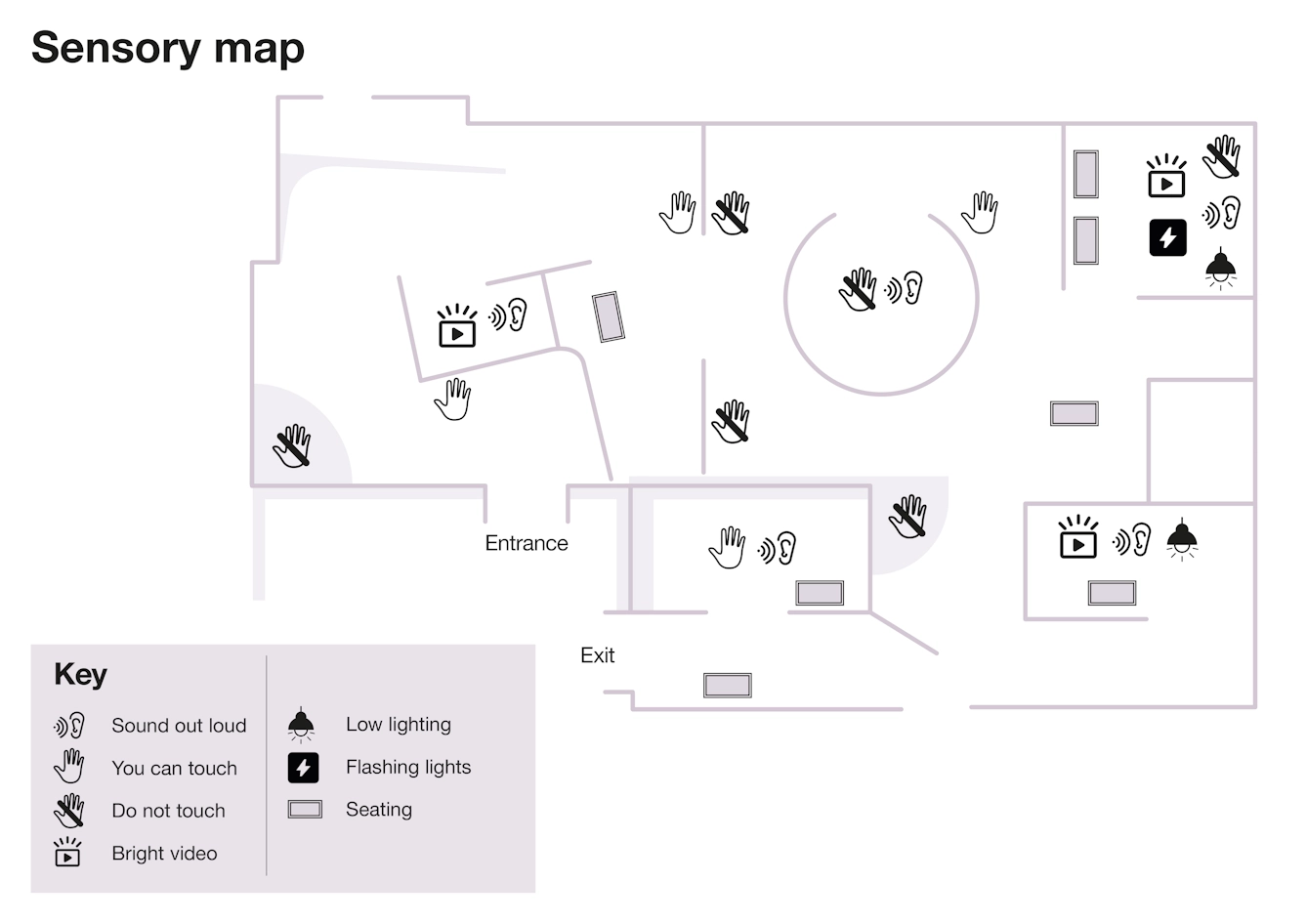
‘The Coming of Age’ exhibition at Wellcome Collection, Gallery Photo: Steven Pocock. Source: Wellcome Collection. Attribution-NonCommercial 4.0 International (CC BY-NC 4.0).
The sensory map shows you where these things are.
We will tell you more about them later in this visual story.
What is in the atrium
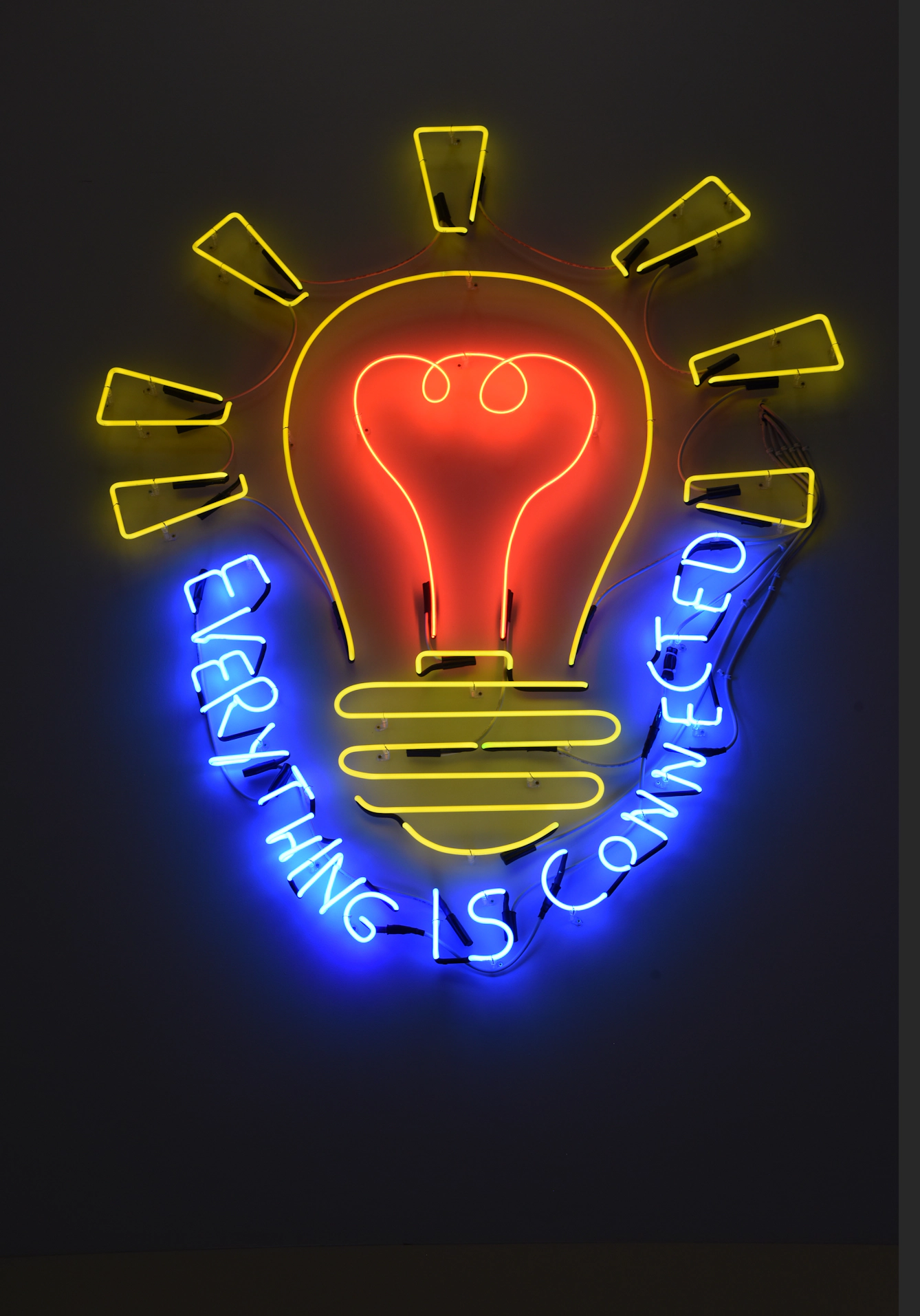
Everything is Connected, Ian Beesley, 2026.
‘Everything is Connected’ by Ian Beesley
This is an artwork made from a neon light.
Neon is a bright coloured light made with glass tubes and electricity.
This artwork is shaped like a light bulb. Ian Beesley made this artwork. Ian wanted to show the idea of a ‘light-bulb moment’. A light-bulb moment means suddenly understanding something new.
The work is called ‘Everything is Connected’.
Ian made this artwork to show that our past, present and future are linked as we grow older
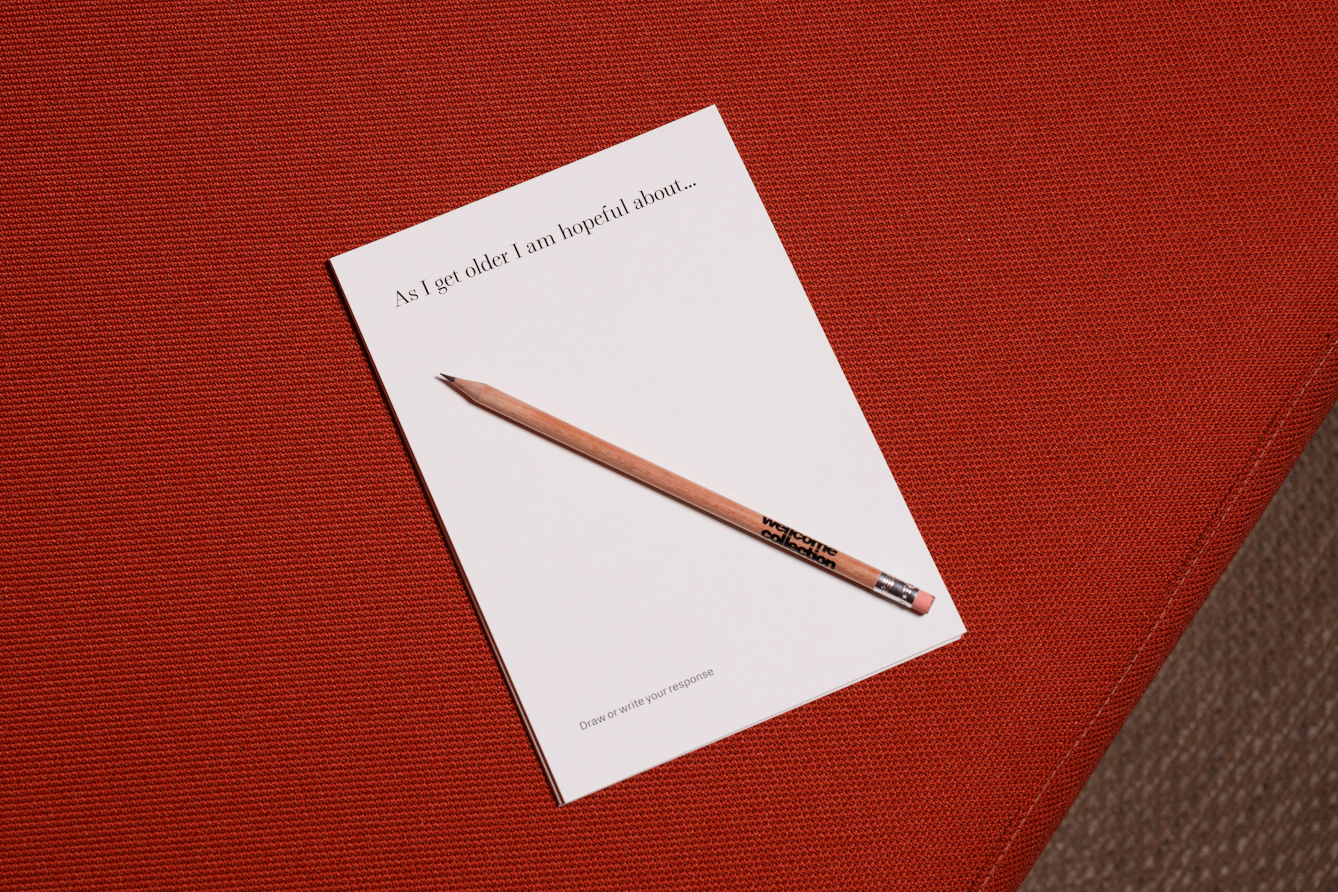
‘The Coming of Age’ exhibition at Wellcome Collection, Gallery Photo: Steven Pocock. Source: Wellcome Collection. Attribution-NonCommercial 4.0 International (CC BY-NC 4.0).
Response wall
Here you can answer some questions about ageing.
You can write your answers on a piece of paper.
Then you can hang this paper on the wall so that other people can read it.
You can also read other people’s answers.
There are no wrong or right answers. You can write whatever you think or feel.
What is in the introduction
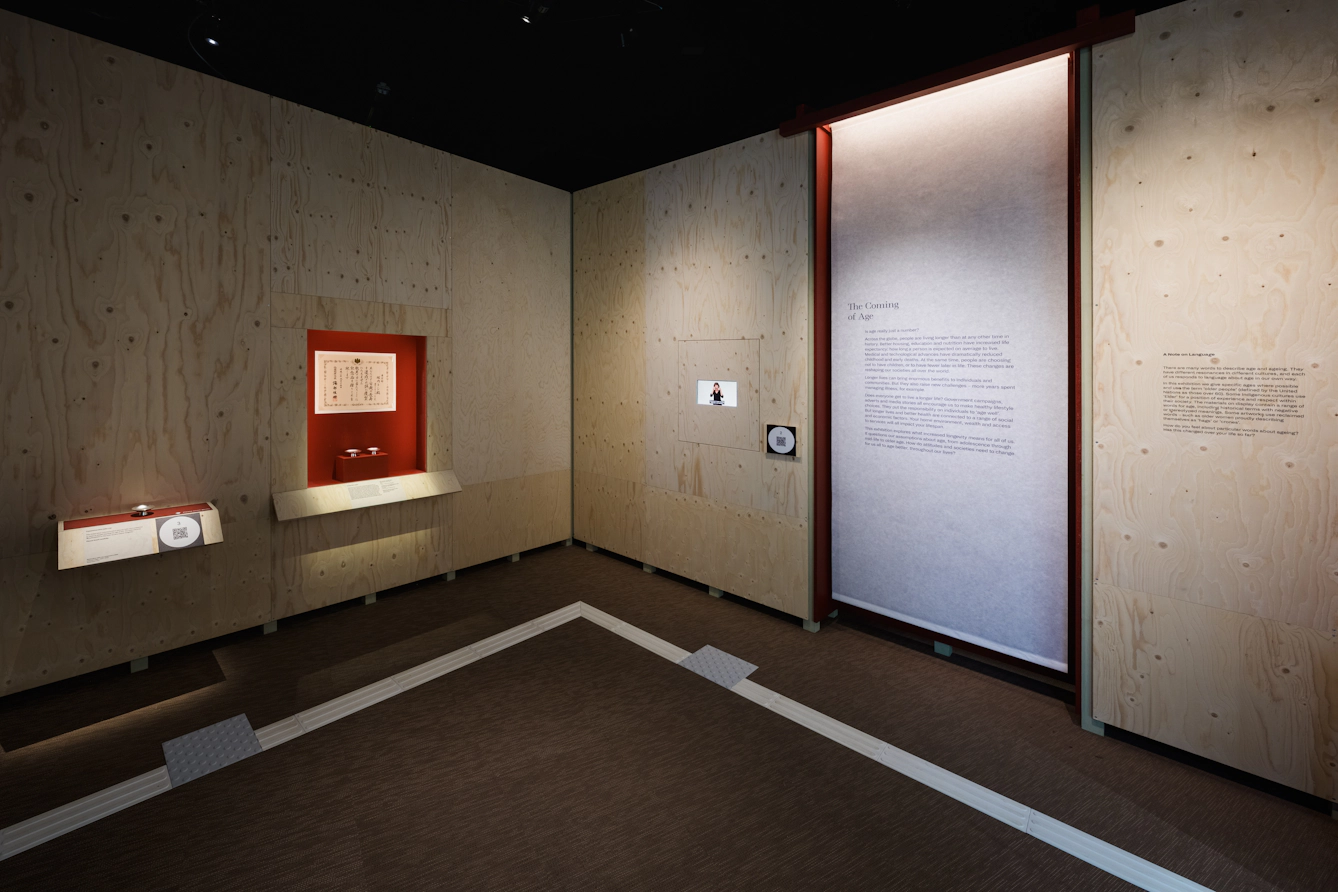
‘The Coming of Age’ exhibition at Wellcome Collection, Gallery Photo: Steven Pocock. Source: Wellcome Collection. Attribution-NonCommercial 4.0 International (CC BY-NC 4.0).
People now live longer than people did in the past.
Living longer can be good. Living longer gives more time for family and fun.
But living longer can also be hard. Living longer can mean more years living with illness.
Illness is when a person feels unwell.
Getting older is different for different people.
Getting older can be different for different people, because of:
- where they live
- what help they get.
This exhibition looks at these different experiences of ageing.
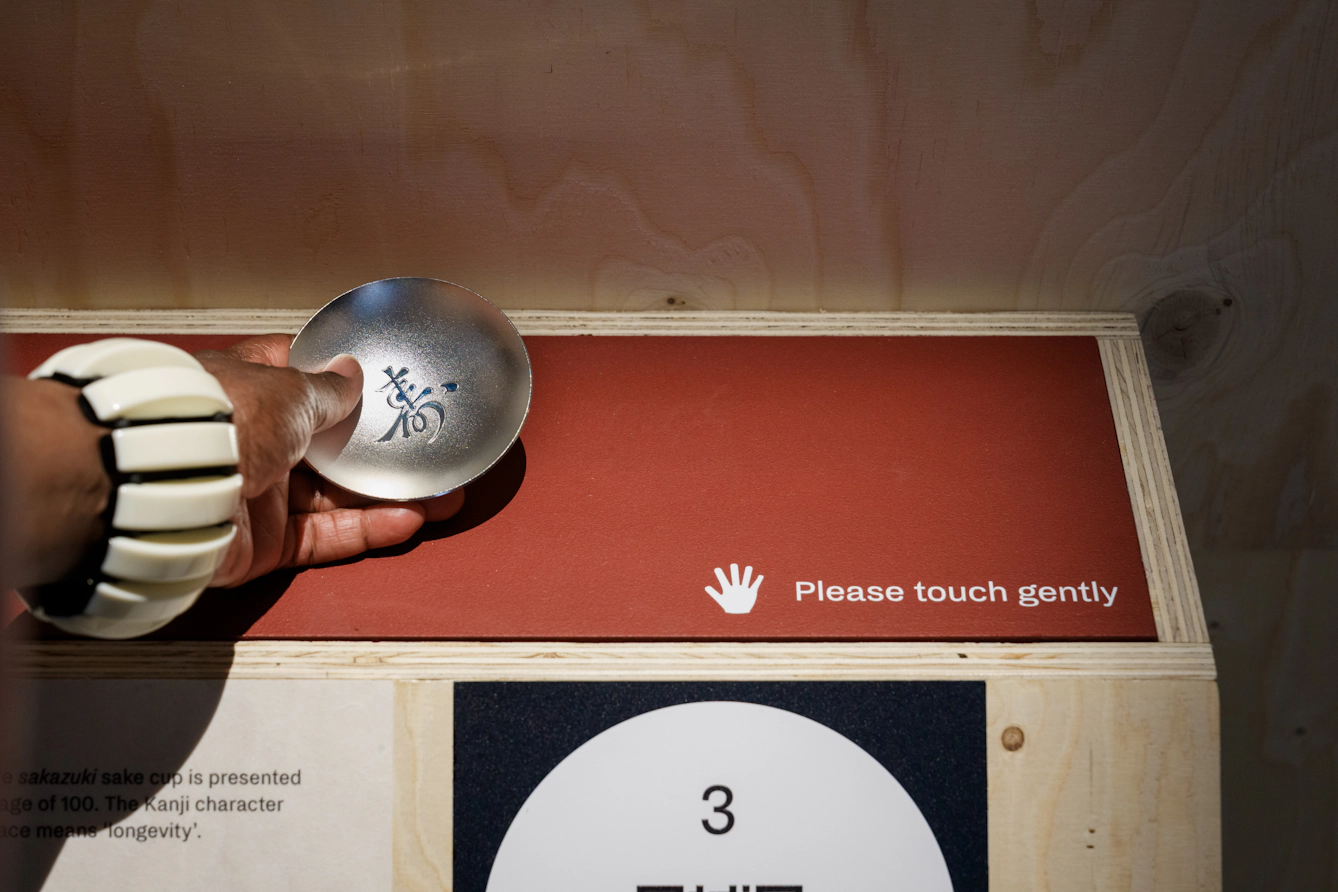
Commemorative sake cup, unknown maker, Japan, 2010s. ‘The Coming of Age’ exhibition at Wellcome Collection, Gallery Photo: Steven Pocock. Source: Wellcome Collection. Attribution-NonCommercial 4.0 International (CC BY-NC 4.0).
Sake cup
Sake is a Japanese word. When we say this word it sounds like sa-kay.
Sake is a Japanese alcoholic drink made from rice.
This cup was made for drinking sake.
When a Japanese person lives to be 100 years old, the Japanese government gives a special sake cup to that person on their birthday. This is to show respect.
In the past only a small number of people received a cup. Now many more people reach 100 years old.
Giving cups to more people cost a lot of money.
So now people are given cheaper cups.
This makes us think about ageing and how society cares for older people.
You can touch this object.
What is in section 1
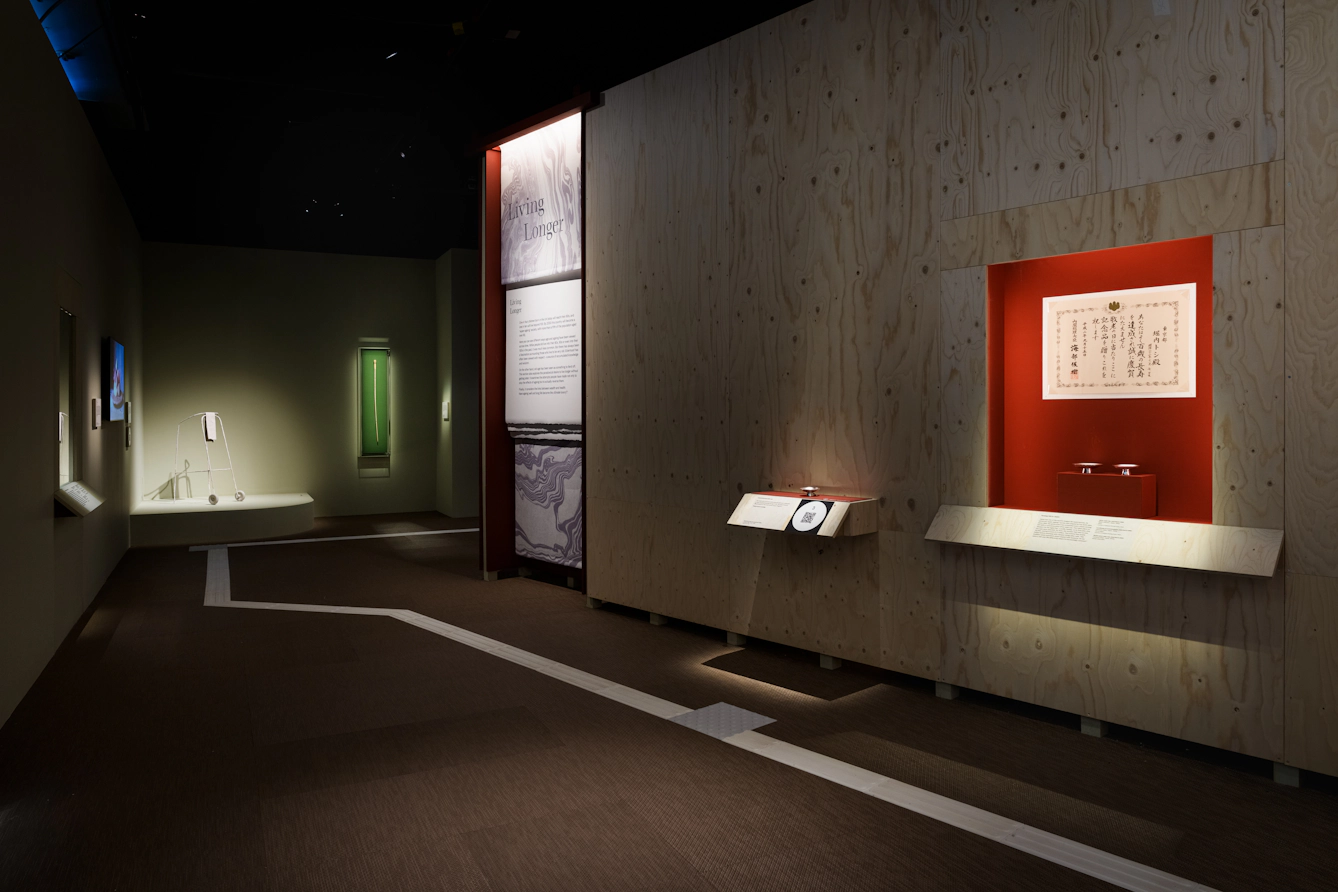
'The Coming of Age' exhibition at Wellcome Collection, Gallery Photo: Steven Pocock. Source: Wellcome Collection. Attribution-NonCommercial 4.0 International (CC BY-NC 4.0).
Section 1 is called ‘Living Longer’.
People now live longer than people did in the past.
This section shows different ideas about ageing over time.
This section also looks at:
- how people try to stay feeling young
- how money affects ageing.
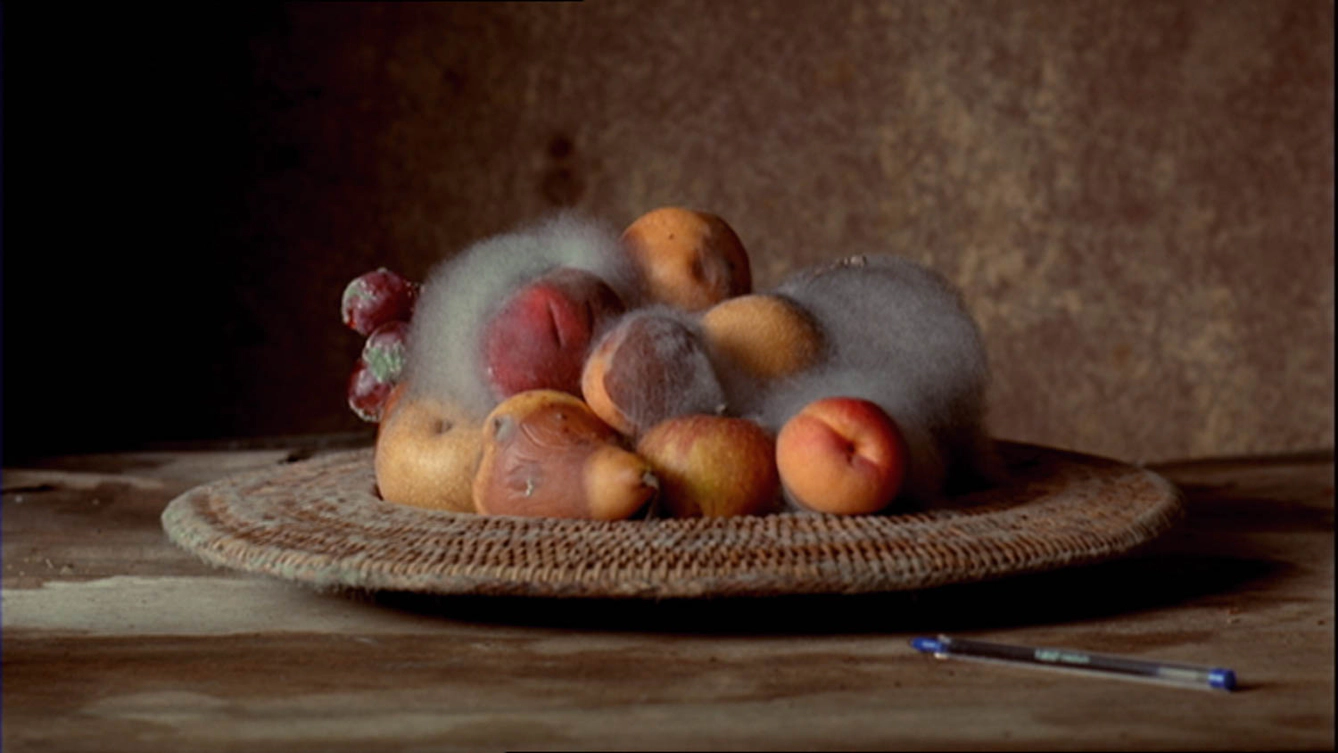
‘Still Life’, Sam Taylor-Johnson, 2001. © Sam Taylor-Johnson. All Rights Reserved.
‘Still-Life’ by Sam Taylor-Johnson
This work shows a bowl of fruit on a table.
At first it looks like a still photograph.
Then the fruit slowly changes. It ripens, gets soft, and then rots.
Next to the fruit is a pen. The pen does not change.
The work is about time. It shows how some things grow and fade while others stay the same.
This work is quiet and simple, but it makes you think about life and change.
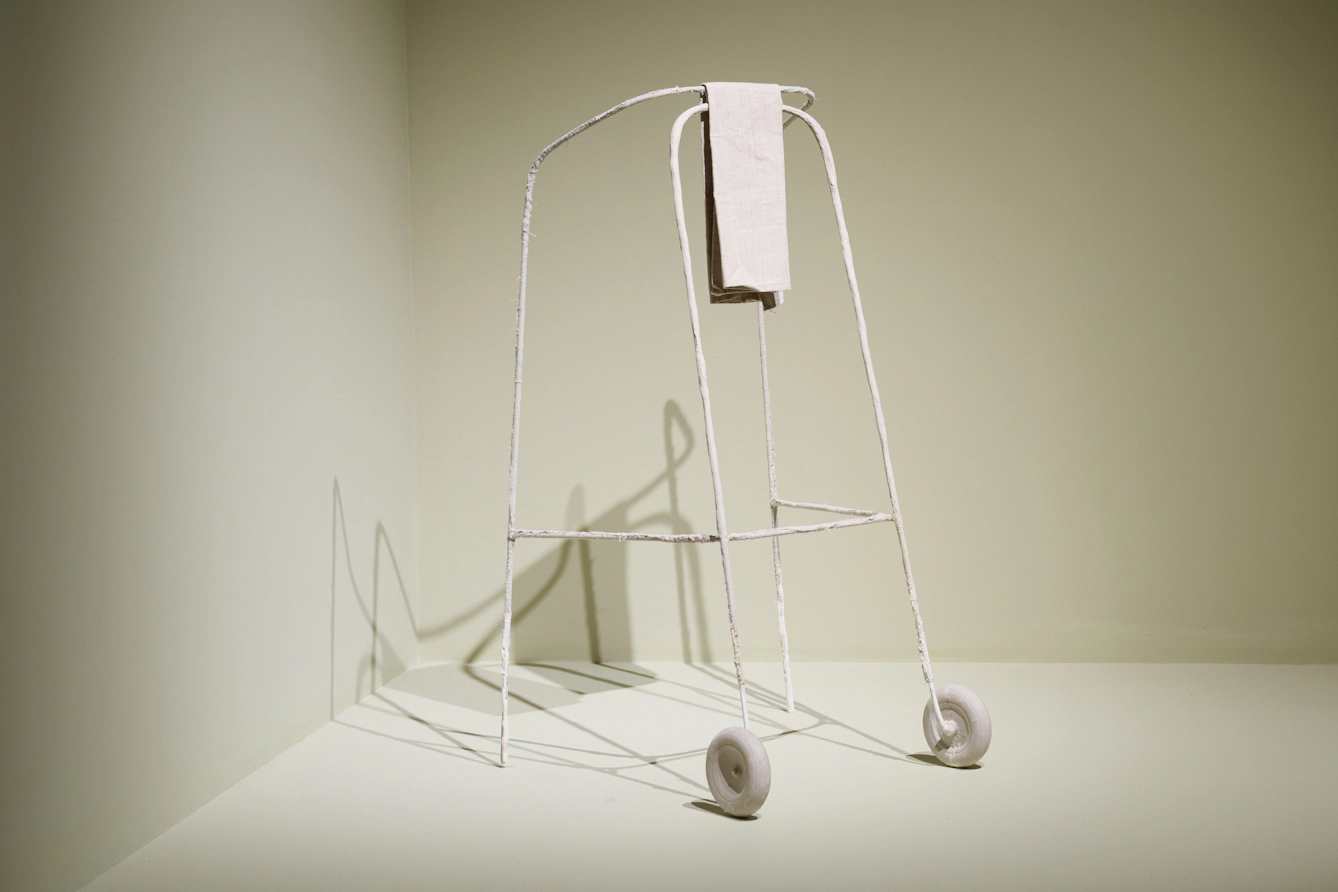
‘Zimmer’, Daphne Wright, 2019. ‘The Coming of Age’ exhibition at Wellcome Collection, Gallery Photo: Steven Pocock. Source: Wellcome Collection. Attribution-NonCommercial 4.0 International (CC BY-NC 4.0).
‘Zimmer’ by Daphne Wright
This sculpture is about Zimmer frames.
Zimmer frames are walking frames that help people move safely.
Zimmer frames give people support and make daily life easier.
The artist Daphne Wright made this frame from soft clay. Soft clay is fragile.
Fragile means easy to break.
Daphne visited people in nursing homes. Daphne saw that people add objects to their frames to make them personal and useful.
The frame in this artwork has a cloth to make it more comfortable to hold.
The sculpture shows that Zimmer frames can:
- help people move around
- be used in different ways for different needs.

Please do not touch this work.
It can break easily.
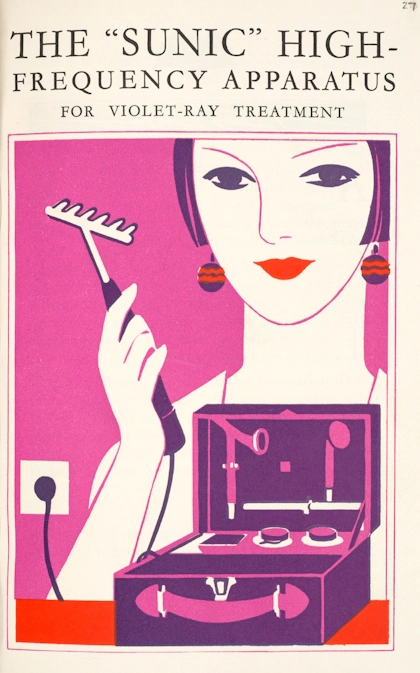
Treatments against ageing
Here you can see old products that people believed would slow down ageing.
People hoped these products would help them:
- live longer
- look younger.
The jar had something called ‘syrup of long life’ inside it.
The small book is about pills that promised long life.
People used the machine to shine purple light on their body and face.
None of these things would make people look younger.
These objects remind us that people have worried about ageing for a long time. The objects show how people thought it was better to look younger.
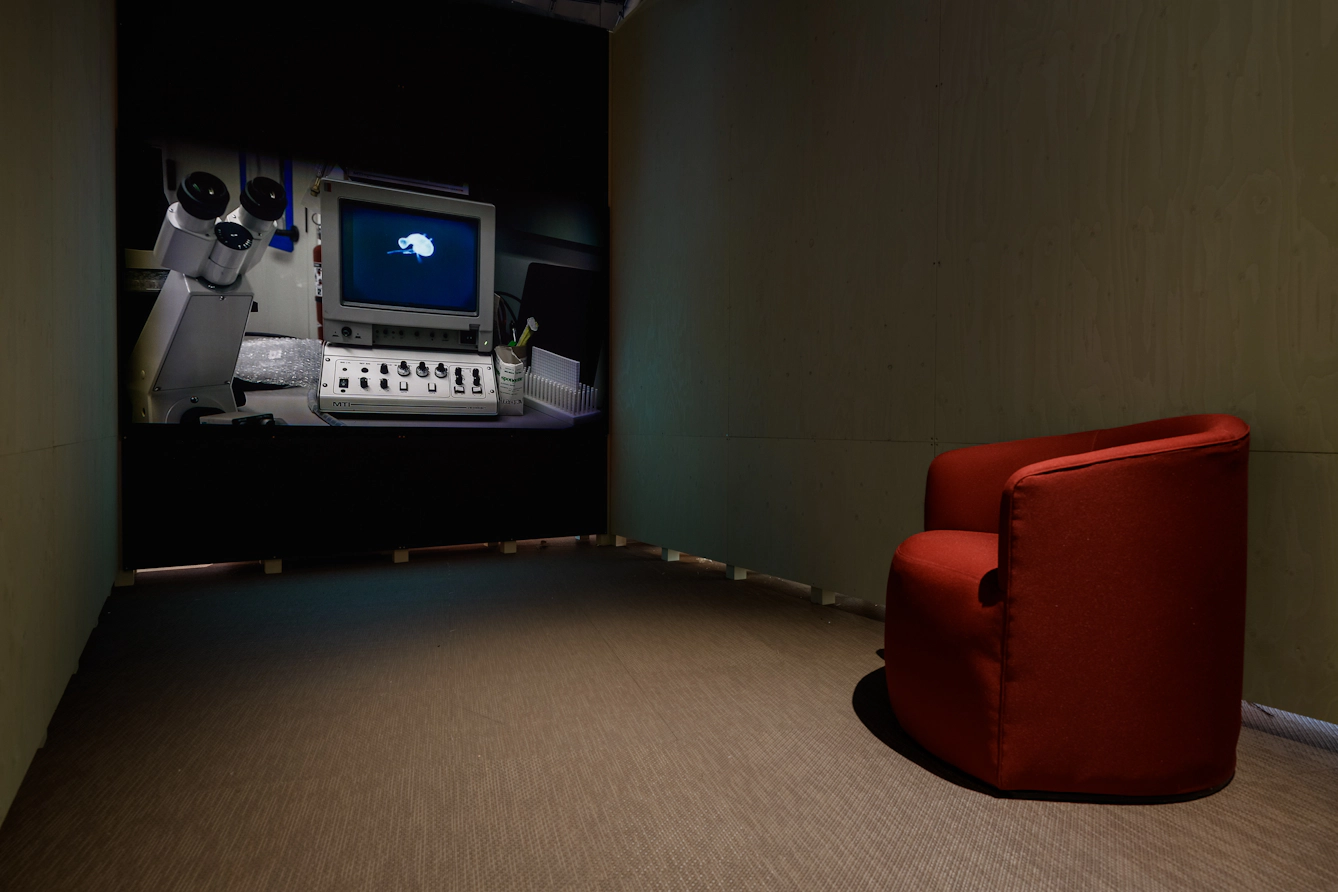
‘The Problem of the Hydra’, Maija Tammi, 2017–20. ‘The Coming of Age’ exhibition at Wellcome Collection, Gallery Photo: Steven Pocock. Source: Wellcome Collection. Attribution-NonCommercial 4.0 International (CC BY-NC 4.0).
‘The Problem of the Hydra’ by Maija Tammi
This film is about an animal called a hydra.
Hydras are tiny animals that live in water.
Hydras do not get old like other animals. They can live forever.
Scientists have studied hydras for a long time because they are so unusual.
This film asks what it would be like to live forever.
This film is 10 minutes long.

This film is on a large screen.
There is sound playing out loud.
What is in section 2
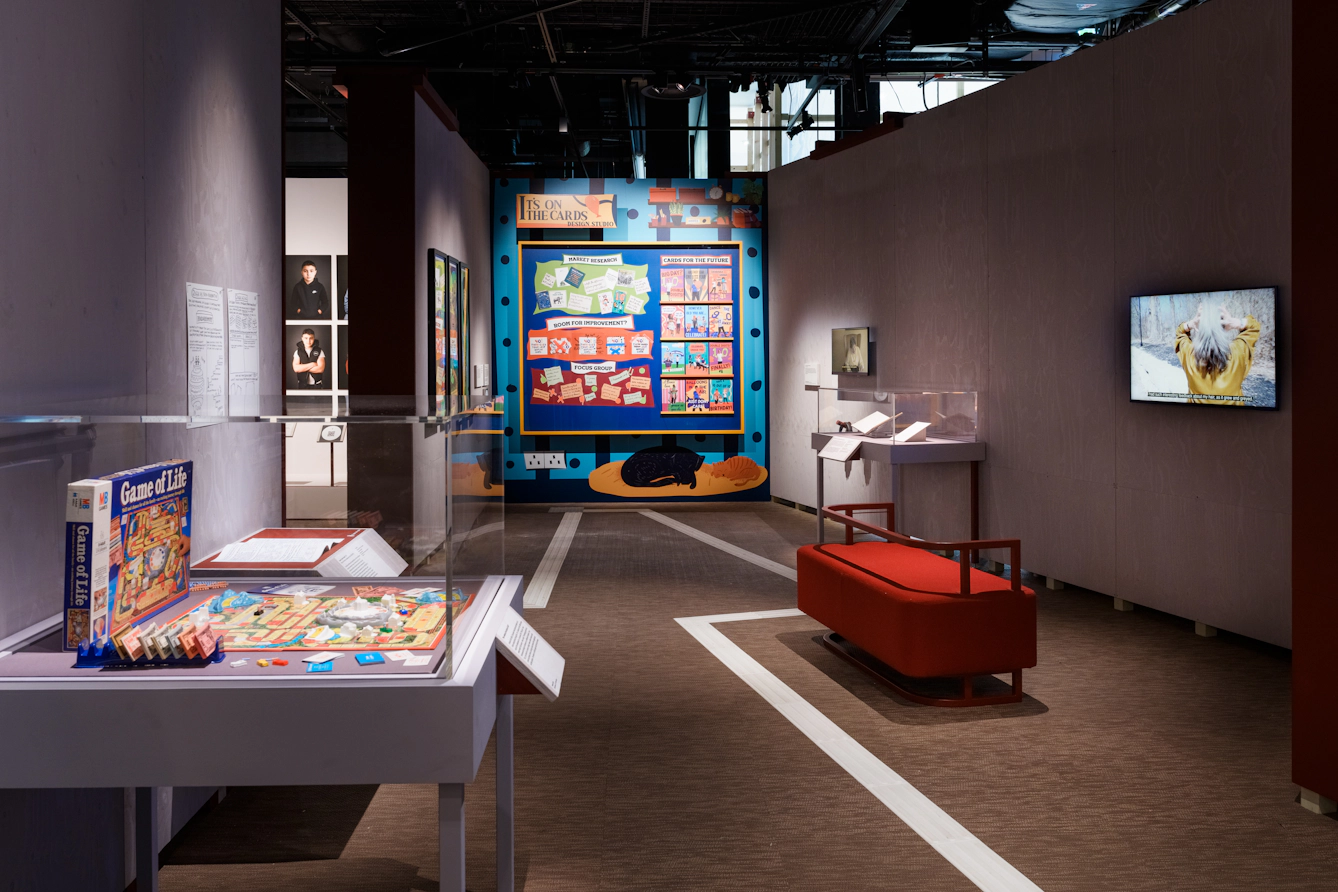
‘The Coming of Age’ exhibition at Wellcome Collection, Gallery Photo: Steven Pocock. Source: Wellcome Collection. Attribution-NonCommercial 4.0 International (CC BY-NC 4.0).
Section 2 is called ‘Life’s Courses’.
Course can mean path or journey.
We all get older every day.
Some people think everyone has the same path through life. They think that at each age, we all do the same things.
So sometimes people worry they have not done the right thing for their age.
This section asks what happens when our lives do not follow one clear path.
It shows that people live their lives in many different ways.
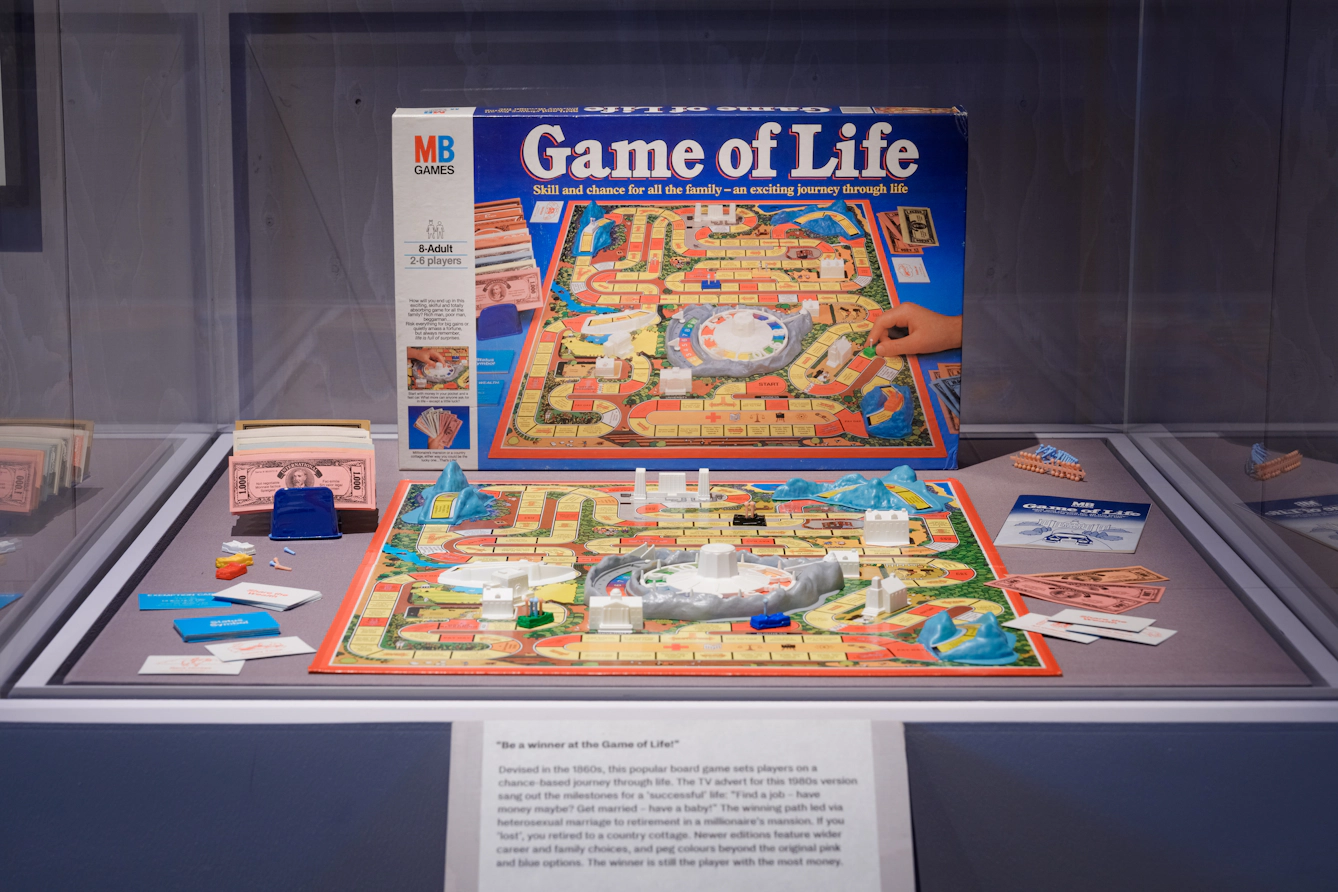
‘Game of Life’, MB Games, 1984 edition. ‘The Coming of Age’ exhibition at Wellcome Collection, Gallery Photo: Steven Pocock. Source: Wellcome Collection. Attribution-NonCommercial 4.0 International (CC BY-NC 4.0).
‘Game of Life’
This board game is from about 40 years ago. But people have been playing games like this for over 160 years.
Players move around the board and choose things like getting a job and getting married.
To win the game, the players need to earn lots of money and live in a big house.
This game shows one way of life. It does not show how many people live in different ways.
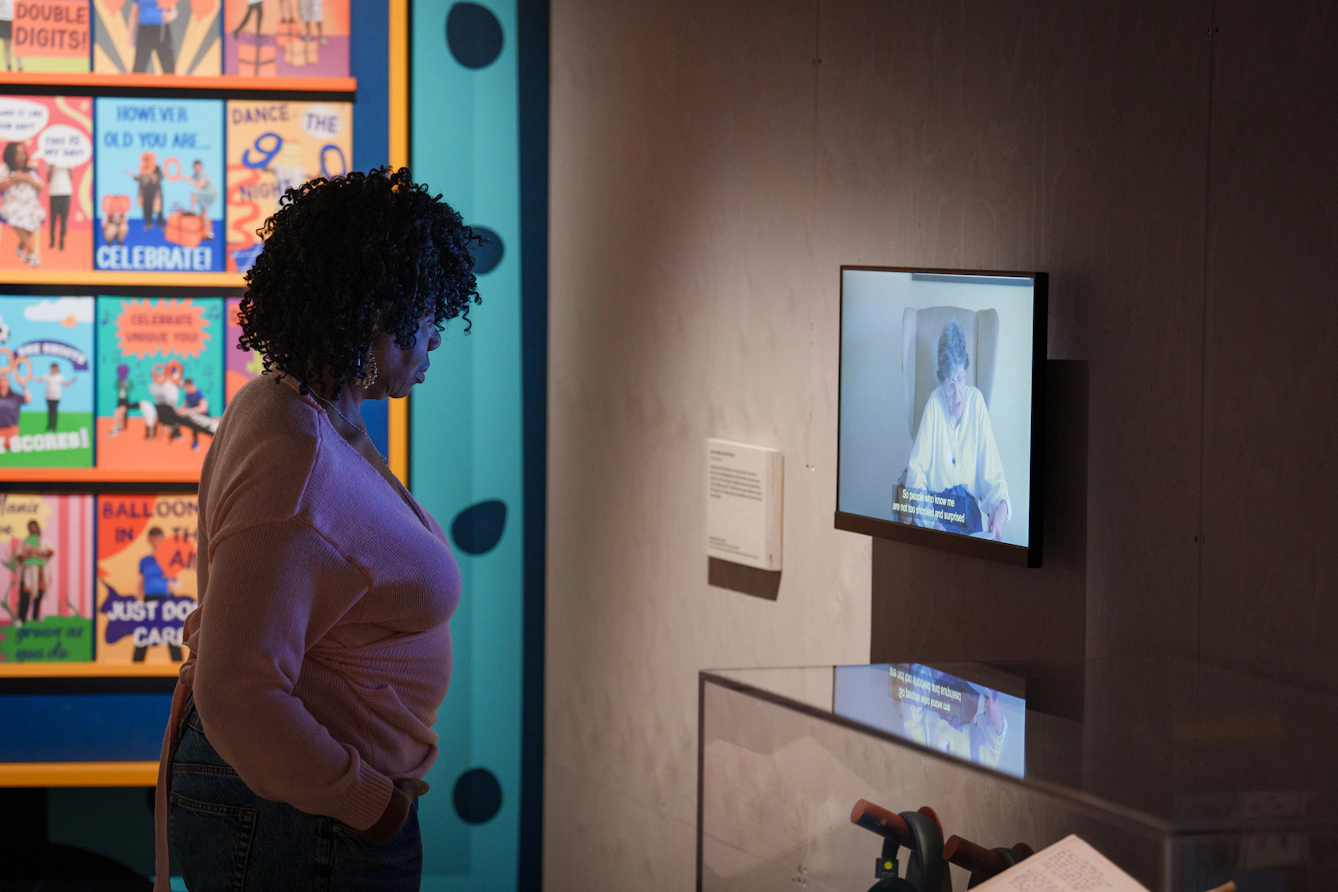
Jenny Joseph reads ‘Warning’, film © Pamela Robertson‑Pearce, 2008. ‘The Coming of Age’ exhibition at Wellcome Collection, Gallery Photo: Steven Pocock. Source: Wellcome Collection. Attribution-NonCommercial 4.0 International (CC BY-NC 4.0).
‘Warning’ by Jenny Joseph
Jenny Joseph was a poet. ‘Warning’ is a poem she wrote when she was 29 years old. You can see the poem in this case.
The poem has a famous first line about wearing purple and a bright red hat. The poem is fun.
The poem says it is okay to be a bit different and not follow all the rules, at any age.
Jenny wrote this poem when she was 29. Jenny was imagining life when she got older.
This film of her reading the poem helps us think about getting older, and the different feelings people have about it.
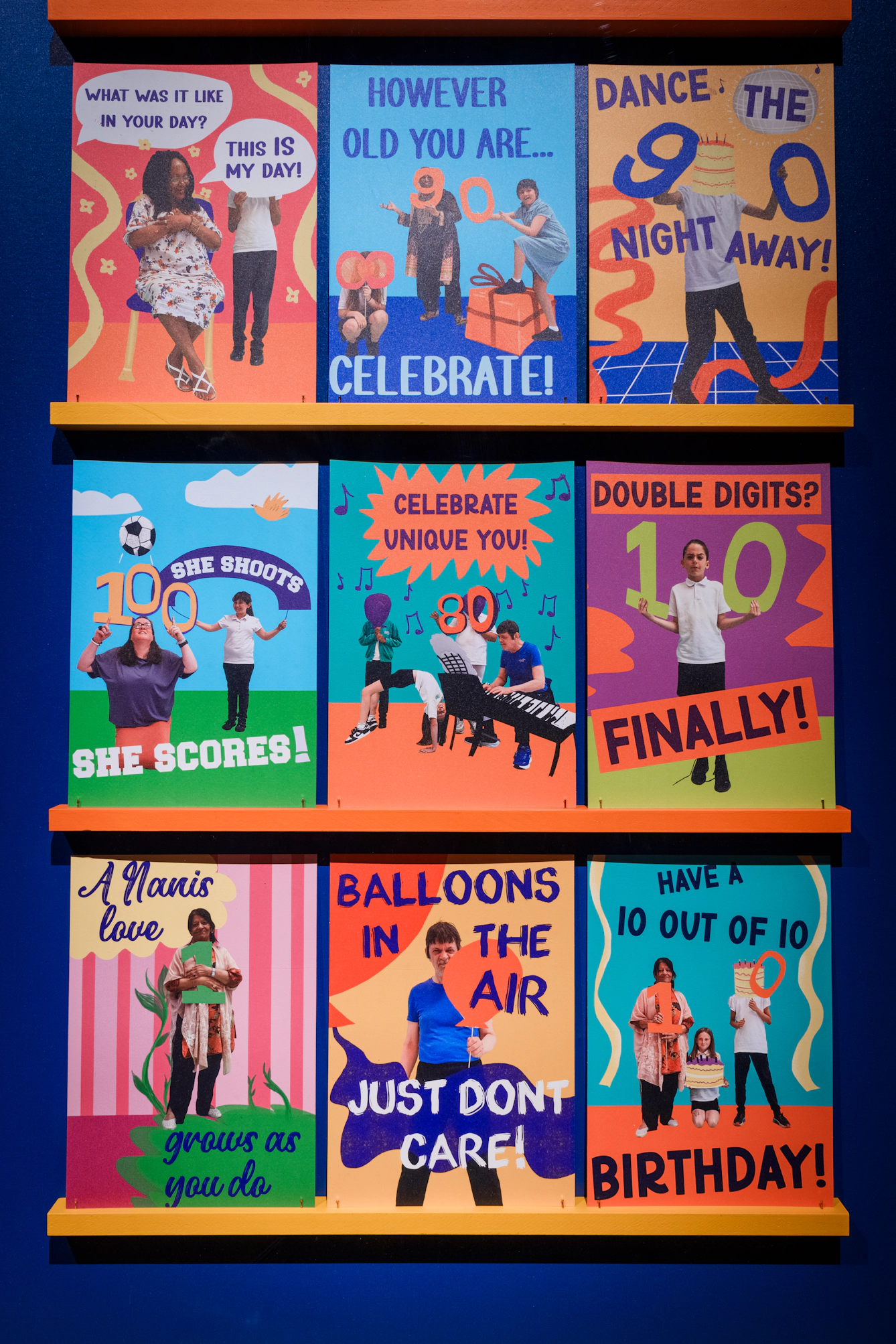
‘It’s on the Cards’, Skye Baker, Sue Mayo and intergenerational participants, 2025. ‘The Coming of Age’ exhibition at Wellcome Collection, Gallery Photo: Steven Pocock. Source: Wellcome Collection. Attribution-NonCommercial 4.0 International (CC BY-NC 4.0).
‘It’s on the Cards’ by Magic Me
This project is about birthday cards. It looks at how birthday cards show ideas about age.
The project was done by artists, school students and older people.
Birthday cards sometimes have unkind things on them about getting older.
The group worked together to design birthday cards.
Their birthday cards have different and kinder ideas about getting older.
This display has some of the cards the group made.
It also tells us how the group made the cards.
What is in section 3
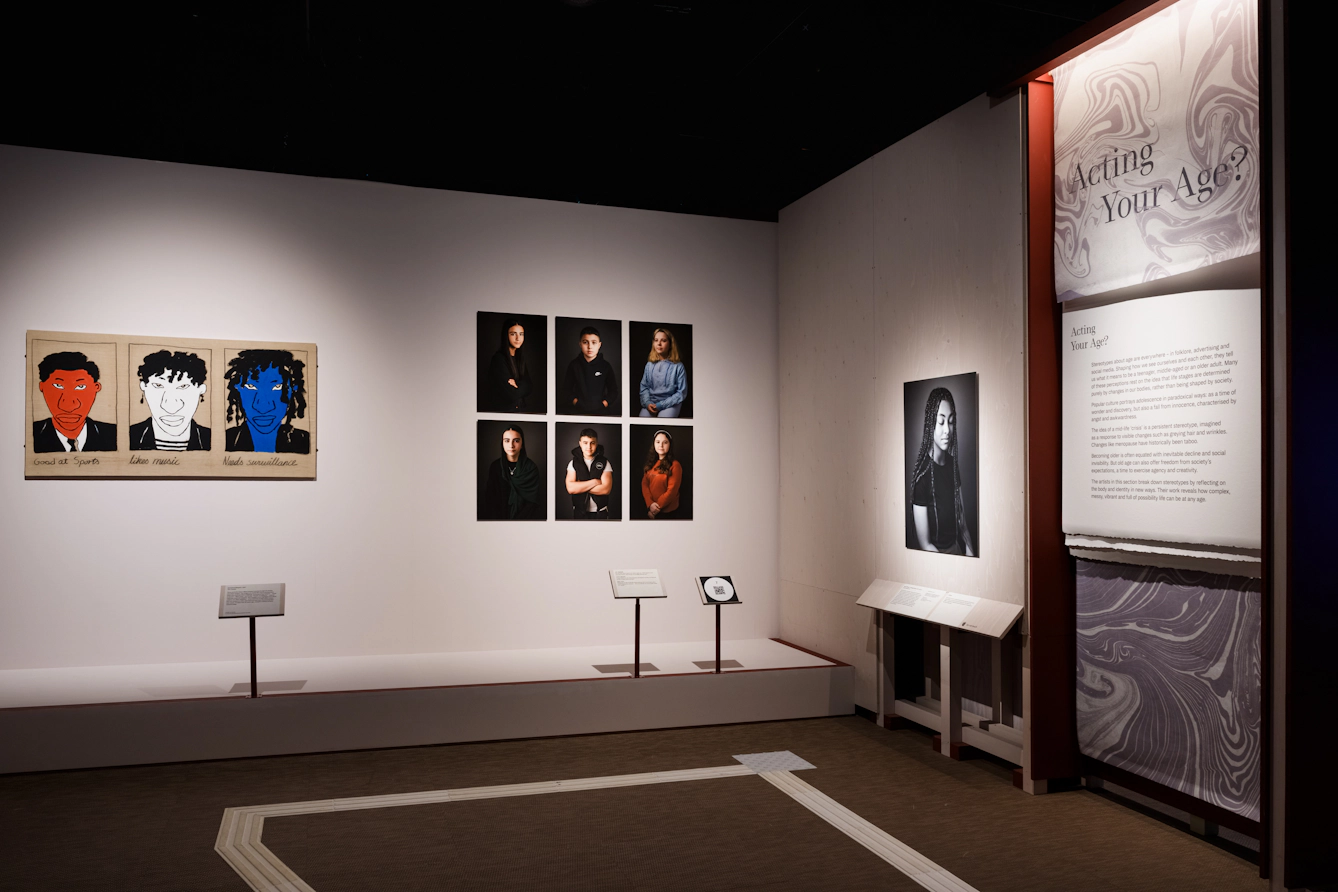
‘The Coming of Age’ exhibition at Wellcome Collection, Gallery Photo: Steven Pocock. Source: Wellcome Collection. Attribution-NonCommercial 4.0 International (CC BY-NC 4.0).
Section 3 is called ‘Acting Your Age?’
This section is about different ideas about what it means to be different ages.
These ideas come from lots of different places.
They might come from television or social media.
The ideas tell us:
- what people think teenagers are like
- what people think middle-aged people are like
- what people think older people are like.
Some people think age is only about the body.
But age is also about how society treats people.
This section looks at new ideas about ageing.
It shows that life can be exciting at any age.
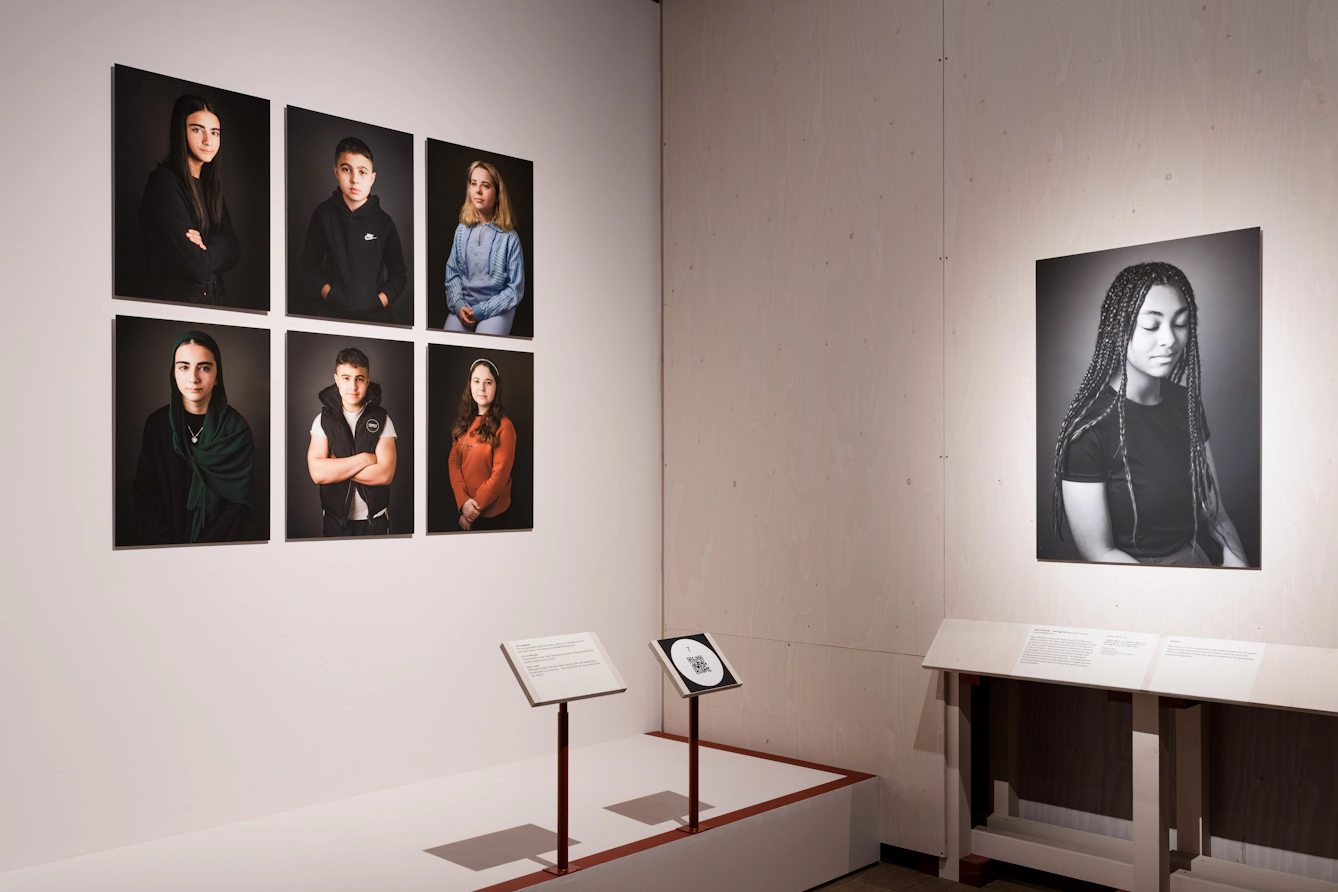
Age of Wonder – Teenage Stories, Carolyn Mendelsohn, 2022–ongoing. ‘The Coming of Age’ exhibition at Wellcome Collection, Gallery Photo: Steven Pocock. Source: Wellcome Collection. Attribution-NonCommercial 4.0 International (CC BY-NC 4.0).
‘Age of Wonder’ by Carolyn Mendelsohn
‘Age of Wonder’ is a collection of photos taken by Carolyn Mendelsohn.
Carolyn took photos of young people in Bradford, a city in the north of England.
The photos were taken over several years.
You can see 6 of Carolyn’s photos.
The photos are of 3 different people.
For each person there is 1 photograph when they are younger and 1 photograph when they are older.
These photos show how the people in them have changed over time. The people might look different.
The people might also have different feelings and ideas.
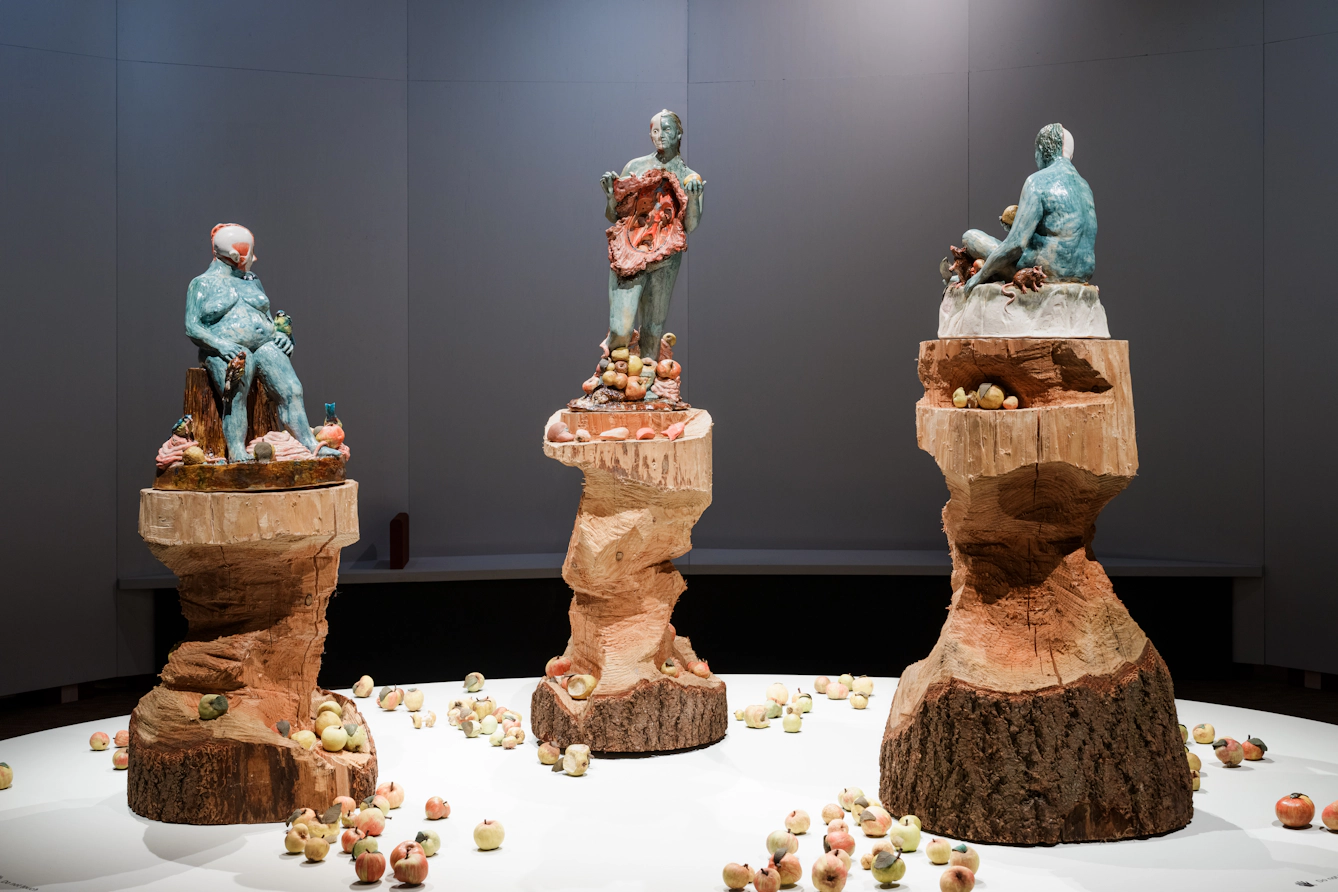
‘Wild Apples’, Serena Korda, 2024. ‘The Coming of Age’ exhibition at Wellcome Collection, Gallery Photo: Steven Pocock. Source: Wellcome Collection. Attribution-NonCommercial 4.0 International (CC BY-NC 4.0).
‘Wild Apples’ by Serena Korda
This artwork shows clay sculptures made by artist Serena Korda. There are 3 sculptures of real women’s bodies.
There are also many painted clay apples lying on the floor. Serena Korda copied real apples to make these.
You can hear a recording of people singing. They were singing to apple trees.
The artwork shows that every woman’s life and body is different.
This sound plays out loud. You do not need headphones to hear it.
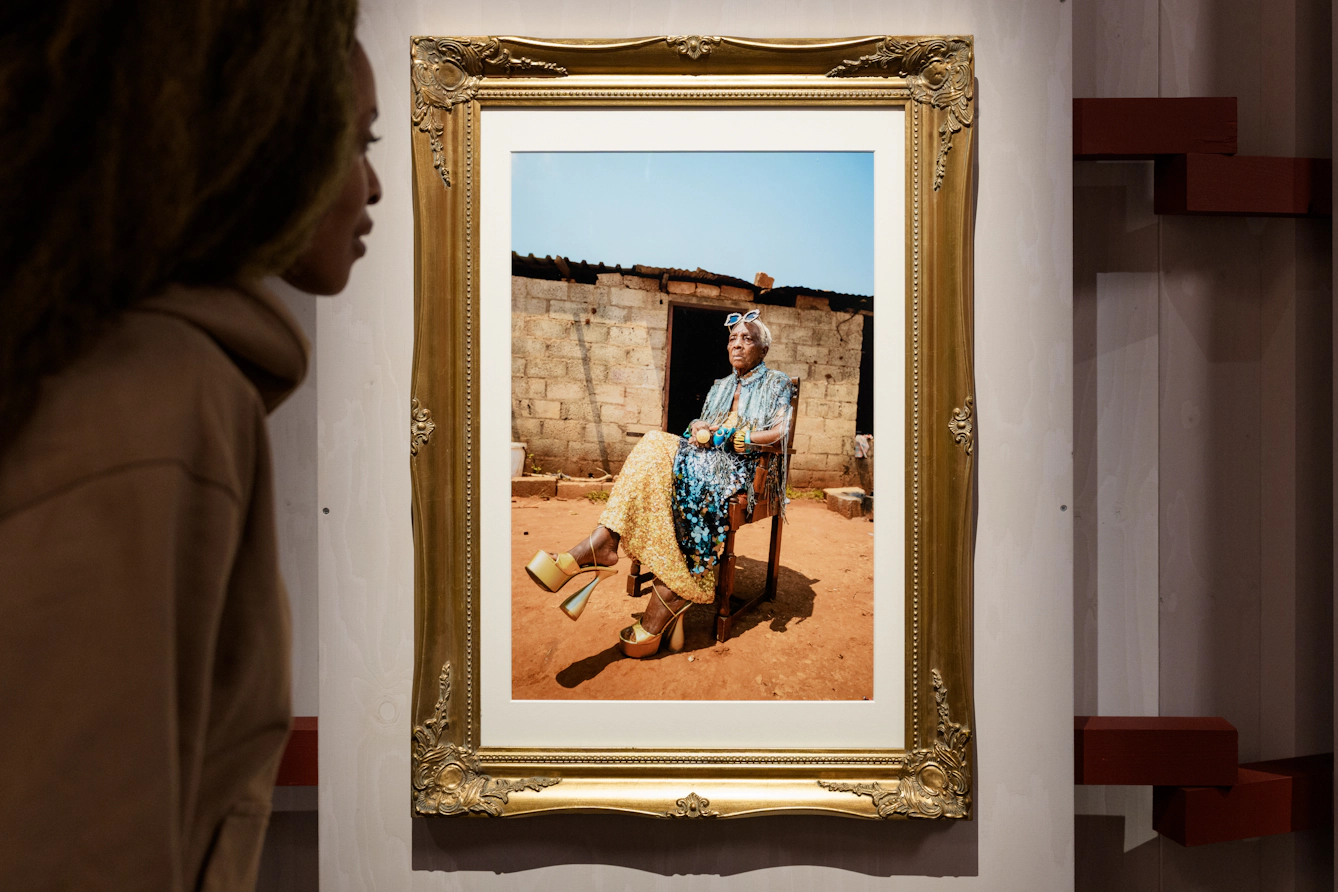
‘Legendary Glamma – High Fashion in the African Landscape’, Diana Kaumba, 2024. ‘The Coming of Age’ exhibition at Wellcome Collection, Gallery Photo: Steven Pocock. Source: Wellcome Collection. Attribution-NonCommercial 4.0 International (CC BY-NC 4.0).
‘Legendary Glamma’ by Diana Kaumba
You can see photos taken by Diana Kaumba.
The photos are of her grandmother.
Her grandmother is called Margret Chola and she is about 80 years old.
Diana asked Margret to try on bright and colourful clothes for the photos.
People around the world have seen the photos on Instagram.
The photos have become very popular.
People enjoy the photos of Margret because they are fun and joyful.
The photos shows that fashion and joy can be part of life at any age.
What is in section 4
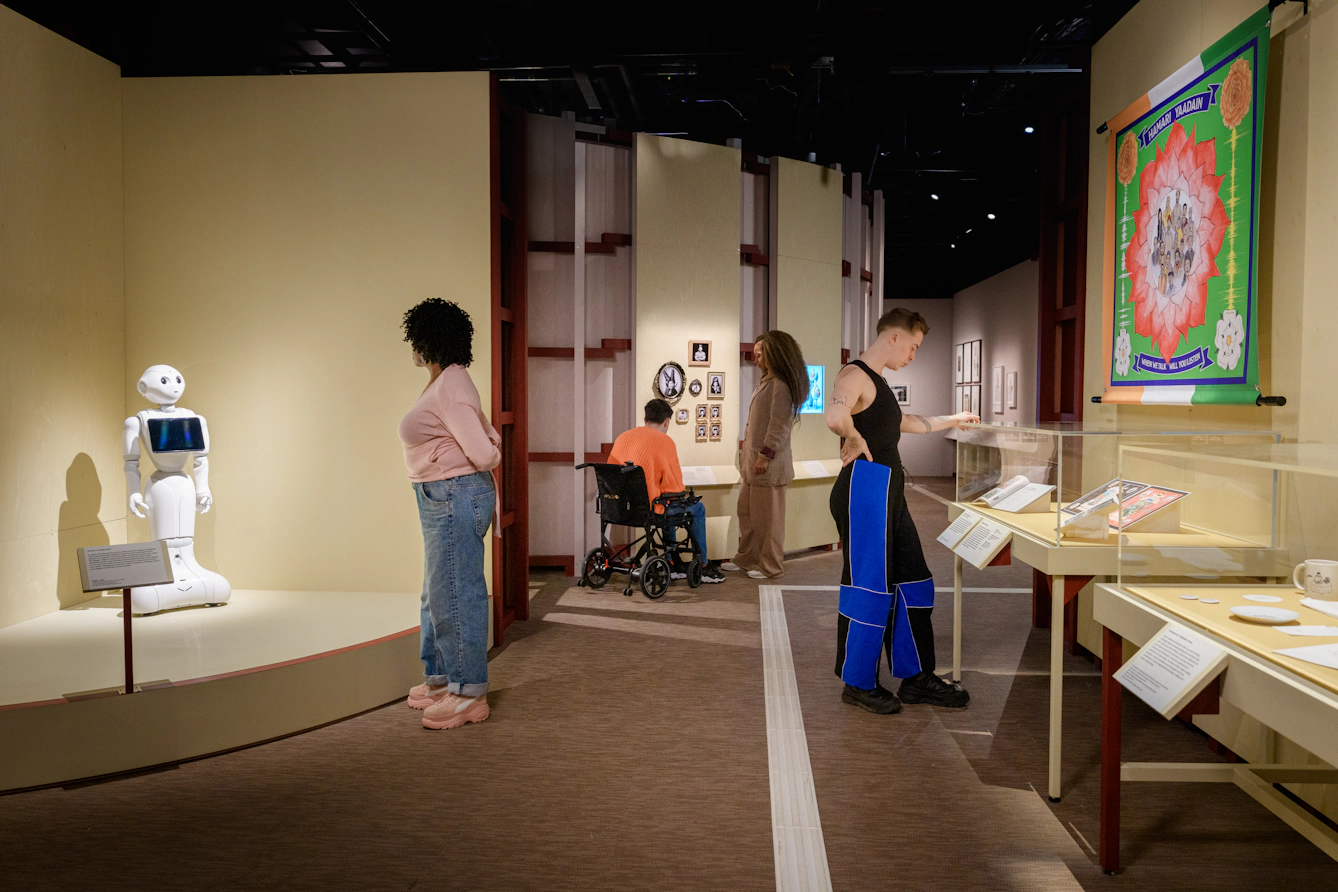
‘The Coming of Age’ exhibition at Wellcome Collection, Gallery Photo: Steven Pocock. Source: Wellcome Collection. Attribution-NonCommercial 4.0 International (CC BY-NC 4.0).
Section 4 is called ‘Connection and Care’.
This section is about how we take care of people.
Sometimes people need support when they get older.
This might be medical care.
It might also be support to live at home.
This can include support with cooking, cleaning and washing.
Sometimes care comes from family, friends or neighbours.
Some care comes from paid workers.
Technology can also help us take care of people.
Care helps people feel safe and looked after.
Software Garden, Rory Pilgrim, 2018.
‘Software Garden’ by Rory Pilgrim
This is a long film with music, voices and moving pictures.
It shows people talking about life, technology and the future.
Many different people worked together to make this film.
The film looks at how technology changes our lives.
The film makes us think about how we can take care of each other.
The film is 51 minutes long.
This film is on a large screen.
There is sound playing out loud.
Visitor Experience Assistants. Source: Wellcome Collection. Attribution-NonCommercial 4.0 International (CC BY-NC 4.0).
If you need any help, you can speak to a member of our team.

You can sit on a bench and watch the film.

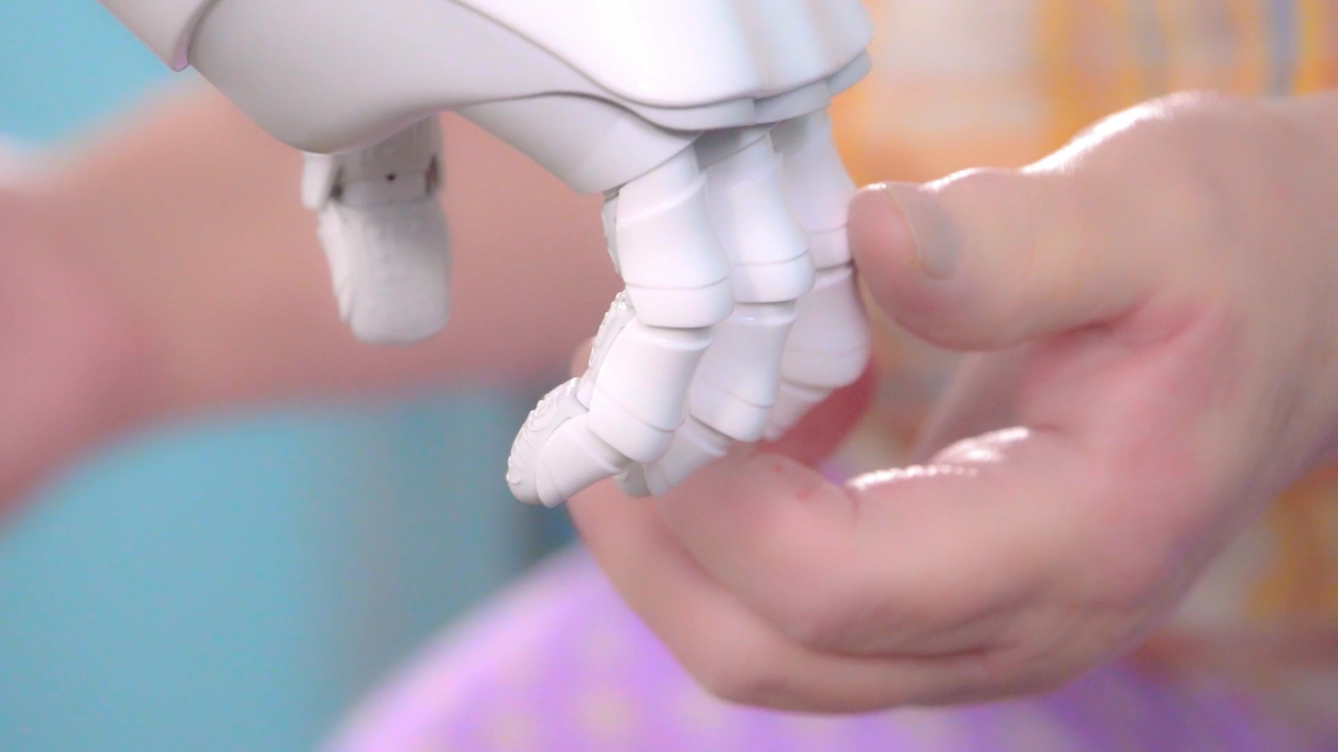
‘Pepper’ robot, Softbank Robotics Europe, 2016, Gallery Photo: Steven Pocock. Source: Science Museum Group. Attribution-NonCommercial 4.0 International (CC BY-NC 4.0).
Pepper robot
Pepper is a robot made to care for people.
The robot was tested in care settings in Japan and Europe.
Care settings are places where people get support.
The tests showed that robots cannot give care in the same way humans can.
People need kindness and other people to talk to. The robot cannot do these things.
The robots cost a lot of money to buy and use.
Because not many people wanted these robots, Pepper stopped being made in 2021.
Do not touch the robot.
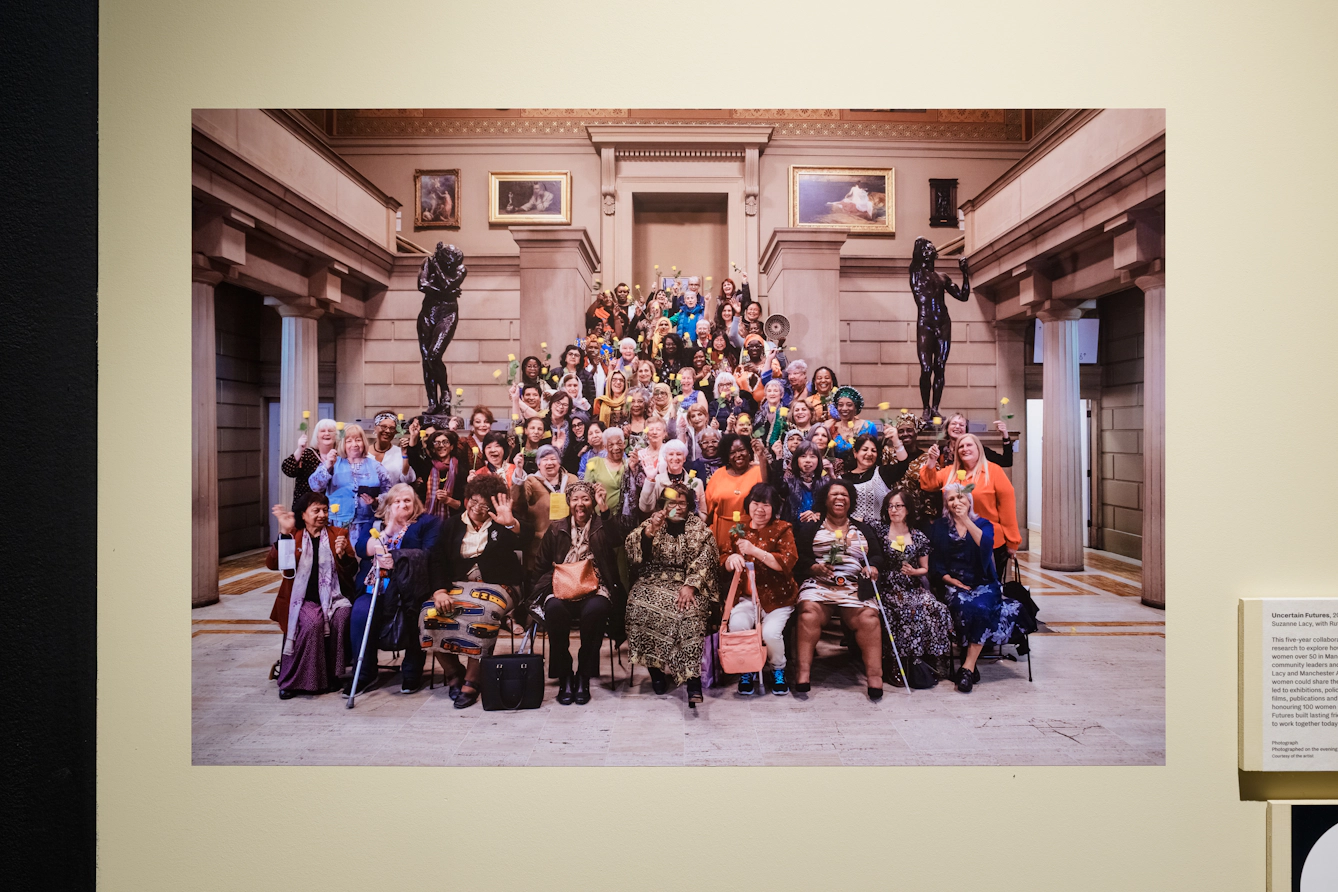
Uncertain Futures, Suzanne Lacy with Ruth Edson, 2019–2024. ‘The Coming of Age’ exhibition at Wellcome Collection, Gallery Photo: Steven Pocock. Source: Wellcome Collection. Attribution-NonCommercial 4.0 International (CC BY-NC 4.0).
‘Uncertain Futures’ by Suzanne Lacy
This is a film about women and work.
The artist Suzanne Lacy worked with women from Manchester, a city in the north of England.
Suzanne talked to women over 50 and recorded their stories about work and life.
The women talked about things like age and fairness in jobs.
On the wall at the entrance is a photo of the 100 women who took part.
You can watch the film that tells the women’s stories.
There is a large screen on the wall.
This work plays sound out loud.
You can sit on seats to watch the film.
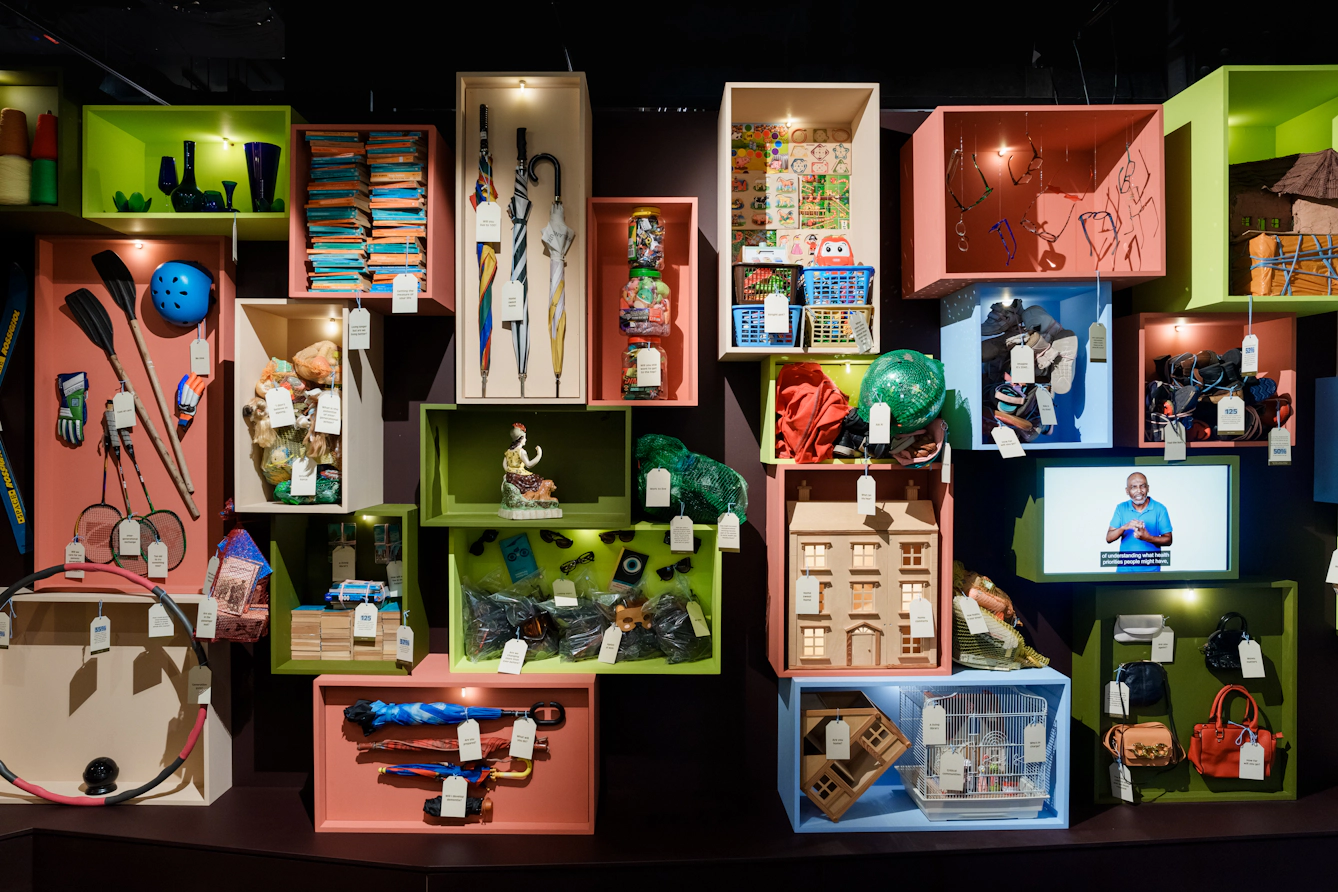
‘Unclaimed’, The Liminal Space, 2026. ‘The Coming of Age’ exhibition at Wellcome Collection, Gallery Photo: Steven Pocock. Source: Wellcome Collection. Attribution-NonCommercial 4.0 International (CC BY-NC 4.0).
‘Unclaimed’ by The Liminal Space
This room has been designed to look like a lost property office.
A lost property office is a place where lost things are kept. These might be:
- bags
- umbrellas
- hats.
Each thing in a lost property office belongs to a person. The thing is part of the person’s life story.
This lost property office helps us think about growing older and being remembered.
Some people might feel forgotten, like a thing in a lost property office.

There is a screen with a British Sign Language video on the wall.
You can hear recordings of people telling their own stories out loud.
You can touch the objects.
You can sit on the seats here.
Accessibility in the exhibition
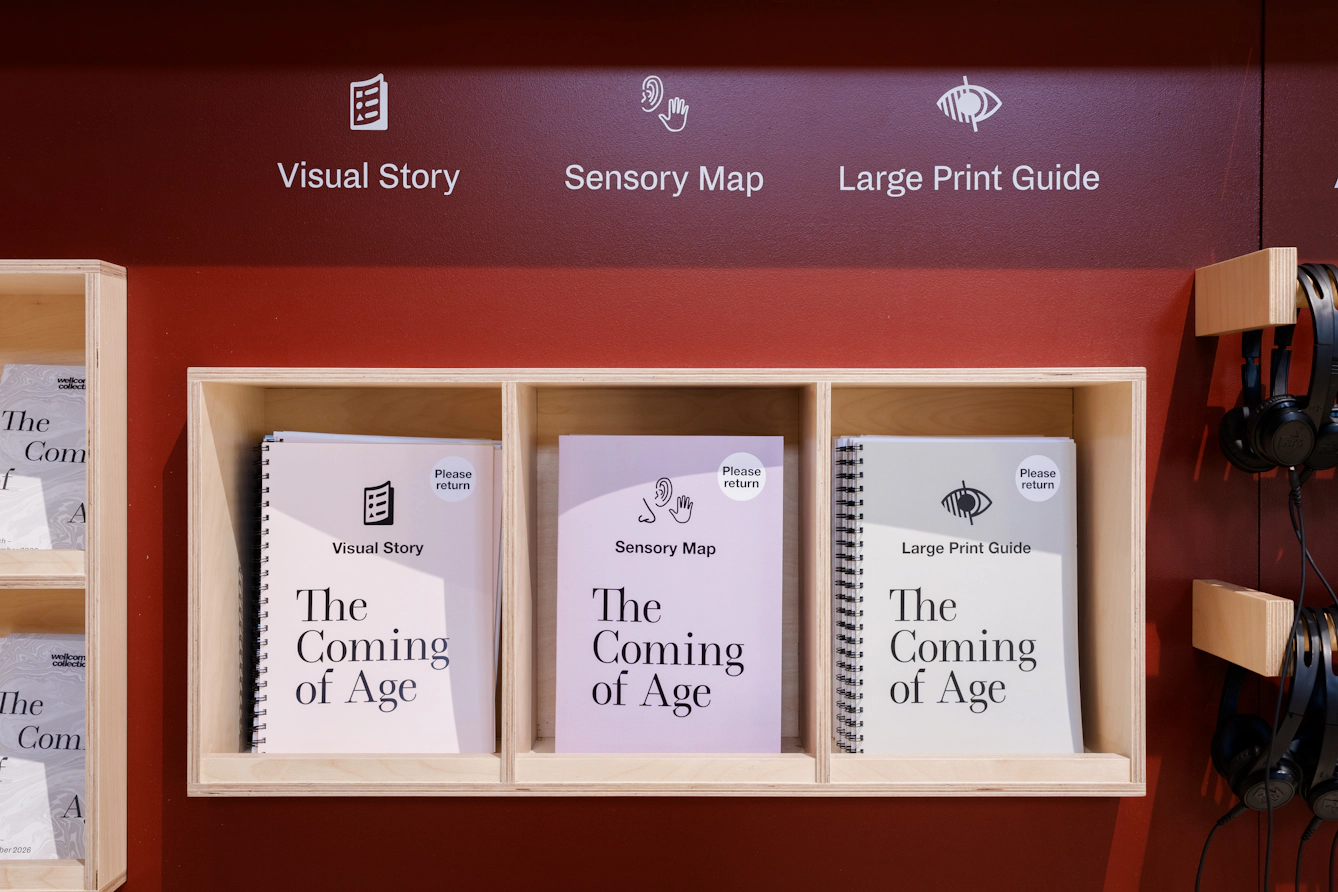
‘The Coming of Age’ exhibition at Wellcome Collection, Gallery Photo: Steven Pocock. Source: Wellcome Collection. Attribution-NonCommercial 4.0 International (CC BY-NC 4.0).
You can find accessible guides at the start of the exhibition.
The guides are:
- a gallery guide with words and pictures
- a large-print guide
- a visual story
- a sensory map.
A sensory map shows you where there are things like out-loud sound, bright lights or seating.
Digital guides

There are 2 digital guides that you can use:
- an audio-described guide to hear what 10 artworks in the exhibition look like
- a British Sign Language guide of videos for people who use BSL.
The digital guides are on our website.

There are 12 stops in the digital guides.
There is a number and a QR code next to each stop in the exhibition. You can scan the QR codes with your phone to get the digital guides.
To scan a QR code:
1) open the camera on your phone
2) point it at the QR code
3) click on the link that appears.
If you do not know how to scan a QR code, we can help you.
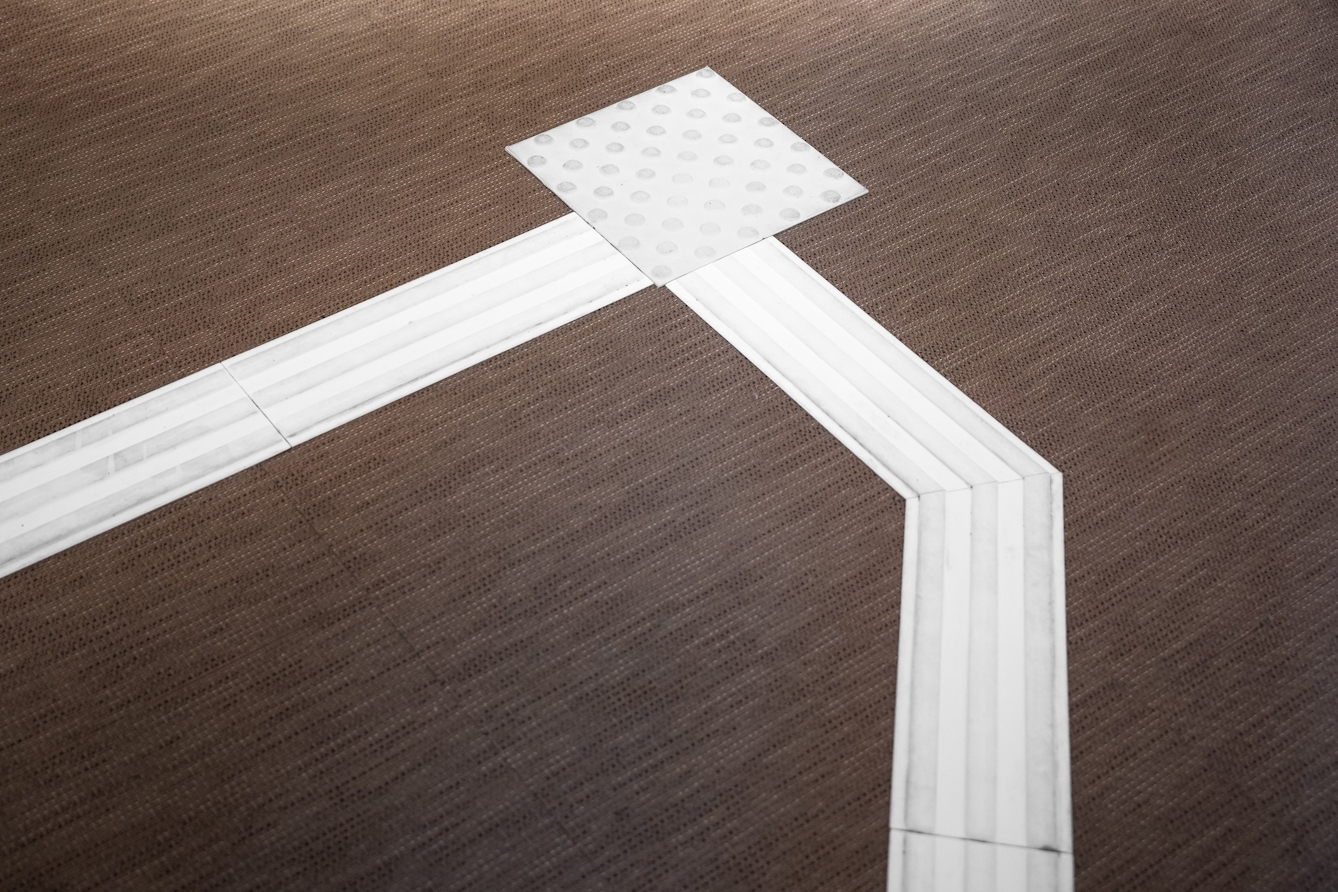
Tactile line at Wellcome Collection, Gallery Photo: Benjamin Gilbert. Attribution-NonCommercial 4.0 International (CC BY-NC 4.0).
There is a white line on the exhibition floor. Follow the white line to get to each stop.
The white line has a pattern that you can feel with your feet.
If you want to watch the BSL guide on your phone or other device, you can:
1) scan the QR code with your phone camera
2) choose ‘Watch British Sign Language videos’.
If you want to listen to the audio-described guide on your phone or other device, you can:
1) scan the QR code with your phone camera
2) choose ‘Listen to audio’.
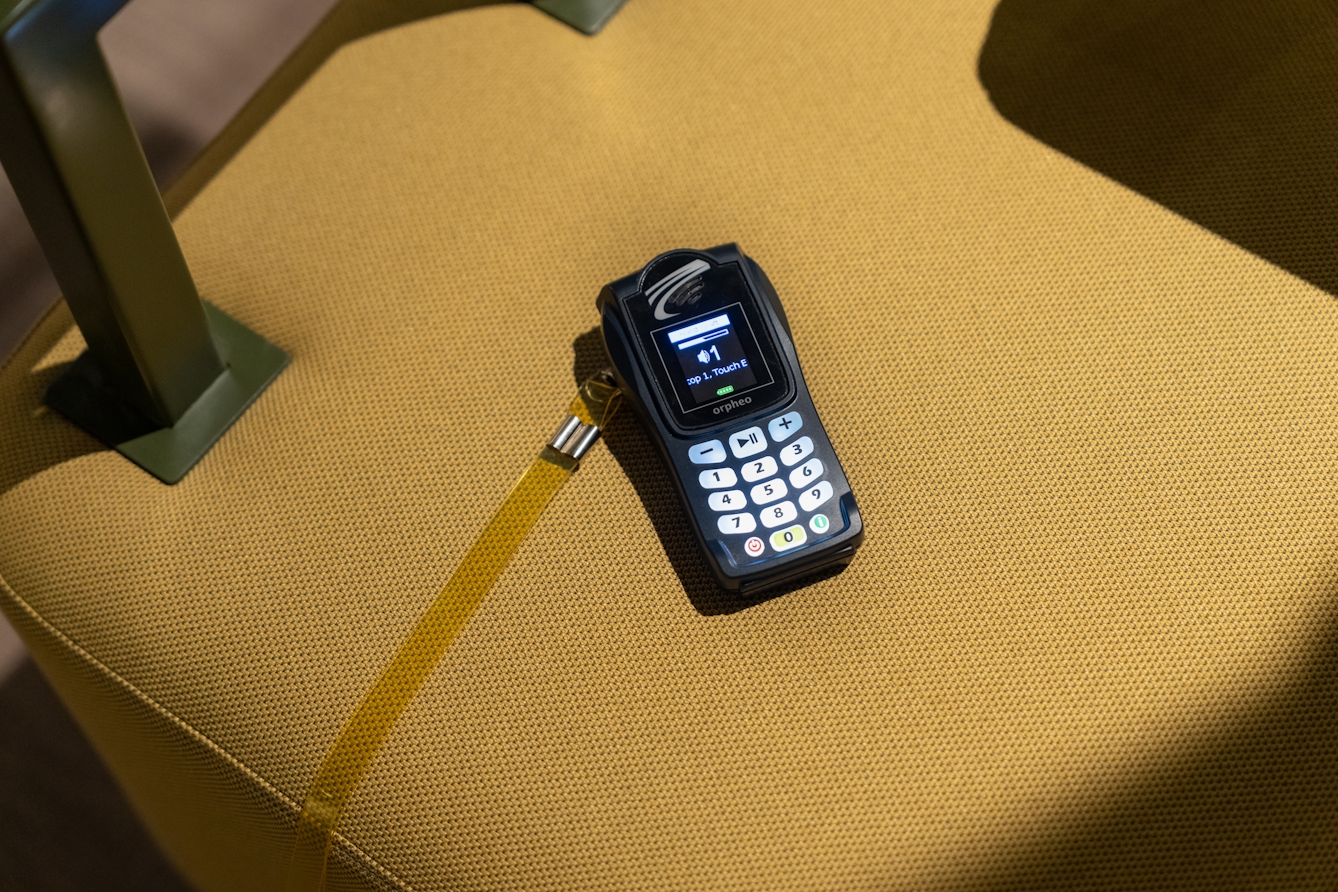
Or you can listen to the audio-described guide by:
1) picking up a touch-button handset in the exhibition
2) pressing the number of the audio stop.
You can also book an audio-described tour. On this tour a member of our team will explain what the things in the exhibition look like. You can find the dates on our website.
If you want an audio-described tour for your visit today, please tell a member of our gallery team.

You can use our WiFi for free. To do this, you need to:
1) turn your phone’s WiFi on
2) choose ‘Wellcome Guest’
3) enter your email address
4) choose ‘Connect’ to accept our terms and conditions.
Visitor Experience Assistants. Source: Wellcome Collection. Attribution-NonCommercial 4.0 International (CC BY-NC 4.0).
If you need help with anything, you can ask a member of our gallery team.
Relaxed openings
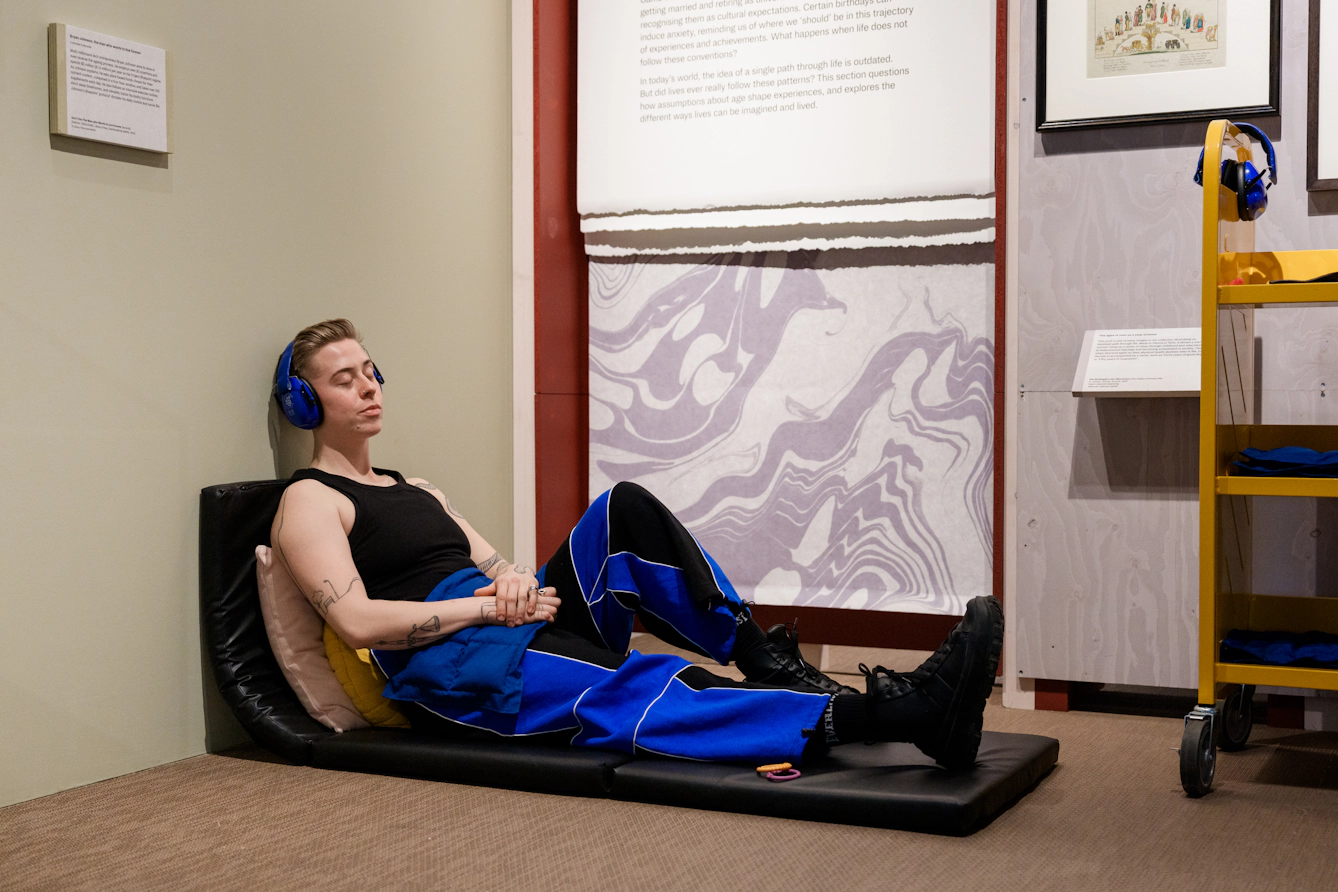
‘The Coming of Age’ exhibition at Wellcome Collection, Gallery Photo: Steven Pocock. Source: Wellcome Collection. Attribution-NonCommercial 4.0 International (CC BY-NC 4.0).
If you need additional support to enjoy this exhibition, join us for a Relaxed Opening. At a Relaxed Opening there will be:
- fewer visitors
- extra gallery staff to help you.
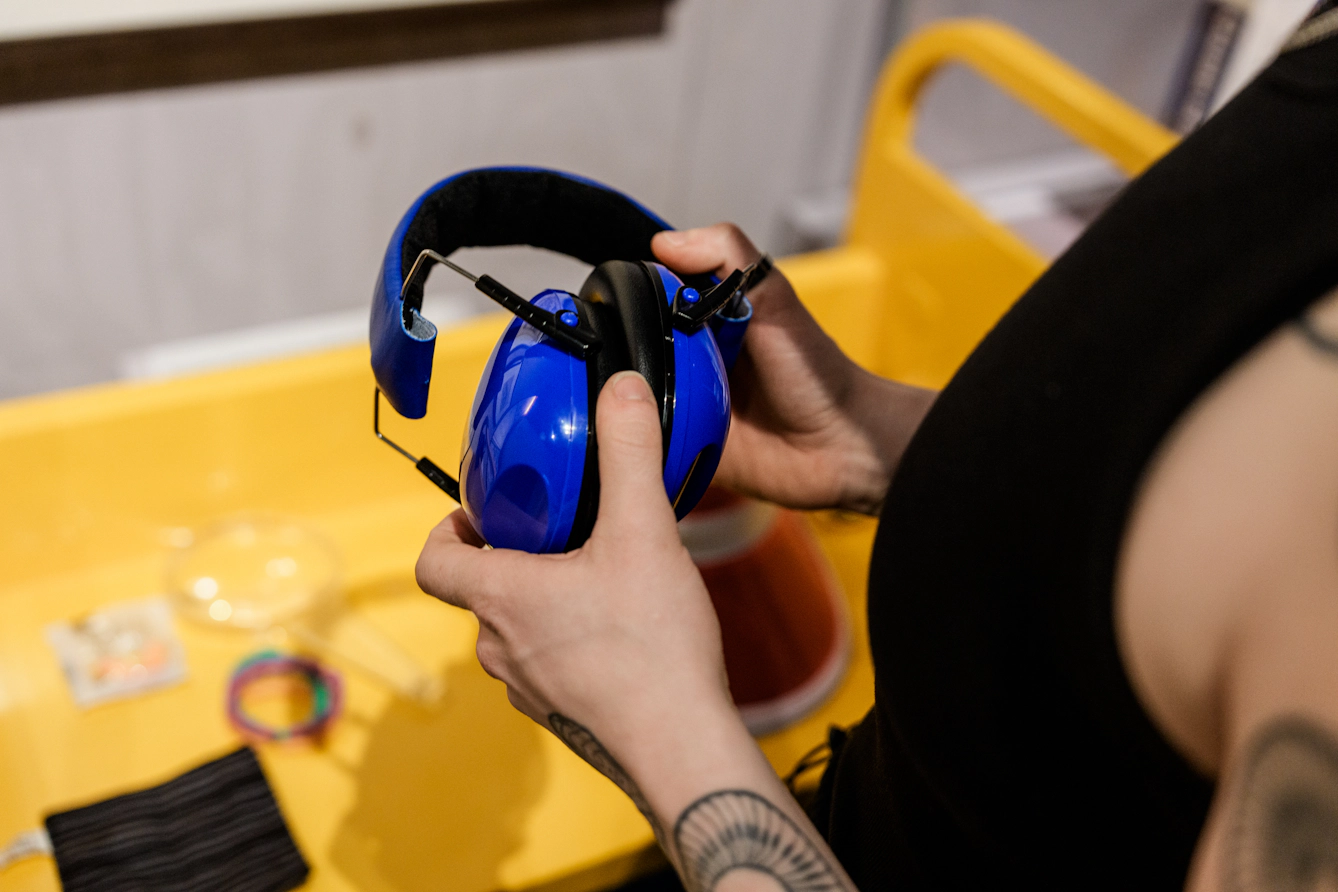
‘The Coming of Age’ exhibition at Wellcome Collection, Gallery Photo: Steven Pocock. Source: Wellcome Collection. Attribution-NonCommercial 4.0 International (CC BY-NC 4.0).
At a Relaxed Opening you can use our:
- cushions
- ear defenders
- tinted glasses
- tinted visors
- weighted lap pads.
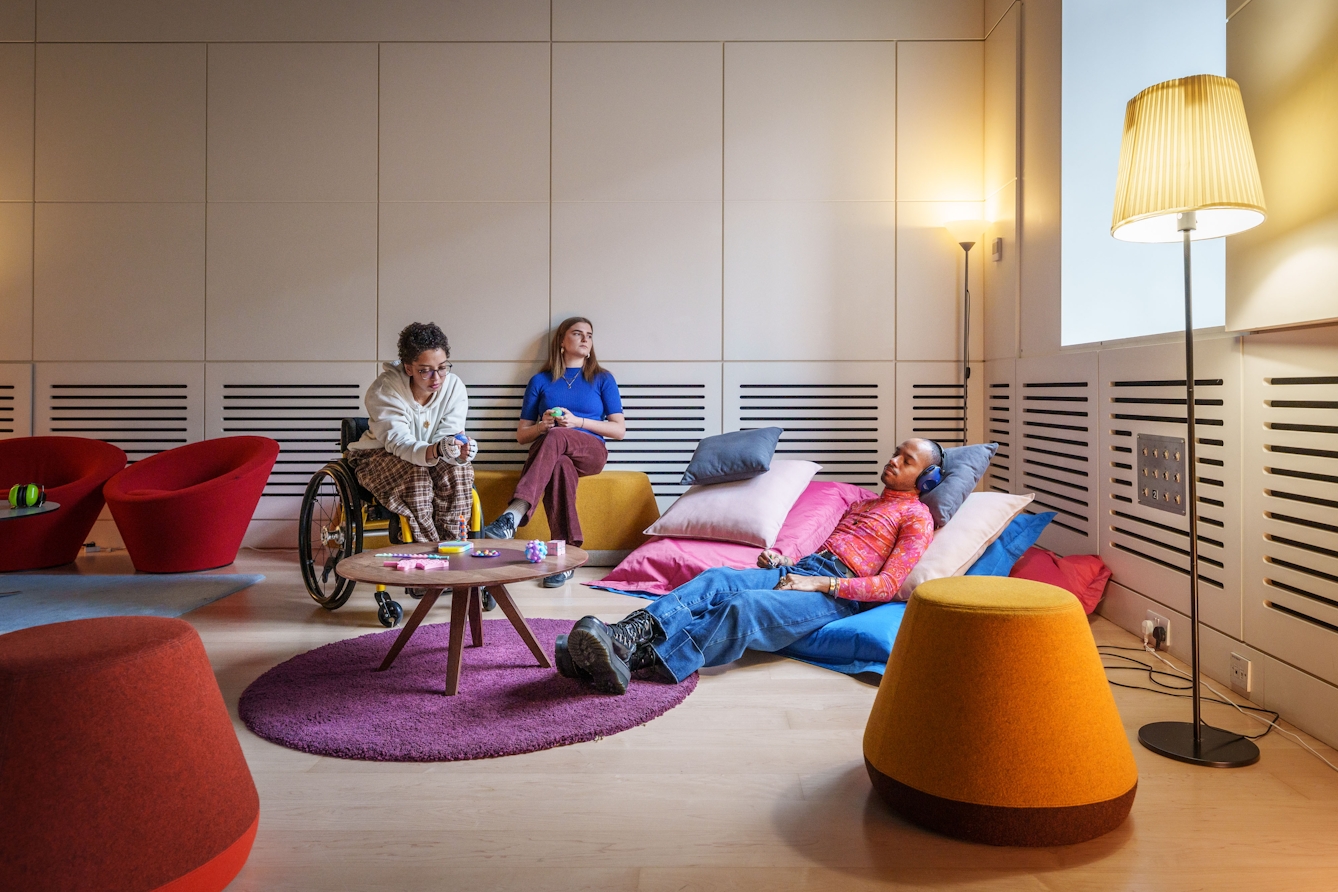
Chill-Out Room at Wellcome Collection. Source: Wellcome Collection. © Wellcome Collection.
At a Relaxed Opening there will be a Chill-Out Room. The Chill-Out Room has:
- low lighting
- soft seats
- sensory and fidget toys.