Modern theories of chemistry / by Lothar Meyer ; translated from the German (5th edition) by Phillips Bedson and W. Carleton.
- Lothar Meyer
- Date:
- 1888
Licence: Public Domain Mark
Credit: Modern theories of chemistry / by Lothar Meyer ; translated from the German (5th edition) by Phillips Bedson and W. Carleton. Source: Wellcome Collection.
Provider: This material has been provided by Royal College of Physicians, London. The original may be consulted at Royal College of Physicians, London.
544/666
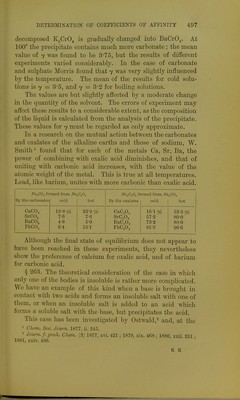
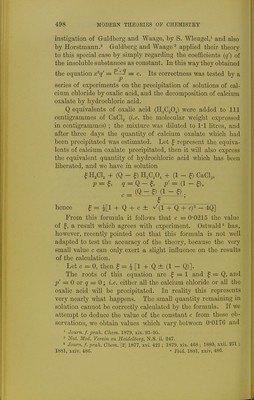
![Equilibrium had evidently not been established. The correct value of 7 lies between these values, as it has been shown that the final state of equilibrium is indei^endent of the original form in which the bodies are combined. Increasing the quantity of the insoluble body, and raising the tempera- ture, hastens the establishment of the state of equihbrium ; diminishing the solvent generally has the same effect, but occasionally the reverse.^ Guldberg and Waage obtained the following results at the temperature of the boiling-point of the mixtures in t hours:— K2CO3 2 n t 7 P 01 t 7 0-27 0-73 66-67 36 2-6 0-24 0-76 100 70 3-2 0-28 0-72 100 72 2-6 0-18 0-82 500 70 4-6 0-20 0-80 500 403 4 0-16 0-84 1000 79 5-8 (0-30) (0-70) 1000 45 2-3 The state of equilibrium was far from being attamed in the last experiments; in the others it had been approximately reached. This shows that 7, i.e. the quantity of carbonate, increases with the quantity of water without reaching the limits found at the lower temperature 23 > 7 > 13. The authors obtained similar numbers when they substi- tuted sodium for potassium salts. James Morris ^ has investi- gated the mutual action between the carbonates and chro- mates, and the carbonates and sulphates of potassium and barium by a somewhat different method. He ascertamed the composition of the precipitates which were produced by barium chloride in a mixture of these potassium salts. He found the ratio of the carbonate (g) to the chromate {'p) remaining m the solution, at the ordinary temperature, to be 7 = ^ = 10, in round numbers. P If the precipitate is left in the solution the quantity of carbonate in the solution is increased as a portion of the un- ' The precipitation of barium as chromate takes place more rapidly in dilute solutions (Ostwald, Jour7i. f. prakt. Chcm. [2] 1880, xxii. 259). - Iiiaug. Diss. Tiibingen, 1879 ; Annalen, 1882, ccxiii. 253.](https://iiif.wellcomecollection.org/image/b2265172x_0548.jp2/full/800%2C/0/default.jpg)