Licence: In copyright
Credit: Ernest Forneau, 1872-1949 / [Thomas Anderson Henry]. Source: Wellcome Collection.
8/12
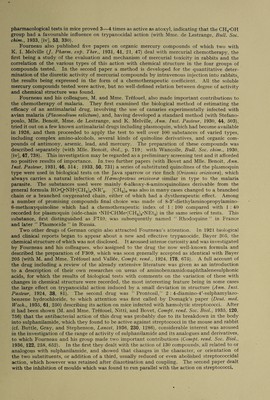
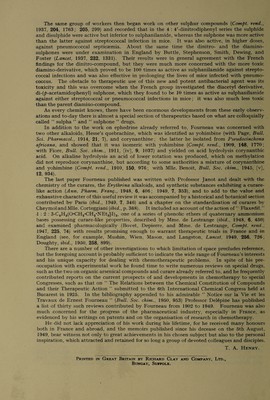
![The same group of workers then began work on other sulphur compounds (Compt. rend., 1937, 204, 1763; 205, 299) and recorded that in the 4 : 4,-dinitrodiphenyl series the sulphide and disulphide were active but inferior to sulphanilamide, whereas the sulphone was more active than the latter against streptococcal infection in mice. It was also active, in higher doses, against pneumococcal septicaemia. About the same time the dinitro- and the diamino- sulphones were under examination in England by Buttle, Stephenson, Smith, Dewing, and Foster [Lancet, 1937, 232, 1331). Their results were in general agreement with the French findings for the dinitro-compound, but they were much more concerned with the more toxic diamino-derivative, which proved to be 100 times as active as sulphanilamide against strepto¬ coccal infections and was also effective in prolonging the lives of mice infected with pneumo¬ coccus. The obstacle to therapeutic use of this new and potent antibacterial agent was its toxicity and this was overcome when the French group investigated the diacetyl derivative, di-(£-acetamidophenyl) sulphone, which they found to be 10 times as active as sulphanilamide against either streptococcal or pneumococcal infections in mice; it was also much less toxic than the parent diamino-compound. As every chemist knows, there have been enormous developments from these early observ¬ ations and to-day there is almost a special section of therapeutics based on what are colloquially called “ sulpha ” and “ sulphone ” drugs. In addition to the work on ephedrine already referred to, Fourneau was concerned with two other alkaloids, Hesse’s quebrachine, which was identified as yohimbine (with Page, Bull. Sci. Pharmacol., 1914, 21, 7), and corynanthine; the latter he isolated from Pseudocinchona africana, and showed that it was isomeric with yohimbine [Compt. rend., 1909, 148, 1770; with Fiore, Bull. Soc. chim., 1911, [iv], 9, 1037) and yielded on acid hydrolysis corynanthic acid. On alkaline hydrolysis an acid of lower rotation was produced, which on methylation did not reproduce corynanthine, but according to some authorities a mixture of corynanthine and yohimbine [Compt. rend., 1910, 150, 976; with Mile. Benoit, Bull. Soc. chim., 1945, [v], 12, 934). The last paper Fourneau published was written with Professor Janot and dealt with the chemistry of the curares, the Erythrina alkaloids, and synthetic substances exhibiting a curare¬ like action [Ann. Pharm. Fvanq., 1948, 6, 406; 1949, 7, 353), and to add to the value and exhaustive character of this useful review it was accompanied by a historical and botanical section contributed by Paris [ibid., 1949, 7, 346) and a chapter on the standardisation of curares by Cheymoland Mile. Corteggiani [ibid., p. 368). It included an account of the action of “ Flaxedil, ” 1:2: 3-C6H3(0‘,CH2*CH2’NEt3}I)3, one of a series of phenolic ethers of quaternary ammonium bases possessing curare-like properties, described by Mme. de Lestrange [ibid., 1948, 6, 450) and examined pharmacologically (Bovet, Depierre, and Mme. de Lestrange, Compt. rend., 1947, 225, 74) with results promising enough to warrant therapeutic trials in France and in England (see, for example, Mushin, Wien, Mason, and Langston, Lancet, 1949, 256, 726; Doughty, ibid., 1950, 258, 899). There are a number of other investigations to which limitation of space precludes reference, but the foregoing account is probably sufficient to indicate the wide range of Fourneau’s interests and his unique capacity for dealing with chemotherapeutic problems. In spite of his pre¬ occupation with experimental work he found time to write numerous reviews on special drugs, such as the two on organic arsenical compounds and curare already referred to, and he frequently contributed reports on the current prospects of and developments in chemotherapy to special Congresses, such as that on “ The Relations between the Chemical Constitution of Compounds and their Therapeutic Action ” submitted to the 6th International Chemical Congress held at Bucarest in 1925. In the bibliography appended to his admirable “ Notice sur la Vie et les Travaux de Ernest Fourneau ” [Bull. Soc. chim., 1950, 953) Professor Del6pine has published a list of thirty such reviews contributed by Fourneau from 1902 to 1949. Fourneau was also much concerned for the progress of the pharmaceutical industry, especially in France, as evidenced by his writings on patents and on the organisation of research in chemotherapy. He did not lack appreciation of his work during his lifetime, for he received many honours both in France and abroad, and the memoirs published since his decease on the 5th August, 1949, bear witness not only to great achievements in his chosen subject but also to the personal inspiration, which attracted and retained for so long a group of devoted colleagues and disciples. T. A. Henry. Printed in Great Britain by Richard Clay and Company, Ltd., Bungay, Suffolk.](https://iiif.wellcomecollection.org/image/b30633588_0008.jp2/full/800%2C/0/default.jpg)




 No text description is available for this image
 No text description is available for this image
 No text description is available for this image