Restoration of an extinct elephantine marsupial (Diprotodon australis) / by Professor Owen.
- Owen, Richard, Sir, 1804-1892.
- Date:
- 1870
Licence: Public Domain Mark
Credit: Restoration of an extinct elephantine marsupial (Diprotodon australis) / by Professor Owen. Source: Wellcome Collection.
Provider: This material has been provided by The Royal College of Surgeons of England. The original may be consulted at The Royal College of Surgeons of England.
14/94 (page 530)
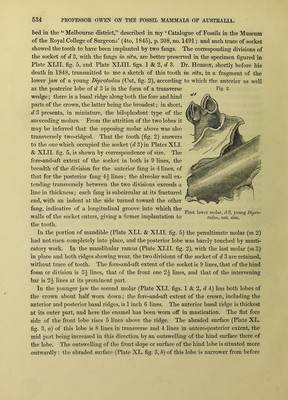
![working surfaces of the four molars describes a slight convexity downwards (Plate XXXVIII, fig. 1); the exterior line is also slightly convex (ib. fig. 2) ; the interior line is concave in a less degree; the right and left series are moderately convergent anteriorly. The interspace between the hind lobes of the last [molars (m 3) is 4 inches 1 line; that between the front lobes of the first molars {d 4) is 3 inches 1 line; these dimensions give the breadth of the palate between the right and left teeth above symbolized. All the molars in place have an enamelled crown divided into two transverse lobes (Plates XXXVII., XXXVIII. a, h), with accessory ridges (f, g), and are inserted by cement-clad contracting roots as in Macro^iis. The summits of the transverse lobes are abraded in all the molars of the specimens figured; but least so in the hind lobe of the subject of m 3, fig. 2, Plate XXXVIII. The socket of the first small molar (fig. 1, 3) is partially preserved in the entire skull; it consists of two cavities, the hindmost the largest, the tooth having only two roots. In the subject of Plate XXXVII. figs. 1 & 2, the crown of 4 is ground down nearly to the bottom of the cleft {h); the fore-and-aft extent of the grinding-surface is 1 inch 2 lines; its transverse extent across the hind lobe is the same. Across the fore part of the base of the tooth is a low ridge (/*), to the level of which the anterior lobe (a) is almost worn. The corresponding ridge at the back part of the tooth is continued along both the outer and inner borders (g, g) of so much of the back part of the hind lobe as is not ground down; the whole of the surface projects beyond the level of the worn surface of the following molar (fig. 1, m). The transverse cleft is deepest at its outer and inner ends; a ridge of enamel descends from each of these ends of the anterior lobe, and, meeting a corresponding projection of the oppposite lobe, it partially closes the entry of the valley. The anterior basal ridge is strongly developed in m 1, especially at its inner end; the interspace between it and the anterior lobe widens toward the inner side of the tooth [f). The anterior lobe is worn down nearly to the level of the ridge; the surface describes a transverse irregular ellipse; that of the posterior lobe is narrower: in both a mid linear tract of osteo-dentine (o, o) is exposed. The narrow hind basal ridge {g) is continued upon the hind lobe as in ]) 4, and that lobe projects 'clear beyond the level of the grinding-surface of m 2. The antero-posterior and transverse diameters of the working- surface of m 1 are each 1 inch 6 lines. The anterior basal ridge [f) is strongly developed in m 2, and the antero-posterior diameter of the tooth (1 inch 9 lines) rather exceeds the transverse diameter. The front lobe {a) is worn down to within 5 lines of the basal ridge. The minor degree of abrasion of the hind lobe shows the curve of the grinding-surface, concave backward, which is lost as the thicker part of the lobe is reached. The hind basal ridge {g) is feebly developed. In the last molar [m 3) the hind lobe is markedly less than the front one, by its more rapid loss of transverse dimension: it is rather narrower in this line at its base, as it is in fore-and-aft extent. The last upper molar of Biprotodon may be readily determined by its posterior contraction. In some individuals the hind surface of the hind lobe](https://iiif.wellcomecollection.org/image/b22414393_0016.jp2/full/800%2C/0/default.jpg)