Medical reform : a letter to the Right Hon. Viscount Melbourne with the outlines of a Bill for regulating the practice of surgeon-apothecaries and chemists and druggists ... and a plan for suppressing uneducated practitioners ... / by Martin Sinclair.
- Date:
- [1840?]
Licence: Public Domain Mark
Credit: Medical reform : a letter to the Right Hon. Viscount Melbourne with the outlines of a Bill for regulating the practice of surgeon-apothecaries and chemists and druggists ... and a plan for suppressing uneducated practitioners ... / by Martin Sinclair. Source: Wellcome Collection.
Provider: This material has been provided by the Royal College of Physicians of Edinburgh. The original may be consulted at the Royal College of Physicians of Edinburgh.
23/36 page 23
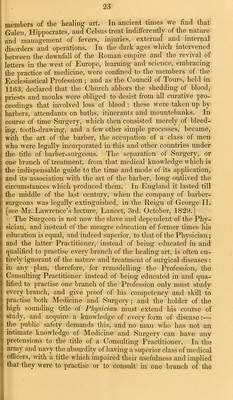
![members of the healing art. In ancient times we find that Galen, Hippocrates, and Celsus treat indifferently of the nature i and management of fevers, injuries, external and internal j| disorders and operations. In the dark ages which intervened • between the downfall of the Roman empire and the revival of n letters in the west of Europe, learning and science, embracing the practice of medicine, were confined to the members of the Ecclesiastical Profession; and as the Council of Tours, held in 1163, declared that the Church abhors the shedding of blood, priests and monks were obliged to desist from all curative pro- : ceedings that involved loss of blood : these were taken up by : barbers, attendants on baths, itinerants and mountebanks. In course of time Surgery, which then consisted merely of bleed- ing, tooth-drawing, and a few other simple processes, became, with the art of the barber, the occupation of a class of men who were legally incorporated in this and other countries under the title of barber-surgeons. The separation of Surgery, or one branch of treatment, from that medical knowledge which is the indispensable guide to the time and mode of its application, and its association with the art of the barber, long outlived the circumstances which produced them. In England it lasted till the middle of the last century, when the company of barber- surgeons was legally extinguished, in the Reign of George II. [see Mr. Lawrence’s lecture, Lancet, 3rd. October, 1829.] The Surgeon is not now the slave and dependent of the Phy- i sician, and instead of the meagre education of former times his education is equal, and indeed superior, to that of the Physician; and the latter Practitioner, instead of being educated in and qualified to practise every branch of the healing art, is often en- tirely ignorant of the nature and treatment of surgical diseases : in any plan, therefore, for remodelling the Profession, the Consulting Practitioner instead of being educated in and qua- lified to practise one branch of the Profession only must study every branch, and give proof of his competency and skill to practise both Medicine and Surgery; and the holder of the high sounding title of Physician must extend his course of study, and acquire a knowledge of every foim of disease:— the public safety demands this, and no man who has not an intimate knowledge of Medicine and Surgery can have any pretensions to the title of a Consulting Practitioner. In the army and navy the absurdity of having a superior class of medical officers, with a title which impaired their usefulness and implied that they were to practise or to consult in one branch of the](https://iiif.wellcomecollection.org/image/b21935488_0025.jp2/full/800%2C/0/default.jpg)

 No text description is available for this image
 No text description is available for this image
 No text description is available for this image