Fossil feathers and some heretofore undescribed fossil birds / by R.W. Shufeldt.
- Robert Wilson Shufeldt
- Date:
- 1913
Licence: In copyright
Credit: Fossil feathers and some heretofore undescribed fossil birds / by R.W. Shufeldt. Source: Wellcome Collection.
Provider: This material has been provided by The Royal College of Surgeons of England. The original may be consulted at The Royal College of Surgeons of England.
13/28 page 637
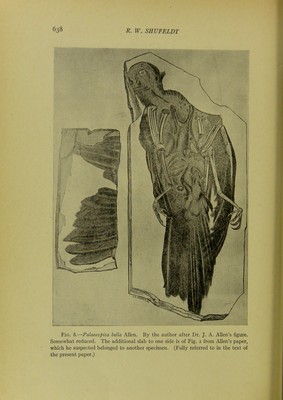
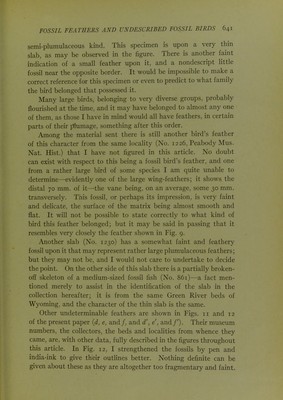
![Unfortunately, in this specimen everything anterior to the posterior margin of either orbit was not obtained by the collector; so it is quite impossible to state positively that this bird was a “Fringilline” bird. Indeed, Dr. Allen himself states in his paper that “the absence of the bill renders it impossible to assign the species to any particular family” (p. 443). By the aid of my camera I made a somewhat reduced copy of the plate illustrating this contribution, and it is here reproduced as Fig. 8, with the additional figure beside it as in the original. With respect to the fossil feathers here shown, Dr. Allen further states: The specimen bears also remarkably distinct impressions of the wings and tail, indicating not only the general form of these parts, but even the shafts and barbs of the feathers The most remarkable feature of the specimen is the definiteness of the feather impressions. Both the shafts and barbs are shown with great distinctness in the rectrices, and the tips of the primaries of one wing are also sharply defined, overlying the edge of the partly expanded tail. The tip of the opposite wing can also be seen beneath the tail. Another specimen from the same locality, and probably representing the same species, consists of the tip of the tail and about the apical third of a half- expanded wing [here shown in the smaller slab in Fig. 8]. In this example the tail is also pointed and graduated. About seven of the outer primaries of the wing are shown with great distinctness, and two others can be easily made out. The third primary is the longest; the second is slightly shorter; the first and fourth are about equal. There are also in the collection three detached contour feathers of small size, but whether pertaining to the same species as the other specimens cannot, of course, be determined. From near the same locality, Dr. Allen, in 1871, obtained a few distinct impressions of feathers from the same Florissant shales; but he, in so far as I am aware, never published a specific description of them. When visiting at my home in the spring of 1913, Mr. Cockerell informed meThat it was not a rare event to meet with fossil feathers in those beds similar to the ones here shown in Figs. 5 and 6. It was Dr. F. V. Hayden, in 1869 I believe, who discovered the first fossil feather of a bird in North America, it having been obtained in the fresh-water Tertiary deposits of Green River, Wyo.—a locality where so many fossils have been collected. Marsh described this specimen as “the distal portion of a large](https://iiif.wellcomecollection.org/image/b22440793_0015.jp2/full/800%2C/0/default.jpg)
 No text description is available for this image
 No text description is available for this image
 No text description is available for this image