Licence: In copyright
Credit: The names of animals in the Bantu languages / A. Werner. Source: Wellcome Collection.
Provider: This material has been provided by The Royal College of Surgeons of England. The original may be consulted at The Royal College of Surgeons of England.
3/20
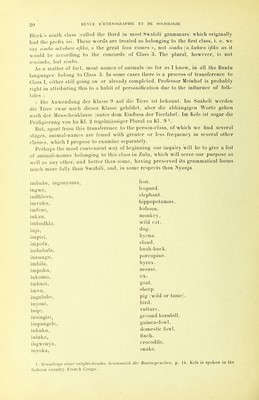
![THE NAMES OF BANTU LANGUAGES (Londres). In an interesting paper contributed to the Reuue dns Idees for January 15,1907, M. Van Gennep lays stress on the importance of studying the noun-classes of the Bantu languages from a new point of view. The ideas underlying this arran- gement have long been a puzzle to philologists. Beyond the facts that one class consisted of nouns denoting the names of persons, another of verbs used as nouns and a third (in some languages) of diminutives, while others contained, though they did not exclusively consist of, the names of trees and of abstract qualities respectively, it seemed impossible to discover the principle on which words were included in one class rather than another. Most attempts in this direction have been more or less fantastic in character, and were, M. Van Gennep thinks, fore- doomed to failure, because they approached the question from a purely European point of view. The solution, he suggests, may lie along the lines indicated by Mr. Dennett in At the Back of the Black Mans Mind : (now supplemented by Nige- rian Studies], — viz., in discovering the « logical system » of the Bantu — the prin- ciple on which they classify the facts of the visible world, so far as these are known to them : « Ce systeme de classification des choses de I'univers, phenomene de I’ordre social, entraine une classification correspondante des mots designant ces choses. » We may remark, in passing, that considerable light is likely to be thrown on this subject by M. Torday’s researches among the Bushongo, whose system of sacred animals, intimately connected with their social organization, seems to complete and explain the information obtained by Mr. Dennett from the Bavili, and the hints as to the Warundi contained in P. Van der Burgt’s work, to which M. Van Gennep refers at the end of his essay. The present can hardly be called an attempt at solving the problem in ques^ lion — that would, for many reasons, be a task beyond my powers, — but an endeavour to examine two points connected with it : the way in which the names of animals are distributed through the various noun -classes, and the distribution of root-words denoting animals though the whole area of the Bantu language -field. One of the most generally accepted opinions with regard to the Bantu lan- guages is, that, though they have no grammatical gender as we understand it (i. e. no distinction of sex expressed in Ihe forms of the language) they make a very clear distinction between living things and things without life. This is borne out by the fact that, in Swahili, the best known (or perhaps we shoudd say the least unfamiliar) Bantu language to most Europeans, all names of living beings are included in the first, or person-class. But a little further study shows that this is not entirely accurate. Not only do other languages place most names of animals in entirely dilferent classes, but internal evidence shows that, even in Swahili, the arrangement is an afterthought, a late grammatical development, evidently the result of logic and reflection. For instance, simba « a lion », chni, « a leopard », which, as they stand, have no prefix and do not vary in the plural, belong to](https://iiif.wellcomecollection.org/image/b22419032_0005.jp2/full/800%2C/0/default.jpg)