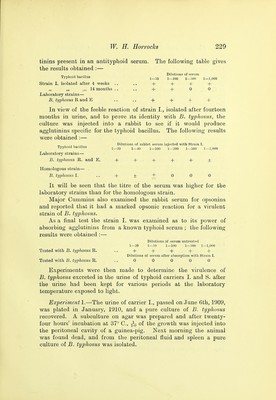
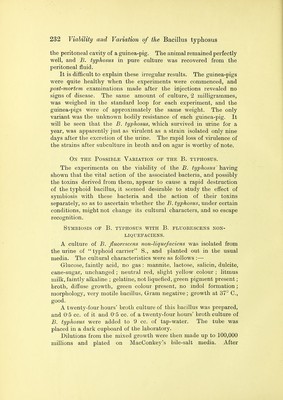
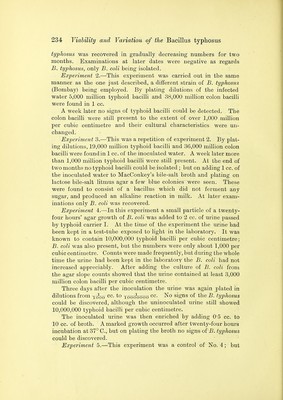
Collected papers reprinted from the Journal of the Royal Army Medical Corps.
- Royal Army Medical Corps.
- Date:
- 1912
Licence: In copyright
Credit: Collected papers reprinted from the Journal of the Royal Army Medical Corps. Source: Wellcome Collection.
Provider: This material has been provided by Royal College of Physicians, London. The original may be consulted at Royal College of Physicians, London.
14/306 page 230
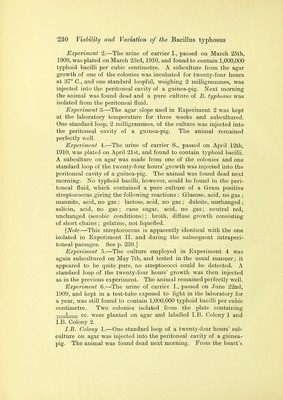
![Experiment 2.—The urine of carrier I., passed on March 25th, 1909, was plated on March 23rd, 1910, and found to contain 1,000,000 typhoid bacilli per cubic centimetre. A subculture from the agar growth of one of the colonies was incubated for twenty-four hours at 87° C, and one standard loopful, weighing 2 milligrammes, was injected into the peritoneal cavity of a guinea-pig. Next morning the animal was found dead and a pure culture of B. typhosus was isolated from the peritoneal fluid. Experiment 3.—The agar slope used in Experiment 2 was kept at the laboratory temperature for three weeks and subcultured. One standard loop, 2 milligrammes, of the culture was injected into the peritoneal cavity of a guinea-pig. The animal remained perfectly well. Experiment 4.—The urine of carrier S., passed on April 12th, 1910, was plated on April 21st, and found to contain typhoid bacilli. A subculture on agar was made from one of the colonies and one standard loop of the twenty-four hours' growth was injected into the peritoneal cavity of a guinea-pig. The animal was found dead next morning. No typhoid bacilli, however, could be found in the peri- toneal fluid, which contained a pure culture of a Gram positive streptococcus giving the following reactions : Glucose, acid, no gas ; mannite, acid, no gas ; lactose, acid, no gas ; dulcite, unchanged ; salicin, acid, no gas; cane sugar, acid, no gas; neutral red, unchanged (aerobic conditions); broth, diffuse growth consisting of short chains ; gelatine, not liquefied. [Note.—This streptococcus is apparently identical with the one isolated in Experiment II. and during the subsequent intraperi- toneal passages. See p. 239.] Experiment 5.—The culture employed in Experiment 4 was again subcultured on May 7th, and tested in the usual manner; it appeared to be quite pure, no streptococci could be detected. A standard loop of the twenty-four hours' growth was then injected as in the previous experiment. The animal remained perfectly well. Experiment 6.—The urine of carrier I., passed on June 22nd, 1909, and kept in a test-tube exposed to light in the laboratory for a year, was still found to contain 1,000,000 typhoid bacilli per cubic centimetre. Two colonies isolated from the plate containing Toooooo cc. were planted on agar and labelled LB. Colony 1 and I.B. Colony 2. I.B. Colony 1.—One standard loop of a twenty-four hours' sub- culture on agar was injected into the peritoneal cavity of a guinea- pig. The animal was found dead next morning. From the heart's](https://iiif.wellcomecollection.org/image/b24750591_0014.jp2/full/800%2C/0/default.jpg)