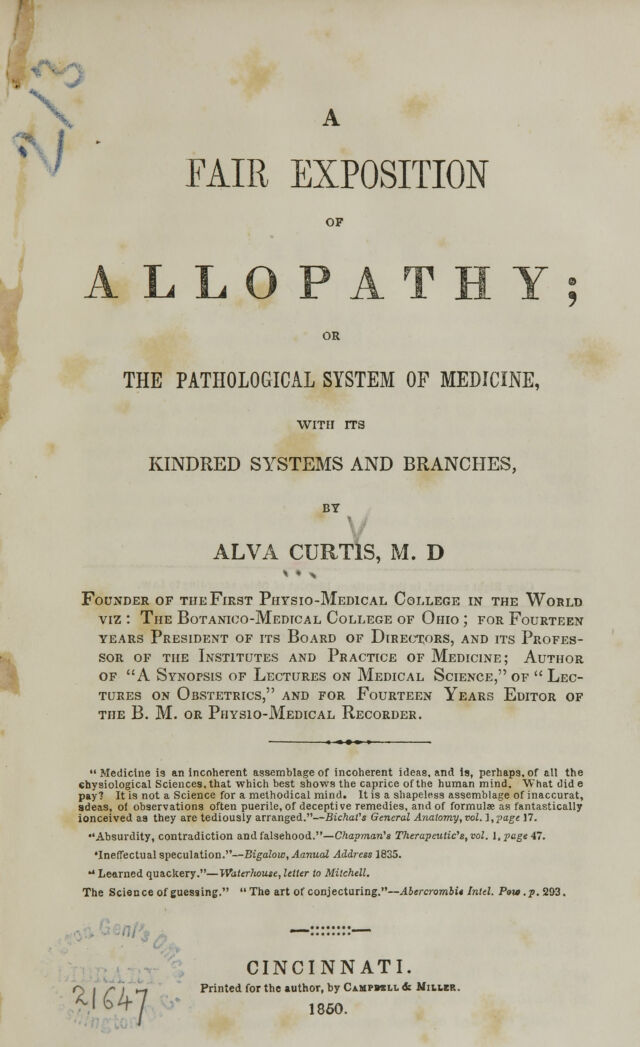
A fair exposition of allopathy, or the pathological system of medicine, with its kindred systems and branches / by Alva Curtis.
- Alva Curtis
- Date:
- 1850
Licence: Public Domain Mark
Credit: A fair exposition of allopathy, or the pathological system of medicine, with its kindred systems and branches / by Alva Curtis. Source: Wellcome Collection.
Provider: This material has been provided by the National Library of Medicine (U.S.), through the Medical Heritage Library. The original may be consulted at the National Library of Medicine (U.S.)
11/52
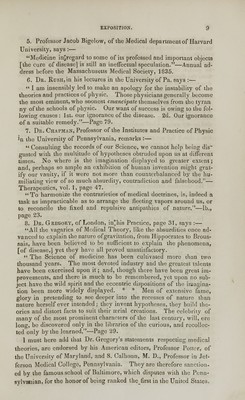
![5. Professor Jacob Bigelow, of the Medical department of Harvard University, says :— Medicine in^regard to some of its professed and important objects [the cure of disease] is still an ineffectual speculation.—Annual ad- dress before the Massachusetts Medical Society, 1835. 6. Dr. Rush, in his lectures in the University of Pa. says :— I am insensibly led to make an apology for the instability of the theories and practices of physic. Those physicians generally become the most eminent, who soonest emancipate themselves from the tyran ny of the schools of physic. Our want of success is owing to the fol- lowing causes : 1st. our ignorance of the disease. 2d. Our ignorance of a suitable remedy.—Page 79. 7. Dr. Chapman, Professor of the Institutes and Practice of Physic in the University of Pennsylvania, remarks :— Consulting the records of our Science, we cannot help being dis~ gusted with the multitude of hypotheses obtruded upon us at different times. No where is the imagination displayed to greater extent; and, perhaps so ample an exhibition of human invention might grat- ify our vanity, if it were not more than counterbalanced by the hu- miliating view of so much absurdity, contradiction and falsehood.'— Therapeutics, vol. 1, page 47. To harmonize the contrarieties of medical doctrines, is, indeed a task as impracticable as to arrange the fleeting vapors around us, or to reconcile the fixed and repulsive antipathies of nature.—lb., page 23. 8. Dr. Gregory, of London, in'his Practice, page 31, says :— All the vagaries of Medical Theory, like the absurdities once ad- vanced to explain the nature of gravitation, from Hippocrates to Brous- sais, have been believed to be sufficient to explain the phenomena, [of disease,] yet they have all proved unsatisfactory. The Science of medicine has been cultivated more than two thousand years. The most devoted industry and the greatest talents have been exercised upon it; and, though there have been great im- provements, and there is much to be remembered, yet upon no sub- ject have the wild spirit and the eccentric dispositions of the imagina- tion been more widely displayed. * * Men of extensive fame, glory in pretending to see deeper into the recesses of nature than nature herself ever intended; they invent hypotheses, they build the- ories and distort facts to suit their serial creations. The celebrity of many of the most prominent characters of the last century, will, ere long, be discovered only in the libraries of the curious, and recollec- ted only by the learned.—Page 29. 1 must here add that Dr. Gregory's statements respecting medical theories, arc endorsed by his American editors, Professor Potter, of the University of Maryland, and S. Calhoun, M. D., Professor in Jef- ferson Medical College, Pennsylvania. They are therefore sanction- ed by the famous school of Baltimore, which disputes with the Penn- sylvawian, for the honor of being ranked thefirst in the United States.](https://iiif.wellcomecollection.org/image/b2111271x_0011.jp2/full/800%2C/0/default.jpg)
 No text description is available for this image
 No text description is available for this image
 No text description is available for this image