The principles and practice of modern surgery / by Roswell Park ... with 722 engravings and 60 full-page plates in colors and monochrome.
- Roswell Park
- Date:
- 1907
Licence: Public Domain Mark
Credit: The principles and practice of modern surgery / by Roswell Park ... with 722 engravings and 60 full-page plates in colors and monochrome. Source: Wellcome Collection.
Provider: This material has been provided by the Augustus C. Long Health Sciences Library at Columbia University and Columbia University Libraries/Information Services, through the Medical Heritage Library. The original may be consulted at the the Augustus C. Long Health Sciences Library at Columbia University and Columbia University.
117/1200
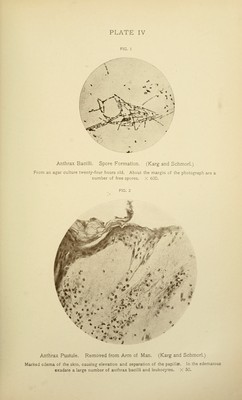
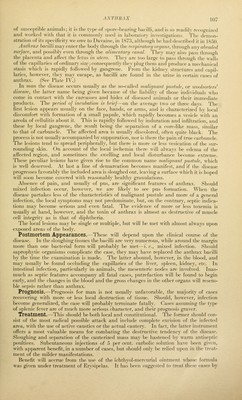
![.I.V77/AM.V of ,sii.sc('|)til)lc animals; it is the t\ |)r of s|)(>n-li(ariii<,' l)a(illi, and is so rc-adilv rcco^iii/cd and worked wilii that it is coninionly nsrd in lal»oratorv invcstifjations. Tlic demon- stration of its .sjH'cificity we owe to Davaine, in iST^i, althoufjli he had deserihed it in 1S')(). Anthrax /^ar////may enter the body throuj^h the rcspiniiori/ortjan-s, through nu\ ahmdtd surface, and possil)ly even through the a/iiiimtari/ canal. They niav also j)ass through the phicenta and affect the fetus /// ulcro. They are too hirge to |)ass tlirough tlie walls of the capillaries of ordinary si/.«-; conse(|Uently they plug them and produce a mechanical stasis which is ra|)idly followed hy gangrene. From the kidney structures and capil- laries, however, thev niav escaj)e, as bacilli are found in the urine in certain cases of anthrax. (See Plate IV.) In man the disease occurs usually as the so-called nia/ir/nanf jntstutc, or voohortcr.s' disease, the latter name being given because of the liability of tho.se individuals who come in contact with the carca.s.ses and hides of di.sea.sed animals or their immediate products. The period of incuhafion is brief—on the average two or three davs. The first lesion apj)ears usually on the face, hands, or arms, and is characterized bv local discomfort with formation of a small ])a|)ule, which rajjidly becomes a vesicle with an areola of cellulitis about it. This is ra|)idly followed by incluration and infiltration, and these by local gangrene, the result being the .se])aration of a core-like mass, similar to that of carbuncle. The affected area is usually discolored, often quite black. The process is not usually accompanied by su])puration, nor is there the pain of true carbuncle. The lesions tend to spread peripherally, but there is more or less vesication of the sur- rounding skin. On account of the local ischemia there will always be edema of the affected region, and sometimes the swelling and local disturbance become extreme. These peculiar lesions have given rise to the common name vialignant 'pustule, which is well deserved. At last a line of demarcation becomes manifest, and if the disea.se progresses favorably the included area is sloughed out, leaving a surface which it is hoj:)ed will soon become covered with reasonably healthy granulations. Absence of pain, and usually of pus, are significant features of anthrax. Should mLxed infection occur, however, we are likely to see pus formation. When the disease partakes less of the characteristics of malignant pustule and more of a general infection, the local .s}iuptoms may not predominate, but, on the contrary, .septic indica- tions may become serious and even fatal. The evidence of more or less toxemia is usually at hand, however, and the toxin of anthrax is almost as destructive of muscle cell integrity as is that of diphtheria. The local lesions may be single or multiple, but will be met with almost always upon exposed areas of the Ixxly. Postmortem Appearances.—These will depend upon the clinical course of the disea.se. In the sloughing tissues the l)acilli are very numerous, while around the margin more than one bacterial form will probably be met—r. e., mixed infection. Should saprophitic organisms complicate the ca.se, they may have replaced the anthrax bacilli by the time the examination is made. The latter abound, however, in the blood, and may usually be found occluding the capillaries of the liver, spleen, kidney, etc. In intestinal infection, particularly in- animals, the mesenteric nodes are involved. Ina.s- much as septic features accompany all fatal cases, putrefaction will be found to begin early, and the changes in the l)lood and the gross changes in the other organs will resem- ble sepsis rather than anthrax. Prognosis.—Progno.sis for man is not usually unfavorable, the majority of ca.ses recovering with more or less local destruction of tissue. Should, however, infection become generalized, the case will probably terminate fatally. Cases assuming the type of splenic fever are of much more serious character, and their prognosis graver. Treatment.—This should be both local and constitutional. The former should con- sist of the most radical possible attack and include complete excision of the infected area, with the u.se of active caustic-s or the actual cautery. In fact, the latter instrument offers a most valuable means for combating the destructive tendency of the disease. Sloughing and separation of the cauterized ma.ss may be hastened by warm antiseptic poultices. Subcutaneous injections of 5 per cent, carbolic solution have been given, with apparent benefit, in a number of cases, but should only be relied upon in the treat- ment of the milder manifestations. Benefit will accrue from the use of the ichthyol-mercurial ointment whose formula was given under treatment of Erysijielas. It has been suggested to treat these cases by](https://iiif.wellcomecollection.org/image/b21211176_0117.jp2/full/800%2C/0/default.jpg)