A tragedy of the great plague of Milan in 1630 / Robert Fletcher.
- Fletcher, R. (Robert), 1925-2019.
- Date:
- 1898
Licence: Public Domain Mark
Credit: A tragedy of the great plague of Milan in 1630 / Robert Fletcher. Source: Wellcome Collection.
5/14 page 177
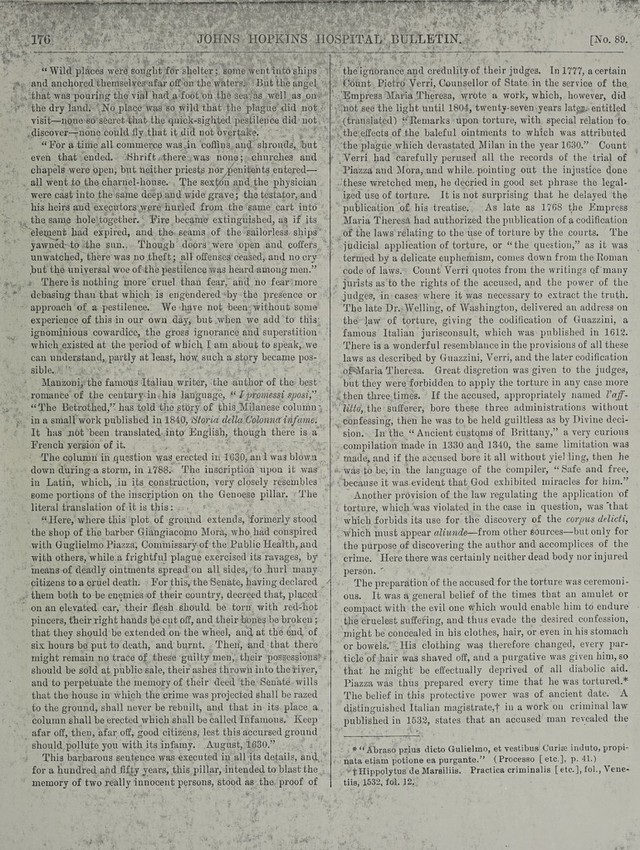
![I - >; $ August, 1898.] JOHNS HOPKINS HOSPITAL BULLETIN. secret of his ability to resist torture and refrain from cries or disclosures. He confessed that one of his relatives had pre- ■ pared for him a cake of wheat flour, to which was added the mixed milk of a mother and daughter. Every day he was to swallow some crumbs of this cake, and as long as it lasted it insured his insensibility to torment. On the other hand, there were certain liquids and greases which, when rubbed into the body of an accused person, counteracted all his protective charms, and, says Marsiliis, with cynical exultation, “when that was done one could hear the joints crack' and the bones sing.” M. Le Blanc* says that these counter-charms were- known in England in the 12th century, in Italy in the 14th century, and in China to quite recent days.f The original account of the,proceedings which led to the tragic end of Piazza and Mora is that of the Canon Ripamonti. He was born in 1577, and was historiographer of Milan. He published the first ten volumes of the Ecclesiastical History of Milan, in 1617, and by request of the Decurions wrote an account of the plague which devasted the city in 1630* This/ latter is a quarto book of 410 pages, written in Latin, and pub¬ lished at Milan in 1641. The title-page is a copper-plate en¬ graving, curiously emblematic. There is a gigantic skeleton filling the entire page; his hands hold weapons, armor, and books of devotion; his bony feet protrude from under a car¬ pet on which lies a man, the victim of the plague. In front of the skeleton is an altar witlra crucifix, to which a woman, seated, with the usual naked boy attendin^'her, points with a sword. ( Two hundred years later, in 1841, this work was translated into Italian by Erancesco Cusani, who has added many valu¬ able notes in an appendix. In 1839 the full official account of the trials of the “Anoint- ers ” was published in Milan.J It is in Italiau, but all that relates to the application of the torture is discreetly veiled in the less familiar Latin, which, however, the modern editor has translated into Italian. From these sources the facts have been obtained, now to be briefly presented. * * .. Early in the morning of the 21st of June, 1630, during the prevalence of the plague in Milan, a woman of the lower classes saw from her window a man going down the street who was writing on a paper. He wiped his fingers on the wall of a house, probably to get rid of ink-stains, but with the readiness of ignorance and fear, she was sure that he was smearing deadly ointments to promote the spread of the pestilence. A crowd of excited women invaded the Council-chamber, and the Senate was informed of the occurrence. Orders were imme¬ diately j^rven to trace out and arrest the guilty* man. It must seem strange to us that the rulers of. a great city* even at that time, could have been so ignorant as to believe _i__ • ' *LoBlanc, (Edmond). Del’ancient croyance it des moyens se¬ crets de defier la torture. Paris, 1892) p. 14. ' ; . t Bodin states that magic words conferring immunity under tor¬ ture were sometimes written on the scalp of sorcerers, where it was concealed by the hair. (De la demonomanie des sorcieres, 1587.) t Processo originals degli Untori nella peste del 1G30. Milan, 1839. that such means could be productive of the pestilence, or that any man or men could desire to destroy their fellow-citizens, and risk their own lives besides. But extraordinary occur¬ rences demanded extraordinary causes to account for them. The plague was attributed to hail, to the poisoning of the fountains by the Jews—to deadly ointpients so placed that passers-by would touch them. It became dangerous for any one to touch walls or buildings. Ripamonti relates that three French travelers admiring the faqade of a building, one of them touched the marble, and was immediately set upon by the mob and dragged half dead to -the prison. An old man, 80 years of age, about to sit down on a bench in the church of San Antonio, wiped off the dust with his cloak. A woman cried out that he was anointing the benches,' and even there, in the house of Hod, the worshippers beat and kicked the life out of the unfortunate man. Such, was the spirit of the time. ^The earliest notice, perhaps, of this belief in “ Anointers” is to be found in the works of Guy de Chauliac, who was phy¬ sician to Pope Clement VI and was living in Avignon, in 1348, when the Black Death ravaged that city. He says: “It was believed that the Jews had poisoned the world, for which reason they were slain. In other plaoes they drove away beggars after cutting off their ears * ,* * and if it was found that any one had powders or ointments, he was compelled to swallow them, to show they were not poisons.* Ambrqise Pare, in his Lime, de la peste, throws further light on the matter. In his Advice to Magistrates, during the visitation of the pestilence, he concludes the chapter thus: “ What shall I add ? They must keep an eye on certain thieves, murderers, poisoners, worse than inhuman, who grease and smear the, walls and doors of rich houses with matter from buboes and carbuncles; and other excretions of the plague- stricken, so as to infect the houses and thus be enabled to break into them, pillage and strip them, and even strangle the poor sick people in their beds; which wds done at Lyons in the year 1565. God! what punishment such fellows deserve ; but tliis I leave to the discretion of the Magistrates who have charge of such duties.”! The scrivener, with the ink-horn at his belt, was discovered, and proved to be a certain Guglielmo Piazza, a commissioner of health, a petty officer employed to report cases of the dis¬ ease. He stoutly denied all knowledge of the crime charged to him, and maintained his resolution through two appli¬ cations of torture, although the second one was the “question extraordinary,” in which atrocious complications were added to the ordinary proceeding. But in his cell, broken down with the effects of the torments he had tyvice experienced, and dreading their renewal, which he knew would come, the un¬ happy man yielded to the insidious suggestions of those around him. He confessed, his guilt, and declared that he obtained the death-dealing ointment from the barber Giangiacomo Mora. The latter was ^immediately arrested, but was likewise vehe¬ ment in his declarations of innocence* avowing that he had never seen or known Piazza. The latter was made of sterner stuff than the barber, who yielded at .the first application of](https://iiif.wellcomecollection.org/image/b30556867_0005.jp2/full/800%2C/0/default.jpg)