The alkaloids of Alstonia barks. Pt. 1, A. constricta, F. Muell / by T.M. Sharp.
- Sharp, Thomas Marvel.
- Date:
- [1934]
Licence: Public Domain Mark
Credit: The alkaloids of Alstonia barks. Pt. 1, A. constricta, F. Muell / by T.M. Sharp. Source: Wellcome Collection.
6/12 page 290
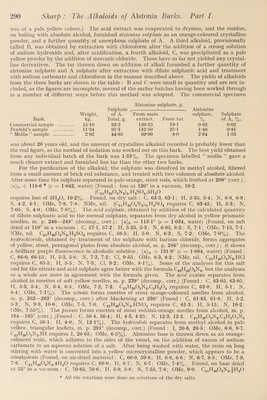
![was of a pale yellow colour.) The acid extract was evaporated to dryness, and the residue, on boiling with absolute alcohol, furnished alstonine sulphate as an orange-coloured crystalline powder, and a further quantity of amorphous sulphate of A. A third alkaloid, provisionally called B, was obtained by extraction with chloroform after the addition of a strong solution of sodium hydroxide and, after acidification, a fourth alkaloid, C, was precipitated as a pale yellow powder by the addition of mercuric chloride. These have so far not yielded any crystal¬ line derivatives. The tar thrown down on addition of alkali furnished a further quantity of alstonine sulphate and A sulphate after extraction with dilute sulphuric acid and treatment with sodium carbonate and chloroform in the manner described above. The yields of alkaloids from the three barks are shown in the table : B and C were small in quantity and are not in¬ cluded, as the figures are incomplete, several of the earlier batches having been worked through in a number of different ways before this method was adopted. The commercial specimen Alstonine sulphate, g. Sulphate ,--—*-* Alstonine Weight, of A. From main sulphate, Sulphate Bark. kg. Total, g. extract. From tar. %. of A, %. Commercial sample . 15T0 93*2 120-25 19-1 0-92 0-62 Penfold’s sample . 1F34 9F3 142-50 25-1 1-48 0-81 “ Mollis” sample . 2-92 44*65 69-00 8-0 2-64 F53 was about 20 years old, and the amount of crystalline alkaloid recorded is probably lower than the real figure, as the method of isolation was worked out on this bark. The best yield obtained from any individual batch of the bark was 1-33%. The specimen labelled “ mollis ” gave a much cleaner extract and furnished less tar than the other two barks. For the purification of the alkaloid, the sulphate was dissolved in methyl alcohol, filtered from a small amount of brick-red substance, and treated with two volumes of absolute alcohol. After some time the sulphate separated in pale orange, stout rods, which frothed at 209° (corr.) ; [a]D + 118-6 * [c — 1-042, water) [Found : loss at 120° in a vacuum, 10-2. (C21FI20O3N2)2,H2SO4,5H2O requires loss of 5H20, 10-2%. Found, on dry salt : C, 63-3, 63-1; H, 5-35, 5-4; N, 6-8, 6-9; S, 4-2, 4-1; OMe, 7-8, 7-8; NMe, nil. (C21H20O3N2)2,H2SO4 requires C, 63-45; H, 5-3; N, 7-05; S, 4-0; OMe, 7-8%]. The acid sulphate, obtained by addition of the calculated quantity of dilute sulphuric acid to the normal sulphate, separates from dry alcohol in yellow prismatic needles, m. p. 246—248° (decomp., corr.); [a]D = 113-1° (c = 1-034, water) (Found, on salt dried at 110° in a vacuum : C, 57-1, 57-2; H, 5-25, 5-3; N, 6-05, 6-2; S, 7-1; OMe, 7-15, 7-1; NMe, nil. C21H20O3N2,H2SO4 requires C, 56-5; H, 5-0; N, 6-3; S, 7-2; OMe, 7-0%). The hydrochloride, obtained by treatment of the sulphate with barium chloride, forms aggregates of yellow, stout, pentagonal plates from absolute alcohol, m. p. 286° (decomp., corr.); it shows a brilliant purple fluorescence in alcoholic solution; [a]D -j- 131-9° (c = 1-064, water) (Found : C, 66-0, 66-15; H, 5-3, 5-6; N, 7-3, 7-2; Cl, 9-55; OMe, 8-3, 8-2; NMe, nil. C21H20O3N2,HCl requires C, 65-5; H, 5-5; N, 7-3; Cl, 9-2; OMe, 8-1%). Some of the analyses for this salt and for the nitrate and acid sulphate agree better with the formula C22H2203N2, but the analyses as a whole are more in agreement with the formula given. The acid oxalate separates from alcohol in rosettes of soft yellow needles, m. p. 239° (decomp., corr.) (Found : C, 63-05, 63-05; H, 5-3, 5-4; N, 6-4, 6-5; OMe, 7-2, 7-2. C21H20O3N2,C2H2O4 requires C, 63-0; H, 5-1; N, 6- 4; OMe, 7-1%). The nitrate forms rosettes of stout orange-coloured needles from alcohol, m. p. 262—263° (decomp., corr.) after blackening at 230° (Found: C, 61-85, 61-8; H, 5-2, 5-3; N, 9-9, 10-0; OMe, 7-5, 7-6. C21H20O3N2,HNO3 requires C, 61-3; H, 5-15; N, 10-2; OMe, 7-55%). The picrate forms rosettes of stout reddish-orange needles from alcohol, m. p. 194—195° (corr.) (Found: C, 56-4, 56-4; H, 4-3, 4-25; N, 12-3, 12-2. C21H20O3N2,C6H3O7N3 requires C, 56-1; H, 4-0; N, 12-1%). The hydriodide separates from methyl alcohol in pale yellow, triangular leaflets, m. p. 291° (decomp., corr.) (Found : I, 26-6, 26-5; OMe, 6-6, 6-7. C21H20O3N2,HI requires I, 26-65; OMe, 6-5%). Alstonine base is thrown down as an orange- coloured resin, which adheres to the sides of the vessel, on the addition of excess of sodium carbonate to an aqueous solution of a salt. After being washed with water, the resin on long stirring with water is converted into a yellow microcrystalline powder, which appears to be a tetrahydrate (Found, on air-dried material : C, 60-0, 59-8; H, 6-8, 6-6; N, 6-7, 6-5; OMe, 7-9, 7- 8. C21H20O3N2,4H2O requires C, 60-0; FT, 6-7; N, 6-7; OMe, 7-4%. Found, on base dried at 55° in a vacuum : C, 70-65, 70-6; H, 5-9, 5-8; N, 7-55, 7-8; OMe, 9-0. C21H20O3N2,JH20 * All the rotations were done on solutions of the dry salts.](https://iiif.wellcomecollection.org/image/b30629640_0006.jp2/full/800%2C/0/default.jpg)