Observations on filariae / by Patrick Manson [and others] ; communicated, with an introduction, by the president.
- Manson, Patrick, 1844-1922.
- Date:
- 1880
Licence: Public Domain Mark
Credit: Observations on filariae / by Patrick Manson [and others] ; communicated, with an introduction, by the president. Source: Wellcome Collection.
Provider: This material has been provided by The Royal College of Surgeons of England. The original may be consulted at The Royal College of Surgeons of England.
3/26 page 1
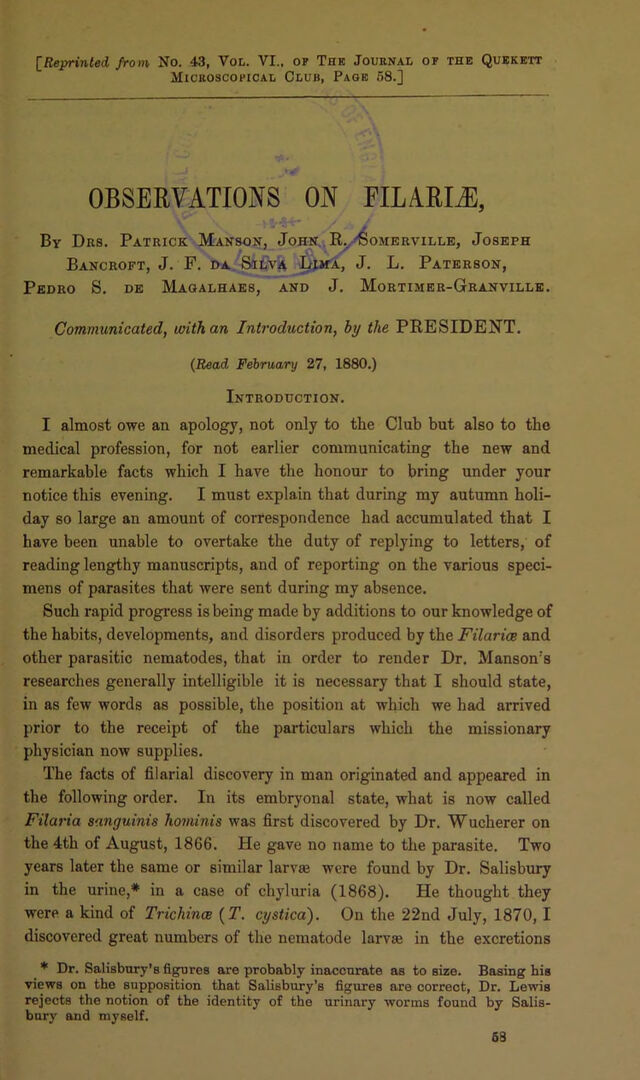
![[Reprinted from No. 43, Vol. VI.. or The Journal or the Quekett Microscopical Club, Page 58.] OBSERVATIONS ON EILARLE, By Drs. Patrick Manson, John R.,-Somerville, Joseph Bancroft, J. P. da Silva Lima, J. L. Paterson, Pedro S. de Maoalhaes, and J. Mortimer-Granville. Communicated, with an Introduction, by the PRESIDENT. (Read February 27, 1880.) Introduction. I almost owe an apology, not only to the Club but also to tbo medical profession, for not earlier communicating the new and remarkable facts which I have the honour to bring under your notice this evening. I must explain that during my autumn holi- day so large an amount of correspondence had accumulated that I have been unable to overtake the duty of replying to letters, of reading lengthy manuscripts, and of reporting on the various speci- mens of parasites that were sent during my absence. Such rapid progress is being made by additions to our knowledge of the habits, developments, and disorders produced by the Filarice and other parasitic nematodes, that in order to render Dr. Manson’s researches generally intelligible it is necessary that I should state, in as few words as possible, the position at which we had arrived prior to the receipt of the particulars which the missionary physician now supplies. The facts of filarial discovery in man originated and appeared in the following order. In its embryonal state, what is now called Filaria sanguinis hominis was first discovered by Dr. Wucherer on the 4th of August, 1866. He gave no name to the parasite. Two years later the same or similar larvaj were found by Dr. Salisbury in the urine,* in a case of chyluria (1868). He thought they were a kind of Trichince (T. cystica). On the 22nd July, 1870, I discovered great numbers of the nematode larvaj in the excretions * Dr. Salisbury’s figures are probably inaccurate as to size. Basing his views on the supposition that Salisbury’s figures are correct, Dr. Lewis rejects the notion of the identity of the urinary worms found by Salis- bury and myself.](https://iiif.wellcomecollection.org/image/b22431275_0005.jp2/full/800%2C/0/default.jpg)