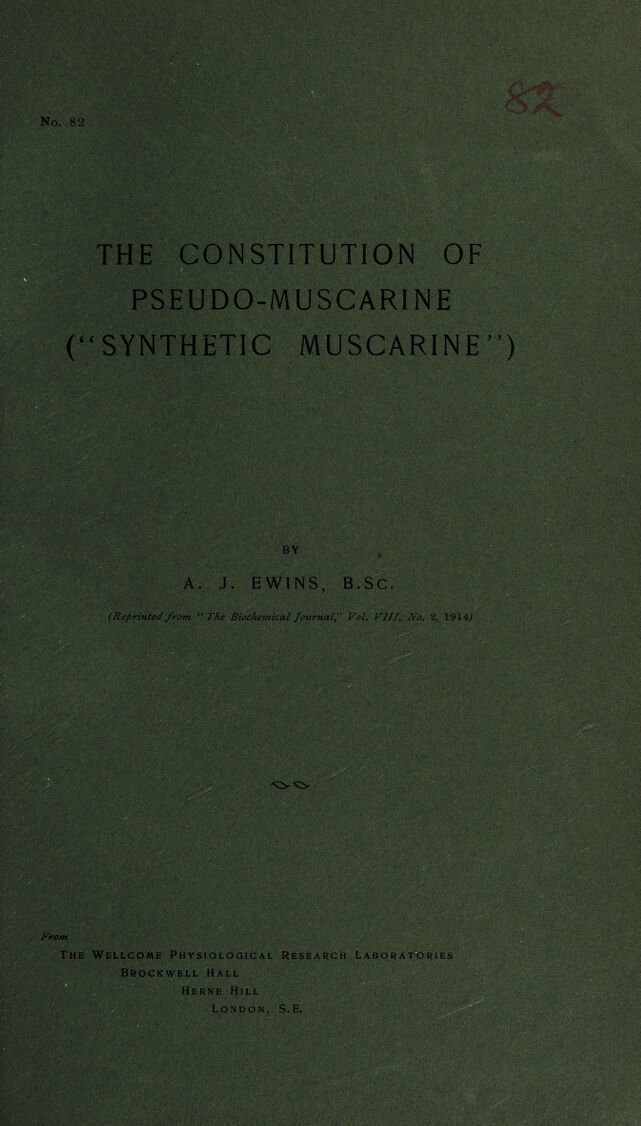
The constitution of pseudo-muscarine ("synthetic muscarine") / by A.J. Ewins.
- Ewins, Arthur James.
- Date:
- [1914?]
Licence: In copyright
Credit: The constitution of pseudo-muscarine ("synthetic muscarine") / by A.J. Ewins. Source: Wellcome Collection.
6/12 page 212
![[1894] (who termed it “ nitroso-choline ”) in the preparation of pseudo¬ muscarine by Schmiedeberg and Harnack’s method. He considered this substance, however, to be a bye-product of the reaction, chiefly on account of a difference of crystalline form of the platinichlorides of the base and of pseudo-muscarine respectively. It was, however, remarked by Schmiedeberg and Harnack [1877] that the platinichloride of pseudo-muscarine (synthetic muscarine) which crystallises ordinarily in octahedra might also form “Feder- fahne ahnliche Aggregaten,” a description which corresponds with that of “ federbartartige Krystallen ” recorded by Nothnagel for the platinichloride of “ nitroso-choline/’ That the supposed difference of constitution of these two bases in reality had very little foundation is supported by the analytical figures recorded by Nothnagel [1894] and shown in the following table: Pseudo-muscarine Nitroso-choline platinichloride nlatini chloride Choline nitrous [N(CH3)3CH2.CH(OH)2]2 rN(CH3)3CH2CH2O.NO]2 ester platinichloride PtCl62H20 PtCl62H25 (anhydrous) Found Found Calculated C =17-66 17-69 17-8 H= 4-92 3-70 3-85 N — 8-31 8-31 Cl = 31-07 — 31-6 Pt = 28-54, 28-60, 28-44 28-73 28-93 Aurichloride Aurichloride Aurichloride Au = 42-66 Au = 41-79 Au = 41-7 It will be observed that Nothnagel also formulates the “nitroso-choline” platinichloride as containing two molecules of water of crystallisation which, he states, were not removed by long heating at 100°. Nevertheless after drying the salt at 100° he obtained figures which, as is seen, agree well for the anhydrous salt. This fact was also pointed out by Schmidt and Wagner [1904], who obtained “ nitroso-choline ” by the prolonged action of con¬ centrated nitric acid on choline at the ordinary temperature. The identity of this base with pseudo-(synthetic) muscarine is further supported by the similarity of the melting points of the aurichlorides (“pseudo-muscarine” aurichloride m.p. 234° after sintering from 174°; “nitroso-choline” auri- chloride m.p. 240°) and by the fact stated by Nothnagel that the solubilities of the platinichloride are very similar. In view, therefore, of the foregoing facts, it must be accepted that by the action of concentrated nitric acid upon choline as originally described by Schmiedeberg and Harnack, only one base yielding a platinichloride com¬ paratively little soluble in cold water is produced. This base, which, as will](https://iiif.wellcomecollection.org/image/b30620909_0006.jp2/full/800%2C/0/default.jpg)