New views on provisional callus / by Frank H. Hamilton.
- Frank Hastings Hamilton
- Date:
- 1853
Licence: Public Domain Mark
Credit: New views on provisional callus / by Frank H. Hamilton. Source: Wellcome Collection.
Provider: This material has been provided by the National Library of Medicine (U.S.), through the Medical Heritage Library. The original may be consulted at the National Library of Medicine (U.S.)
4/16
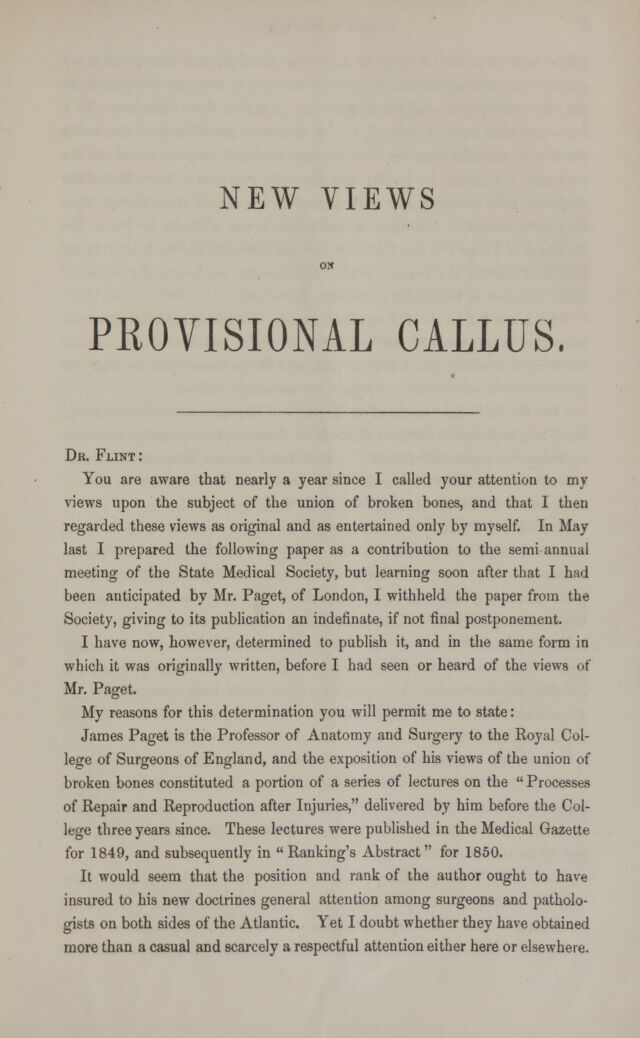
![I have seen no notice of them in American Journals, and among the many eminent surgeons with whom I have conversed, both teachers and practition- ers, only one or two retained a vague impression of their existence. By a letter also from a friend in Paris, I learn that upon careful inquiry the writer could not ascertain that any one in that city had seen or heard of the doctrines announced by Paget; and the only evidence I hive that these doctrines have attracted any more attention at home, in great Britain, than they have abroad, is furnished in the notice given of them by Pirri Professor of Surgery in the University of Aberdeen, in his work on su published during the present year. After having explained the mode of union of bones, as taught by Dupuytren, he remarks: Such are the views of Dupuytren on this interesting subject; and until lately they were generally received as the correct explanation of the su< i ive changes that take place, both in man, and in the lower animals, from the occurrence of fracture until the injury is completely repaired. . Paget, in his ' on Repair and Reproduction after Injuries,' has brought forward different views from those which formerly prevailed ling the repair of a fractured human bone, and has supported his opin- • u)i><t conclusive evidence. His views on this subject are in accord- ance with those of Mr. Stanley.—Pirrie's Surgery, p. 127. [I think Mr. Pirrie is not entirely right in saying that Mr. Paget's views are in accordance with those of Mr. Stanley. Mr. Stanley says, in the human subject, no such cartilaginous and osseous deposit uniformly takes place around the fractured bone; here, therefore,it is not an essential part of the repara ss. This passi es that he regards provisional callus as a general but not uniform occurrence; useful, but not essen- tial. These are by no means in accordance with Mr. Paget's views; nor are they the views which I propose to advocate. If such were actually Mr. Paget's views, then it will be seen that we are not agreed, and I should still claim originality for my doctrine.] I thought it proper, therefore, that I should attempt to direct the attention of my professional brethren to Mr. Paget, by a reproduction of his and by a public statement of my own conclusions — conclusions nearly or quite iden- tical, to which, without concert, we had almost simultaneously arrived, and yet by somewhat different roads. Mr. Paget's first impressions of the fallacies of the doctrines of Dupuytren, and his subsequent full i were obtained solely from pathological specimens — from the large collection of fractures in the museum of the college. While my first impressions were received from examinations of](https://iiif.wellcomecollection.org/image/b21126070_0004.jp2/full/800%2C/0/default.jpg)


 No text description is available for this image
 No text description is available for this image
 No text description is available for this image