Technology transfer : administration of the Bayh-Dole Act by research universities : report to Congressional committees / United States General Accounting Office.
- United States. General Accounting Office
- Date:
- [1998]
Licence: Public Domain Mark
Credit: Technology transfer : administration of the Bayh-Dole Act by research universities : report to Congressional committees / United States General Accounting Office. Source: Wellcome Collection.
30/88 page 28
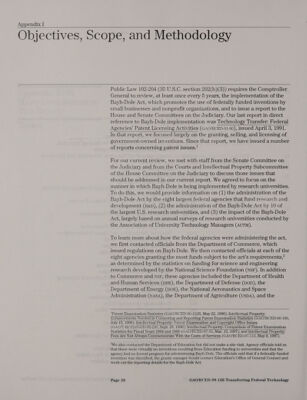
![Objectives, Scope, and Methodology Public Law 102-204 (35 U.S.C. section 202(b)(3)) requires the Comptroller General to review, at least once every 5 years, the implementation of the Bayh-Dole Act, which promotes the use of federally funded inventions by smal] businesses and nonprofit organizations, and to issue a report to the House and Senate Committees on the Judiciary. Our last report in direct reference to Bayh-Dole implementation was Technology Transfer: Federal Agencies’ Patent Licensing Activities (GAO/RCED-91-80), issued April 3, 1991. In that report, we focused largely on the granting, selling, and licensing of government-owned inventions. Since that report, we have issued a number of reports concerning patent issues.' For our current review, we met with staff from the Senate Committee on the Judiciary and from the Courts and Intellectual Property Subcommittee of the House Committee on the Judiciary to discuss those issues that should be addressed in our current report. We agreed to focus on the manner in which Bayh-Dole is being implemented by research universities. To do this, we would provide information on (1) the administration of the Bayh-Dole Act by the eight largest federal agencies that fund research and development (R&D), (2) the administration of the Bayh-Dole Act by 10 of the largest U.S. research universities, and (3) the impact of the Bayh-Dole Act, largely based on annual surveys of research universities conducted by the Association of University Technology Managers (AUTM). To learn more about how the federal agencies were administering the act, we first contacted officials from the Department of Commerce, which issued regulations on Bayh-Dole. We then contacted officials at each of the eight agencies granting the most funds subject to the act’s requirements,” as determined by the statistics on funding for science and engineering research developed by the National Science Foundation (NSF). In addition to Commerce and NsF, these agencies included the Department of Health and Human Services (HHS), the Department of Defense (DOD), the Department of Energy (DOE), the National Aeronautics and Space Administration (NASA), the Department of Agriculture (USDA), and the ‘Patent Examination Statistics (GAO/RCED-96-152R, May 22, 1996); Intellectual Property: Enhancements Needed in Computing and Reporting Patent Examination Statistics (GAO/RCED-96-190, July 15, 1996): Intellectual Property: Patent Examination and Copyright Office Issues (GAO/T-RCED/GGD-96-230, Sept. 18, 1996); Intellectual Property: Comparison of Patent Examination Statistics for Fiscal Years 1994 and 1995 (GAO/RCED-97-58, Mar. 13, 1997); and Intellectual Property: Fees Are Not Always Commensurate With the Costs of Services (GAO/RCED-97-113, May 9, 1997). *We also contacted the Department of Education but did not make a site visit. Agency officials told us that there were virtually no inventions resulting from Education funding to universities and that the agency had no formal program for administering Bayh-Dole. The officials said that if a federally funded invention was identified, the grants manager would contact Education’s Office of General Counsel and work out the reporting details for the Bayh-Dole Act.](https://iiif.wellcomecollection.org/image/b32230588_0030.jp2/full/800%2C/0/default.jpg)
 No text description is available for this image
 No text description is available for this image
 No text description is available for this image