Volume 1
The imperial dictionary of the English language : a complete encyclopedic lexicon, literary, scientific, and technological / by John Ogilvie.
- Ogilvie, John
- Date:
- 1885
Licence: Public Domain Mark
Credit: The imperial dictionary of the English language : a complete encyclopedic lexicon, literary, scientific, and technological / by John Ogilvie. Source: Wellcome Collection.
Provider: This material has been provided by Royal College of Physicians, London. The original may be consulted at Royal College of Physicians, London.
93/736 page 67
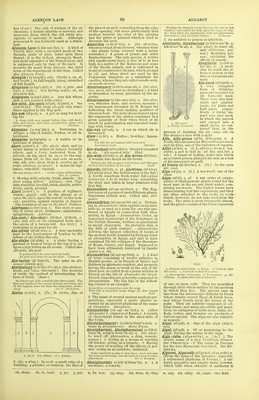
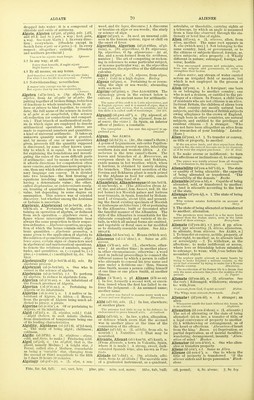
![Alcedo (al-se'do), n. [L. alcedo, alcyon, a kingfisher. See Halcyon.] The knigflsher; a genus of birds, family Alcedinidse. See Kingfisher. Alces (al'ses), n. [L. alces, Gr. cilke, an elk.] A gemis of animals of the Cervidse or deer family, characterized by short and thick neck, thick and brittle hair, a mane on throat, and by having a tuft of hair above the middle of the metatarsal bones of the hind-leg; the elk. It is the size of a horse, and inliabits Russia, Poland, Sweden, and Norway, but particularly the north of North America. See ELK. Alchemic, Alchemical (al-kem'ik, al-kem'- ik-al), a. Relating to or produced by al- chemy. Alchemically (al-kem'ik-al-li), adv. In the manner of alchemy. Lully would prove it aLchemically. Camden. AlChemilla (al-ke-mil'la), n. [Arabic name al-kemeljieh, it being supposed to have won- derful alchemic properties.] A genus of plants, nat. order Rosacefe; lady's-mantle. They are herbs, with lobed leaves and small yeUow or green flowers. See Lady's-man- tle. Alchemist (al'kem-ist), n. One who prac- tises alchemy. Yow s.r'^ Av\ aUhemist; make gold of that. Shak. Alchemistic, Alchemistical (al-kem-ist'ik, al-kem-ist'ik-al), a. Relating to or practis- ing alchemy. Alchemize (al'kem-iz), v.t. To change by alchemy; to transmute, as metals. Lovelace. [Rare. ] Alchemy, Alchymy (al'ke-mi, al'ki-mi), n. [Ar. al, the, and kliiild, chemistry. See Chemistry.] l.tChemistry. ('Alchemywas never at any time anything ditferent from chemistry.' Liebig.) Hence.f rom the fact that the early chemists were often deficient in their theoretical views, and pursued in their experiments delusive ends, such as the dis- covery of the philosopher's stone, which, being mixed with the baser metals, was to transmute them into gold, to be a panacea or universal remedy for diseases, and an alka- hest or universal solvent, it came to mean, specifically—2. The doctrines and practice of those who dabbled in such arts.—3. For- merly, a mixed metal used for utensils. It was a modification of brass; so called be- cause believed to have been originally formed by the art of alchemy: used figui-a- tively by Milton for a trumpet. Your speedy cherubiras Put to their mouths the sounding alchymy. Milton. Alchymic, Alchymical (al-kim'ik, al-kim'- ik-al), a. Same as Alchemic, Alchem- ical. Alchymically (al-kim'ik-al-li), adv. Same as Alcliemically. Alchymist (al'ldm-ist), n. Same as Alchem- ist. Alchymistic, Alchymistical (al-kim-ist'ik, al-kim-ist'ik-al), a. Same as Alchemistic, Alchemiatical. Alchymy (al'ki-mi), n. Same as Alchemy. Alcidae (al'si-de), n. pi. [L.L. alca, an auk. See Auk.] The auk family, a family of natatorial sea-birds, distinguished by a long- ish bill, mostly curved toward the tip, wings short, tail short and graduated, hind toe small or absent, comprehending the sub- families Alcinie (auks proper), Spheniscina; (penguins), and Urina; (guillemots). Alcina (al-si'ne), n. pi. The auks, a sub- family of natatorial sea-birds,family Alcidse, distinguished by a shorter bill than in the penguins and guillemots, compressed and boldly keeled above and below, by having the tip of the upper mandible hooked, and by narrow nostrils. Wings moderate, first quill largest. The hind toe is absent. It comprehends the genera Alca or auks propT, and Fratercula or puffins. Alcmaniau (alk-ma'ni-an), a. [L. alcma- nianus.] Pertaining to Alcman, a Greek lyric poet of the seventh century B.C., cele- brated for his amorous verses.—Alcmanian verse (Alcmanianum metrum), in pros, a verse consisting of two dactyls and two trochees. Alco (al'ko), n. A small variety of dog with a small head and large pendulous ears, found wild in Mexico and Peru, and now domesticated. Alcoate, AlCOhate (al'ko-at, alTco-hat), n. Same as Alcoholate. Alcohol (al'ko-hol), n. [Sp. Pg. alcohol—Ar. al, the, and kohl, a fine powder of antimony applied by orientals to the eyes. On ac- count of the fineness of this powder the name is said to have been transferred to anything very line or purified, as rectified spirits.] (C.2H5O.) A liquid forming the intoxicating' principle of all vinous and spirituous liquors. It is formed by the fer- mentation of aqueous sugar solutions, and by the destructive distillation of organic bodies, as coal. It has also been produced by causing water (HoO) to combine chemi- cally with oleflant gas (C.2H4), the method adopted being to shake the gas with strong sulphuric acid, and afterwards to dilute the mixture with water and distil. Having been first procured from wine, the name of spirit of wine is given to the strongest alco- holic found in commerce, containing about 90° per cent, of pure alcohol. Absolute or pm-e alcohol is a transparent fluid, of a pleasant spirituous smell and bui'uing taste; sp. gi'. 0 793 at 60° F. It has never been frozen, but it becomes viscid at very low temperatures. It is very inflammable, and mixes with water in all proportions, is a solvent of all bodies which are rich in hy- drogen, as organic bases, resins, and oils, and as such much used in chemical opera- tions, and for the preparation of druggists' tinctures; and is a powerful stimulant and antiseptic. It is employed in filling ther- mometers for low temperatures. By volume 55 parts of alcohol and 45 of water, or 49'2 parts by weight of alcohol and 50 8 of water, form proof spirit. Under-proof and over- proof are the designations of weaker or stronger solutions. Alcohol, mixed with various proportions of water, essential oils, sugar,and extracts, forms the different kinds of alcoholic drinks known as ardent spirits, wine, beer, &c. Spirits, as whisky, brandy, &c., contain 40 to 50 per cent, of absolute alcohol; wines, from 17 to 7 or 8; strong ale and porter, 6 to 8; and small beer, 1 per cent. Alcohol is also the general name given to a series of chemical compounds, all of which are constituted similarly. Alcoholate (al'ko-hol-at), n. A salt in which alcohol appears to replace the water of crys- tallization. Alcoholic (al-ko-hol'ik), a. Pertaining to alcohol, or partaking of its qualities. Alcoholic (al-ko-hol'ik), n. An alcoholic liquid. Alcoholism (al'ko-hol-izm), n. The condi- tion of habitual drunkards, whose tissues are saturated with spirits. Called also Chronic Alcoholism. Alcoholization (al-k6-horiz-ashon), n. 1. The act of rectifying spirit till it is wholly deprived of impurities.—2. t The act of re- ducing a substance to an impalpable pow- der. Johnson. Alcoholize (al'ko-hol-iz), D. t. 1. To convert into alcohol; to rectify spirit till it is wholly purified.—2.t To reduce to an impalpable powder. Johnson. Alcoholmeter (al-ko-hol'me-ter), n. Same as Alcoholometer. Alcoholometer, Alcohometer (al'ko-hol- om'et-er, arko-homet-er), n. [Alcohol, and Gr. metron, measure.] An instrument for determining the quantity of pure alcohol in any liquid, with a scale graduated so as to indicate the percentage, either by weight or volume. Alcoholometrical, Alcohometrical (al'- ko-ho-lo-metrik-al, arko-ho-metrik-al), a. Relating to the alcoholometer; as, alcoho- lometrical tables. Alcoholometry, Alcoometry (al'ko-hol- omet-ri, arko-omet-ri), n. The process of estimating the percentage of pure or abso- lute alcohol in a spirituous liquid. Alcoometer (al-ko-om'et-er), n. [Fr. alco- ometre.] Same as Alcoholometer (which see). Alcoran (al'ko-ran or al'ko-ran). See Ko- ran and Alkoran. Alcoranic (al-ko-ran'ik or al-ko-ran'ik), a. Relating to the Alcoran or Mohammedan- ism. Alcoranish (al-ko-ran'ish or al-ko-ran'ish), a. Belonging to the Koran or Alcoran, or to Mohammedanism. ' Some Alcoranish doctors.' Sir T. Herbert. Alcoranist (al-ko-ran'ist or al-ko-ran'ist), n. A strict adherent to the letter of the Koran or Alcoran. Alcove (al'kov), n. [Fr. alcove, Sp. alcoha— Ar. al, the, and kubbeh, an alcove, a little chamber.] A recess; especially, (a) a wide and deep recess in a room, usually separated from it by a screen of columns, by a balus- trade, or by draperies, and intended for the reception of a bed of state or seats, and often liaviug its floor raised above that of the Alcove. room. More rarely, (fc) a lateral recess in a library for the reception of books, (c) An arched or covered seat in a garden, (d) Any natural recess, as a recess in a grove or wood, a small bay, a place nearly inclosed by rocks, hills, and the like. [Chiefly poeti- cal] On mossy banks, beneath the citron grove, The youthful wand'rers found a wild alc(ne. Falco7ier. Alcyon (al'si-on), n. An old or poetical name of the kingfisher. Same as Halcyon (which see). Alcyonaria (al' si - o-nari-a), n. pi. [See Alcyonium.] An order of actinozoan corals, distinguished by six or eight broad leaf-like tentacles, arranged round the mouth like the rays of a star-fish (whence their alter- native name Asteroida). They inhabit a polypidom, and consist of a fleshy external layer, supported on a calcareous axis se- creted from the outer surface of the animal, and embrace the organ-pipe corals, the Al- cyonidee or dead-men's fingers, the Gorgon- Alcyonaria. I, Sea-fan {Gorgonta Jlabellicm). 2, Sea-pen [Pe)t- Jiailila phosphored). 3, Cormtlaria riigosa. idse or sea-fans, and the sea-pens. Some species very much resemble sponges; others are like fans, feathers, itc. Technically they are called Sclerobasic Zoantharia. Alcyonic (al-si-on'ik), a. Pertaining to the Alcyonidie (which see). Alcyonidaa, Alcyoneae (al-si-on'i-de, al-si- on%-e), n. pi. [See Alcyonium.] A family of asteroid polypes, somewhat resembling the sponges. Alcyonium digitatmn, called variously, from its occasional form, dead- man's hand or cow's pajjs, is the type. They are found in all seas and at various depths. Alcyonite (al'si-on-It), n. A fossil alcyonium; one of the spongiferous fossils common in the chalk formation. Alcyonium (al-si-6'ni-um), n. [L.alcyonium, Gr. alkyonion, alkyoneion, a zoophyte so called from its resemblance to the Halcyon's nest. See Halcyon.] A genus of asteroid polypes or Actinozoa, belonging to the family Alcyonidse (which see). Alcyonoid (al'si-on-oid), n. A member of the family Alcyonidae or Alcyoneae. Written also Halcyonoid. Alde'baran (al-deb'ar-an), n. [Ar. name, from al, the, debardn, coming behind: so called, it is said, because it comes behind the remarkable group of the Pleiades. ] A star of the first magnitude in the constel- lation Taurus. Vulgarly called the Bull's](https://iiif.wellcomecollection.org/image/b22652000_0001_0093.jp2/full/800%2C/0/default.jpg)