Volume 1
The imperial dictionary of the English language : a complete encyclopedic lexicon, literary, scientific, and technological / by John Ogilvie.
- Ogilvie, John
- Date:
- 1885
Licence: Public Domain Mark
Credit: The imperial dictionary of the English language : a complete encyclopedic lexicon, literary, scientific, and technological / by John Ogilvie. Source: Wellcome Collection.
Provider: This material has been provided by Royal College of Physicians, London. The original may be consulted at Royal College of Physicians, London.
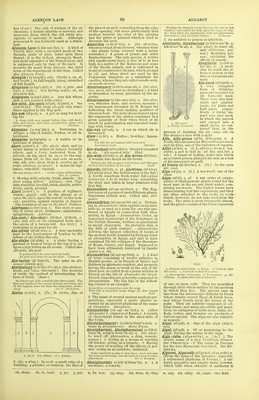
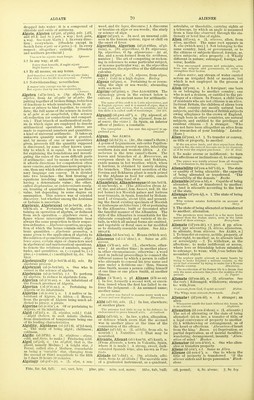
92/736 page 66
![AllData (al-ba'ta), )i. [L. albus, white.] An alloy consisting of a combination of nickel, zinc, tin, and cojiper, often with antimony and silver, united in various proportions. It is a white metal, resembling silver in ap- pearance, and Is made into spoons, forks, teapots, &c. Called also British Plate and German-silver. He was not the genuine article, but a substitute, a kind of a/Ai/,!. G.A.Sala. Albatros, Albatross (al'ba-tros), n. [Fr. albatros, in Flacourt and Dampier algatros, a corruption of Sp. Pg. alcatraz, originally a pelican, but also applied to other aquatic birds. Marcel Devic (in supplement to Littr^'s Dictionary) takes alcatraz to be equivalent to Pg. alcatruz (Ar. al-qcldus), the bucket of a noria or water-wheel, this term being applied to the pelican for the same reason that the Arabs call it saqqcl or water-carrier, from being supposed to carry water to its young ones in the pouch below its bill. ] An aquatic natatorial bird, family Procellariadfe, of which the wandering albatros (Diomedea exulans) is Wandering Albatross {Di'onit-dea cxnlaiis). the best known species. The bill is straight; the upper mandible crooked at the point, and the lower one truncated; the nostrils are oval, open and little prominent, and placed on the sides; the wings are pennated, and there are three webbed toes on each foot. The upper part of the body is of a spotted brown, and the belly white. It is the largest sea-bird known, some measuring 17^ feet from tip to tip of their expanded wings. They abound at the Cape of Good Hope and in Behring's Straits, and have been known to accompany ships for whole days without ever resting on the waves. From this habit it is regarded with feelings of attachment and superstitious awe by sailors, it being reckoned unlucky to kill one. Coleridge has availed himself of this feeling in his 'Ancient Mariner.' Albe.t Albee.t adv. Albeit. Spenser. Albeit (al-be'it), conj. [A compound of the old al in the sense of though, be, and it, and equivalent to be it so; comp. Chaucer's 'al speke he,' 'al have I;' he also uses the fuller form 'al be it so that.'] Be it so; admit all that; although; notwithstanding. Whereas ye say, The Lord saith it, albeit I have not spoken. Ezek. xiii. ii. Albeit so masked, I speak the truth. Tennyson. Alberia (al-be'ri-a), )i. [L. a?6MS, white. ] In her. a shield without ornament or armorial bearings, so called from being white. Albert, Albert-chain (al'bfirt, iil'bert-chan), n. [After the Prince Consort, Albert.] A short chain attaching the watch to a waist- coat button-hole, where it is secured by a bar or hook. Albescent (al-bes'ent), a. [L. albesco, to grow white, an incept, from albus. white. ] Becoming white or rather whitish; moder- ately white; of a pale, hoary aspect. Albicore (al'lje-kor), n. Same as Albacore. Albification (al'bi-fl-kashon), n. [L. albus, white, aml/nc/<i, to make.] The act or pro- cess of iimkiiiK white. Chaucer. Albigenses, Albigeois (al-bi-jens'ez, al-be- zhwa), n. pi. A party of reformers who separated from the Church of Rome in the twelfth century, and were ruthlessly perse- cuted; so called from Albigeois, a small ter- ritory round Albi, a town of Languedoc In France, where they resided. Albin (al'bin), ?i, [L. nZftus, white.] A min- eral of an opaque white colour, regarded as a variety of Bohemian apophyllite. Albinism, Albinoism (al'bin-izm, al-bi'no- izm), n. The state or condition of an albino; leucopathy. The peculiarity of or leucopathy is always born with the individual, and may occur amon^ men of any colour. Nor is it confined to the human race, having been observed also in horses, rabbits, rats, mice, &c., birds (white crows and blackbirds are not particularly uncommon), fishes, and perhaps also in- sects. Pop. Ency. Albino (al-bi'no), n. pi. Albinos or Albi- noes (al-bi'noz). [Pg., from L. albus, white. ] A person of pale, milky complexion, with light hair and pink eyes. This abnormal condition appears to depend on an absence of the minute particles of colouring matter which ordinarily occur in the lowest and last deposited layers of the epidermis or outer skin. Albinos occasionally occur among all races of men. The term is also applied to animals characterized by the same peculiarity in physical constitution. See Albinism. Albion (al'bi-on), n. [Celt, albain—alb, alp, height, cliff, and bdn, white; a name given to the island presumably from the white cliffs of the south coast, the first object seen by the early immigrants. Grimm regards alb, alp, a height, as related to alb (L. albus), white, as indicating the whiteness of snow- clad summits.] An ancient name of Britain, gradually restricted to Scotland; still fre- quently used in poetry as equivalent to Britain. Albite (al'bit), n. [L. albus, v/hite.] Tetrar- toprismatic felspar; soda felspar. A name given to felspar whose alkali is soda instead of potash. Albite forms a constituent part of the greenstone rocks in the neighbour- hood of Edinburgh, and of Aberdeen granite. Alborak (al-bo'rak), n. [Ar. al-burak, from (il, tlie article, and baraka, to flash, barkum, lightning, splendour.] The white mule on which Mohannned is said to have journeyed fi'om the temple of Jerusalem to heaven. Albuginea (al-bu-jin'e-a), n. [See Albu- GINEOUS] In atuit. the white fibrous coating of the eye; the white ; also, a tough fibrous coating of the testicle. Albugineous (al-bii-jin'e-us), a. [Fr. albu- ijiiien.r, from L. albugo, albuginis, whiteness, from albus, white.] Pertaining to or re- sembling the wliite of the eye or of an egg. — Albugineo^is humour, the aqueous humour of the eye.—.4;&)((/i;it'ui(s tunic, the external covering of the eyeball, the albuginea. Albuginous (al-ba'jin-us), a. Same as Albu- gineous. Sir T. Browne. Albugo (al-bu'go), n. [L., from albus, white. ] The disease of the eye, otherwise called Leuco>na (which see). Album (al'bum), n. [L., from albus, white.] 1. In Rom. antiq. a white tablet, on which the names of public officers and also public transactions were written down.—2. A book, originally blank, in which may be inserted autographs of celebrated pei sons or favour- ite pieces of poetry or prose, generally con- tributed by friends.—3. A blank book with ornamental binding for preserving photo- graphic views, cartes de visite, &c. — 4. In law, white or silver money paid as rent. Albumen (al-bQ'men), n. [L., from albus, white.] In physiol. a substance so named from the Latin for the white of an egg, in which it abounds in its purest natural state, serving as the type of the protein compounds or the nitrogenous class of food stuffs. It is a proximate principle, entering largely into the composition of the animal and vegetable fluids and solids, is coagulable by heat at and above 160°, and is composed of carbon, hydrogen, nitrogen, and oxygen, with a little sulphur. It abounds in the serum of the blood, the vitreous and crystal- line humours of the eye, the fluid of dropsy, the substance called coagulable lymph, in nutritive matters, the juice of flesh, &c. The blood contains about 7 per cent, of albumen. It is the starting-point of all the tissues. Vegetable albumen exists in most vegetable juices and many seeds, and has the same composition and properties as animal. Albumen is used to clarify syrupy liquors, and to fix colours in printing. In cookery white of eggs is em- ployed for clarifying, but in large operations like sugar-re- Albumen—Sec- fining the serum of blood is tionofagrain used. With lime it forms a of Wheat, cement to mend broken ware. In bot. the name is applied to the farina- ceous matter which surrounds the embryo. It constitutes the meat of the cocoa-nut, the flour or meal of cereals, the roasted part of coffee, &c. Albumen exists either as soluble or as insoluble albumen. The former variety is converted into the latter by the action of heat. Albumenize (al-bii'men-iz), v. t. pret. & pp. Alburnum. (T a, Alburnum or sap- wood. Heart-wood. c, Pith, da. Bark. albumenized; ppr. albumenizing. To con- vert into albumen; to cover or impregnate with allunnen, as paper with the white of an egg for photographic purposes. Album Grsecum (al'bum gre'kum), w. The dung of dogs, wolves, hyaenas, itc, which, from exposure to the air, becomes white like chalk. It was formerly used as a medicine, and is still used by tanners to soften leather. Albuminin (al-bfl'min-in), n. Oonin ; the substance of the cells inclosing the white of birds' eggs. It contains no nitrogen, and dissolves in caustic potash. Albuminoid (al-bu'min-oid), a. [L. albu- men, and Gr. eidos, resemblance.] Like al- bumen. Albuminoid (al-bu'min-oid), n. A substance resembling albumen. Same as Proteid (which see). Albuminose, Albuminous (al-bii'min-os, al-b(i'min-us), a. 1. Pertaining to or having the properties of albumen.—2. In bot. ap- plied to plants whose seeds have a store of albumen, as all kinds of grain, palms, &c. Albuminousness(al-bil'min-us-nes), n. The state of being albuminous. Albuminuria (al-bu'mi-nuri-a), n. [L. al- bumen, and Gr. ouron, urine.] In med. a granular disease of the cortical part of the kidney, which gives occasion to the secre- tion of urine that contains albumen. Alburn (al'bfei-n), n. Same as Alburnum. Alburn (al'bern), n. [L. alburnus, from albus, white.] A name sometimes given to the fish more commonly called the Bleak. Alburnitas (al-ber'ni-tas), n. A disease in trees, in which the wood remains like al- burnum. Alburnous (al - bfer '- nus), a. Relating to al- bunium. Alburnum (al - biv'- num), ?!.. [L. alburn um, sapwood, from albus, white.] The white and softer part of the wood of exogenousplantsbe- tween the inner bark and the heart-wood. It is frequently called Sapwood, and is gradu- ally transfomed into heart-wood or dura- men. Albyn(al'bin), n. [See Albion.] Another form of Albion; especially restricted to the Highlands of Scotland. Weep, Albyn! to death and captivity led. Campbell. Alca(al'ka), n. [L., from Norse. See Auic] A genus of short-winged sea-birds, the auks. See Auk. Alcadse (al'ka-de), n. pi. Same as Alcidce. Alcahest (al'ka-hest), n. Same as Alka- hest. Alcaic (al-ka'ik), a. [L. alcaicus.] Pertain- ing to Alcceiis, a lyric poet of Mitylene, in Lesbos, who flourished about the close of the seventh and beginning of the sixth cen- tury 'B.C.—Alcaic verse. See next article. Alcaic (al-ka'ik), n. A variety of verse used in Greek and Latin poetry, so called from Alcseus, the inventor; also, a line written in this measure. It consists of five feet, a spondee or iambus, an iambus, a long syl- lable, and two dactyls. Alcaid (al-kad'), n. [Sp. and Pg. alcaide, a governor—Ar. al, the, and q(dd, chief, governor, kdda, to lead.] In Spain, Portu- gal, &c., a commander of a fortress; the chief civil magistrate of a town or city; also, a jailer. Alcalde (al-kal'da), ii. [Sp., from Ar. al- qiidi, the judge, from qada, to judge.] A Spanish magistrate or judge. Alcali. Same as ^Wfa;i(which see). Alcanna (al-kan'na), n. [Sp., from Ar. al- hinnu, henna.] Same as Henna. Alcarraza (al-ka-ra'za; Sp. pron. al-ka-ra'- thii), n. [Sp., from Ar. al-kurrCtz, an earthen vessel.] A vessel made of a species of por- ous pottery manufactured in Spain for the purpose of cooling water. Alcazar (al-ka'zar, Sp. pron. al-ka'thar), n. [Sp., a castle, a fort, a quarter-deck, from the Arabic] A forti'ess: applied also to the royal palaces in Spain, even when not fortified. In the ancient alcazar of the Rioors he found a stately residence. Prescott. Alcedinidse (al-se-din'i-de), n. pi. A family of fissirostral insessorial birds, the kingfishers, typical genus Alcedo. Called also Halcy- onidce.](https://iiif.wellcomecollection.org/image/b22652000_0001_0092.jp2/full/800%2C/0/default.jpg)