Volume 1
The imperial dictionary of the English language : a complete encyclopedic lexicon, literary, scientific, and technological / by John Ogilvie.
- Ogilvie, John
- Date:
- 1885
Licence: Public Domain Mark
Credit: The imperial dictionary of the English language : a complete encyclopedic lexicon, literary, scientific, and technological / by John Ogilvie. Source: Wellcome Collection.
Provider: This material has been provided by Royal College of Physicians, London. The original may be consulted at Royal College of Physicians, London.
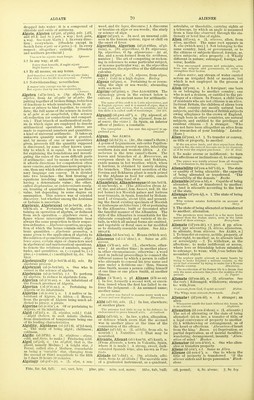
91/736 page 65
![bastrine positive, iu photog. the name given to a collodion positive in wliicli the film, after being colom-ed with dry pigments, is rendered permeable to varnish, and thus shows the colour in the collodion itself. Alabastrite (al-a-bas'trit), 11. [L. alahas- trites, alabaster. See Alabaster.] 1. A name sometimes given to alabaster. Hence— 2. A vase, box, or other vessel formed of alabaster. Alabastron (al-a-bas'tron), n. Same as Alabaster. Alabastrus (al-a-bas'trus), n. [L.L., from alabaster.] A name given to a flower-bud. It was originally applied to the rose-bud. Written also Alabastrxmi. Alack (a-lalc'), interj. [Probably a form of alas.] An exclamation expressive of sorrow. Alackl when once our grace^we have forg-ot, Nothing goes right. Sliak. Alackaday (a-lalc'a-da), interj. [Alas-the- day! Comp. Well-a-day!] An exclamation uttered to express regret or sorrow. Written also Alack-the-day. [Obsolescent.] Alack-the-day ... I pray you tell me is my boy alive or dead. Skak. Alacrify (a-lak'ri-fi), v. t. [L. alacer, alacris, cheerful, and facio, to make.] To make cheerful; to rouse to action; to excite. AlacriOUS (a-lak'ri-us), a. Cheerful; lively. 'Twere well if we were a little more alacriotcs and exact in the performance of the duty. Hammond. Alacriously (a-lak'ri-us-li), adv. Cheerfully. Alacriousness (a-lak'ri-us-nes), n. Brisk- ness. ' To infuse some life, some alacrious- ness into you.' Hammond. Alacrity (a-lak'ri-ti), n. [L. alacritas, from alacer, alacris, cheerful.] Cheerfulness; gaiety; sprightliness; more usually, a cheer- ful readiness or promptitude to do some act; cheerful willingness; as, the soldiers advanced with alacrity to meet the enemy. I have not that alacrity of spirits Nor cheer of mind that I was wont to have. Shak. Alactaga (a-lak'ta-ga), n. The jumping hare of Kussia and Central Asia, a rodent of the family Dipodida; or jerboas. Aladdinist (a-lad'in-ist), n. [From ^Zndcim, a learned divine under Mohammed II. and Bajazed II.] A freethinker among the Mo- hammedans. A-la-grecque, A-la-grec (a-la-grek). [Fr., after the Greek fashion.] In arch, a name for one of the varieties of the fret ornament, used for rimning frelzes, borders, &c., and A-la-grecque. frequently seen in ancient Uoman pave- ments. Alameda (a-la-me'da), n. [Sp.] A public walk planted with trees. A-la-mi-re (a-la-me'ra), n. [A, la, mi, re, notes on the musical scale.] In music, the name of the note A in the acute and super- acute hexachords of Guido Aretino's system of notation. Alamodality (al'a-mo-dali-ti), n. Confor- mity to the prevailing mode or fashion of the times. [Rare.] Alamode (a-la-mod'), adv. [Fr. d la mode, after the fashion. ] According to the fashion or prevailing mode: sometimes used as an adjective; as, ' alamode beef-chops.' Mac- aulay. Alamode (a-la-modO, n. A thin glossy silk for hoods, scarfs, <fec. A-la-mort (a-la-morf), a. [Fr., to, at, or after the manner of death, formed on the type of a-la-mode; or a corruption of all amort. The corresponding phrase all alive gives probability to the latter suggestion. See Amort.] In a half-dead or die-away condition ; depressed; melancholy. 'Tis wrong to bring into a mixed resort, What malces some sick and others a-la-mort. Coiuper. Aland t (a-landO, adv. [Prefix a, at or on, and land.] At or on land. And in mid ocean left them moored aland. Dryden. Aland,t Alaun.t n. [Sp. alano.] A kind of mastiff chiefly used for hunting the boar. Around his char there wenten white alauns Twenty and mo, as gret as any stere. To hunten at the leon or the dere. Chaucer. Alane (a-lanO, adv. Alone. [Scotch.] Alant (al'ant), n. [See Aland.] In her. a mastiff dog Mith short ears. Alantln, Alantlne (a-lan'tin), n. [G. alant, elecampane.] An amylaceous or starchy substance obtained from elecampane; inulin (which see). Alar (a'lar), (i. [L. ato, a wing. ] Pertaining to or having wings or alse. Alargedt (a-larjd'), pp. 1. Given largely.— 2. Enlarged. Wickliffe. Alaria (a-Ia'ri-a), n. [L. ala, a wing.] A genus of Algse, inhabiting the colder parts of the Atlantic and Pacific Oceans. The membranous frond is from 3 to 20 feet long and has a thick midrib. A. esculenta is variously called badderlocks, henware, or ■muslins. The nutritious midrib, stripped of the membranes on each side, is eaten. See BADDERLOCKS. Alarm (a-larm'), n. [Fr. alarme, alarm, from It. all'arme,-!,. ad arma, to arms. The Dan. larm and G. Idrm, noise, are from the same source.] 1. A summons to arms, as on the approach of an enemy; any sound, outcry, or information intended to give notice of approaching danger. ' Sound an alarm in my holy mountain.' Joel ii. 1.— 2. A hostile attack; a tumult; a broil; a dis- turbance. Remove your siege from my unyielding heart; To love's alarms it will not ope the gate. Shak. Crowds of rivals for thy mother's charms Thy palace fill with insults and alaryns. Pope. 3. A sudden fear or painful suspense excited by an apprehension of danger; apprehension; terror; as, there is nothing in his illness to cause alarm.—4. A mechanical contrivance, in the character of a clock or watch, for awakening persons from sleep or rousing their attention.—5. In fencing, an appeal or challenge.—Alarm, Terror, Consternatioyi. Alarm is a sudden shock of fear agitating the feelings and especially arising from some danger to ourselves or others dear to us; ter- ror, excessive fear, affecting the understand- ing and the will, though not necessarily ac- companied by any apprehension of danger— it might be caused by some supposed super- natural appearance for instance; consterna- tion, overwhelming fear accompanied with a certain amount of astonishment, caused by something both terrible and unexpected, completely paralyzing the mental faculties. Syn. Fright, affright, terror, consternation, dismay, agitation, disquiet, disquietude. Alarm (a-iarm'), v.t. 1. To call to arms for defence; to give notice of danger; to rouse to vigilance and exertions for safety.—2. To surprise with apprehension of danger; to disturb with terror; to fill with anxiety by the prospect of evil. ' When rage misguides me, or when fear alarms.' Tickell. Alarm-t)ell (a-larm'bel), n. A bell that gives notice of danger, as the approach of an enemy, fire, &c. 'On the gates alarm- bells or watch-bells. Hilton. Alarm-clock (a-larm'klok), n. A clock which can be so set as to ring loudly at a particular hour, to wake from sleep or ex- cite attention. Alarmed (a-larmd'), a. Indicating alami; as, an alarmed look. Alarm-gauge (a-larm'gaj), n. An auto- matic contrivance in a steam-engine by wliich notice is given when the pressure of steam becomes too high, or the water too low in the boiler. Alarm-gun (a-larm'gun), n. A gun fiired as a signal of alarm. Alarming (a-larm'ing), a. Calculated to rouse alarm; of such a nature as to excite apprehension; as, on the fifth day alarming symptoms appeared. Alarmingly (a-larm'ing-li), adv. In an alarming manner; with alarm; in a manner to excite apprehension. This mode of travelling . . . seemed to our ances- tors wonderfully, and indeed, alarmiyigly rapid. Macanlay. Alarmist (a-larm'ist), n. One that excites alarm; one who is prone to take alarm, and to circulate and exaggerate any sort of bad news, particularly in regard to political matters. He was frightened into a fanatical royalist, and became one of the most extravagant alarmists of those wretched times. Macaitlay. Alarm-post (a-larm'p6st), n. A place to which troops are to repair in case of an alarm. Alarm-watcll (a-larm'woch), n. A watch that can be so set as to strike rapidly at a pre-arranged hour, to awaken from sleep or rouse attention. You shall have a gold alarm-watch, which, as there may be cause, shall awake you. Sir T. Herbert. Alarum (a-lar'um), n. [A corruption of alar^n.] 1. A watchword or signal indicat- ing danger or the nearness of an enemy. Strike alarum, drums. Shak. 2. Any loud noise or disturbance. ' Though it pass your patience and mine to endure her loud alarums.' Shak. Alarum (a-lar'um), v.t. To rouse to a sense of danger, as by sounding an alarm; to alarm. Withered murder Alarum'd by his sentinel the wolf {Whose howl's his watch), thus with his stealthy pace Moves like a ghost. Shak. Alarum-bell (a-lar'um-bel), n. Same as Alarm-bell. Shak. Alary (a'la-ri), a. [L. ala, a wing. ] 1. Relat- ing to the wings of birds and insects. ' The alary system of insects.' Wollaston.—2. In anat. and bot. wing-shaped. Alas (a-las'), exclam. [Fr. hilas, O.Fr. alas, ha las, hailas; Pr. ailas, fem. ai lassa; It. ahi lasso—ahi, ah, and lasso, weary, mifor- tunate, from L. lassus, weary.] An excla- mation expressive of sorrow, grief, pity, concern, or apprehension of evil: in old writers sometimes followed by day or while; as, alas the day, alas the while. See Alack- aday. Alas the day! I never gave him cause. Shak. For pale and wan he was {alas the whiles) Spenser. Alasmodon (a-las'mo-don), n. A genus of bivalve molluscs, the river pearl-mussels of North America. Alatet (a-laf), adv. [Prefix a, of, and late.] Of late; lately. Where cliilling frosts alate did nip. There flasheth now a fire. Greene. Alated, Alate (a'liit-ed, a'liit), a. [L. ala, a, wing ; alatus, winged. ] Winged; having membranous expansions like wings. Spe- cifically, (a) in bot. applied to stems and leaf-stalks when the edges or angles are longitudinally expanded into leaf-like bor- ders. (6) In conch, applied to shells having an expanded lip. A latere (a lat'er-e). [L.] From the side; from beside a person: used in the jihrase Legate a latere. See under Legate. Alatern, Alaternus (al'a-tern, al-a-ter'nus), n. A species of Rhamnus or buckthorn often planted in English town gardens; Rhamnus Alaternus. See Rhamnus. Alauda(a-la'da), n. The genus of insessorial bii'ds to which the lark belongs, containing many species, found in all parts of the globe, and distinguished everywhere for their vigi- lance and their singing on the wing when soaring upward in the air. See Lark. Alaudid83 (a-la'di- de), n. pi. The lark family. (See LARK.) The larks are some- times classed as a sub - family (Alau- dinie) of the finches (Fringillids). Alb, Albe (alb), n. [L. alba, white {ves- tis, garment,under- stood).] A clerical vestment worn by Roman Catholic priests while offici- ating in the more solemn functions of the divine office. It is a long robe of white linen reach- ing to the feet, bound round the Alb. waist by a cincture, and fitting more closely to the body than the surplice. In front at the foot, embroidery or orphrey- work, of a form usually square or oblong, is attached, and at the wrists several enrich- ments appear. These ornaments are called the apparels of the alb. It was originally the common dress of ecclesiastics. Each priest adorn'd was in a surplice white. The bishops donn'd their albs and copes of state. Fairjax. Albacore (allja-kor), n. [Sp. albacora, Pg. albacor, albacora, Fr. albicore, from Ar. bakr, a young camel, a young cow or heifei', and the article al.] A name given to sev- eral fishes of the tunny or mackerel kind, especially to the Pacific tunny (Thynnus Pacificus). Written also Albicore. Albadara (al-ba-da'ra), n. The Arabian cabalistic name for the sesamoid joint of the great toe, to which extraordinary gifts were anciently ascribed. ch, cftain; VOL. I. ch. Sc. loch; g, go; j, job; ii, Fr. to?i; sing; TH, then; th, thin; w, wig; wh, i zh, azure.—See KEY. 5](https://iiif.wellcomecollection.org/image/b22652000_0001_0091.jp2/full/800%2C/0/default.jpg)