Volume 1
The imperial dictionary of the English language : a complete encyclopedic lexicon, literary, scientific, and technological / by John Ogilvie.
- Ogilvie, John
- Date:
- 1885
Licence: Public Domain Mark
Credit: The imperial dictionary of the English language : a complete encyclopedic lexicon, literary, scientific, and technological / by John Ogilvie. Source: Wellcome Collection.
Provider: This material has been provided by Royal College of Physicians, London. The original may be consulted at Royal College of Physicians, London.
86/736 page 60
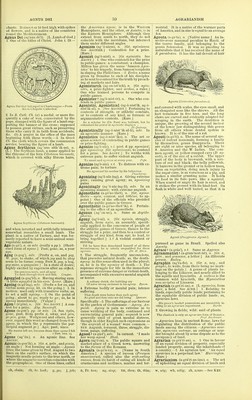
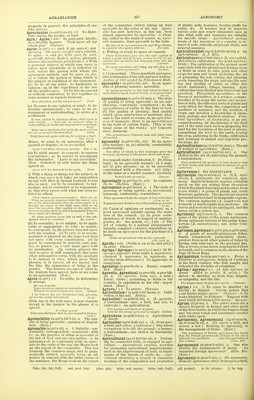
![property in general; the principles of one who does so. Agrarianize (a-gra'ri-an-iz), v.t. To distri- bute aiiioii'4 the people, as land. Agre,t Agree,t alio. In good part; kindly; in a friendly manner. ' Took agree all my whole play.' Chaucer. Agree (a-gre'), v.i. pret. & pp. agreed: ppr. agreeing. [Fr. agreer, to give one's consent, to agree —a, and gre, O.Fr. gret, Pr. grat, good-will, favour, from L. gratus, pleasant, whence aXsogratitude,gratcfulj&c] l.With a personal subject, in which case agree is either used absolutely or is followed by loith before the person with whom the agreement subsists, and by upon, on, for, or to before the person or thing which is the subject or condition of the agreement. («.) To be of one mind; to harmonize in opinion; as, in the expediency of the law all the parties agree. (&) To live in concord or without contention: to live together in some manner as regards harmony. How dost thou and thy master agrcci Shak. (c) To come to one opinion or mind; to de- termine unanimously; to come to an ar- rangement or understanding; to arrive at a settlement. If men, skilled in chyniical affairs, shall agree to •write clearly, . . . they will be reduced either to write nothing, or books that may teach us something. Boyle. Make not a city feast of it, to let the meat cool ere -we can agree tip07i the first place. Shak. Didst thou not ag7-ee with me for apennyaday? Mat. XX. 13. Hence, to come to an agreement after a quarrel or dispute; to be reconciled. Agree -with thine adversary quickly. Mat. v. 25. ■id) To yield assent; to consent; to express ■concurrence; as, he agreed to accompany the ambassador. 'Agree to any covenants.' ShaJc. Followed by viith before the thing agreed on. Agree -with his demands to the point. Shab. 2. With a thing or things for the subject, in which case agree now takes no preposition except with after it, though formerly to was also so used. («) To be consistent; to har- monize; not to contradict or be repugnant; as, this story agrees with what has been re- lated by others. Their witness agreed not together. Mark xiv. 56. When we possess ourselves with the utmost secu- rity of the demonstration, that the three angles of a triangle are equal to two right ones, what do we more but perceive, that equality to two right ones does necessarily agree to, and is inseparable from the three angles of a triangle. Locke. All these qualities agree just as well to the oak, against which he contends. Bp. LoivCti. (b) To resemble; to be similar; to be appli- cable or appropriate ; to tally ; to match; to correspond; as, the picture does not agree icith the original, (c) To suit; to be accom- modated or adapted; as, the same food does not agree loith every constitution, (d) In gram, to correspond in number, case, gen- der, or person; as, a vei'b must agree with its nominative. [In certain phrases the verb to agree is still conjugated, like some other intransitive verbs, with the auxiliary to be instead of have, which gives these phrases, to he agreed, all are agreed, and the like, the appearance of being in the passive. 'The traitors are agreed' (that is, the traitors have agreed, have or are come to an agreement). Shah.] Jlgree (a-gre'), !).f. To settle; to determine; to arrange. He saw from far .... Some troublous uprore or contentious fray. Whereto he drew in haste it to agi-ee. Spenser. I do believe the two Pretenders had, privately, agreed the matter beforehand. Gray. [This use of the verb agree is now obsolete except in the passive in the phrase it is agreed. It is thus agreed That peaceful truce shall be proclaimed in France. Shak.] Agreeability (a-gre'a-bili-ti), n. The qua- lity of being agreeable; easiness of disposi- tion. [Rare.] Agreeable (a-gre'a-bl), a. 1. Suitable; con- formable; correspondent; consistent: with to; as, the practice of virtue is agreeable to the law of God and our own nature.—2. In pursuance of; in conformity with; as, agree- able to the order of the day, the House took np the report of the committee. This was formerly the common usage, and is gram- matically correct, agreeable being an ad- jective in concord with the latter clause of the sentence: the House took up the report of the committee (which taking up was) agreeable to the order of the day. Agree- able has now, however, in this use, been almost superseded by agreeably.—Z. Pleas- ing, either to the mind or senses; as, agree- able manners; fruit agreeable to the taste. My idea of an agreeable person, said Hugo Bohun, is a person who agrees with me. Disraeli. 4. Willing or ready to agree or consent. These Frenchmen give unto the said captain of Calais a great sum of money, so that he will be but content and agreeable that they may enter into the said town. Lati7ner. I'll meet you there, and bring my wife that is to be. . . . You're agreeable / Dickens. 5. t Concordant. ' These manifold and agree- able testimonies of the olde and new writers.' Author of 1596 quoted by Fitzedward Hall, Agreeable t (a-gre'a-bl), adv. In an agree- able or pleasing manner; agreeably. To speak agreeable to him with whom we deal, is more than to speak in good words, or in good order. Baco7i. Agreeableness (a-gre'a-bl-nes), n. The state or quality of being agreeable; as, («) suit- ableness ; conformity; consistency; as, the agreeahleness of virtue to the laws of God. (6) The quality of pleasing; that quality which gives satisfaction or moderate plea- sure to the mind or senses; as, an agreeahle- ness of manners; there is an agreeahleness in the taste of certain fruits. [This is the usual sense of the word.] (c)! Concord- ance; harmony. The agreeablejtess between man and other parts of creation. Grew, Agreeably (a-gre'a-bli), adv. In an agree- able manner; as, (a) suitably; consistently; conformably. The effect of which is, that marriages grow less frequent, agreeably to the maxim above laid down. Paley. See remark under Agreeable, 2. (6) Pleas- ingly ; in an agreeable manner; in a man- ner to give pleasure; as, to be agreeably entertained with a discourse, (c) t Alike ; in the same or a similar manner; similarly. Armed both agreeably. Spenser. Agreeingly (a-gre'ing-Ii), adv. In conform- ity to. Sheldon. [Rare.] Agreement (a-gre'ment), n. 1. The state of agreeing or being agreed; as, (a) concord; harmony; conformity; resemblance. what agreement hath the temple of God with idols ? 2 Cor. vi. i6. Expansion and duration have this farther agreeme^it. Locke. (fc) Union of opinions or sentiments; as, a good agreement subsists among the mem- bers of the council, (c) In gram, corre- spondence of words in respect of number, gender, &c. See Agree, v.i., 2 (d).—2. The act of coming to a mutual arrangement; bargain; compact; contract; stipulation; as, he made an agreement for the purchase of a house. Make an agreeineiit with me by a present. 2 Ki. xviii. 3r. Agrefe.t adv. [Prefix a, on or in, and grief.] In grief. Chaucer. Agrege, t Agregge t (a-grej'),t;. t. and i. [0. Fr. agreger, aggreger, from rustic L. aggraviare, classical L. aggravare, to aggravate, as abridge from abbreviare.] To aggravate; to exaggerate. Agrestial (a-gres'ti-al), a. Rustic; countri- fied. [Rare.] Agrestic, Agrestical (a-gres'tik, a-gres'tik- al), a. [L. agrestis, from ager, a field.] Rural; rustic; pertaining to fields or the country, in opposition to the city; unpol- ished. [Rare. ] Agreve,t f .*. To grieve. Chaucer. Agricolation t (a-grik'o-lashon), n. Culti- vation of tlie soil. Bailey. Agricolistt (a-gTik'61-ist), n. [L. agricola, a liusbandman—ager, a field, and colo, to | cultivate.] An agriculturist. The pasture and the food of plants First let the young agricolist be taught. Dodstey. Agricolous (a-grik'6-lus), a. Agricultural. S. Smith. Agricultor (ag'ri-kult-or), n. [L., from ager, a field, and cultor, a cultivator. ] One whose occupation is to till tlie ground; a farmer; a husbandman; one skilled in husbandry. [Rare.] Agricultural (ag-ri-kul'ttir-al), a. Pertain- ing to, connected with, or engaged in agri- culture. — Agricultural societies, societies for promoting agricultural improvements, such as the improvement of land, of imple- ments, of the breeds of cattle, &c.—Agri- cultural chemistry, a branch of chemistry treating of the composition and properties of plants, soils, manures, feeding-stuffs for cattle, &c. It teaches how to improve barren soils and renew exhausted ones, as also what soils and manures are suitable for specific crops. — Ayricidtural geology treats of the resources of a country in re- spect of soils, subsoils, subjacent strata, and mineral manures. Agriculturalist (ag-ri-kul'tur-al-ist), n. An agriculturist. A. J. Ellis. Agriculture (ag'ri-kul-tur),?i. [X. o(/(;r,a field, awAcultura, cultivation. .See Acrid and Cul- ture. ] The cultivation of the ground, more especially with the plough and in large areas or fields in order to raise grain and other crops for man and beast, including the art of preparing the soil, sowing and planting seeds, removing the crops, and also the rais- ing and feeding of cattle or other live stock; husbandry; tillage; farming. Agri- culture has been divided into theoretical and practical. Theoretical agricidture, or the theory of agriculture, is a science, compre- hending in its scope the nature and proper- ties of soils, the different sorts of plants and seeds fitted for them, the composition and qualities of manures, and the rotation of crops, and involves a knowledge of chem- istry, geology, and kindred sciences. Prac- tical agriculture, or husbandry, is an ai't, comprehending all the labours of the field and of the farm-yard, such as preparing tlie land for the reception of the seed or plants, committing the seed to the eartli, rearing the crop, gathering in the fruits, cultivation and economy of animal and vegetable pro- ductions, &c. Agriculturism(ag-ri-kul'tflr-izm),'/i. The art or science of agriculture. [Rare.] Agriculturist (ag-ri-kul'tur-ist), n. One skilled in the art of cultivating the ground; a husbandman. They preferred the produce of their flocks to that of their lands, and were shepherds instead of agri- culturists. Buckle. Agrievance.t See Aggrievance. Agrimonia (ag-ri-mo'ni-a), n. [L.L. agri- monia, L. argemonia. Gr. argemone, agri- mony. Said to be from Gr. argema, a whitish speck on the eye arising from ulceration (which this plant was supposed to cure), from argos, white. ] A genus of plants, nat. order Rosacese; agrimony. The species are slender perennial herbs found in temperate regions. The common agrimony {A. eupatoria) was formerly of much repute as a medicine. Its leaves and root-stock are astringent, and the latter yields a yellow dye. Agrimony (ag^'ri-mon-i), n. The common name of the plants of the genus Agrimonia. Hemp agrimony belongs to the genus Eupa- torium {E. cannabinum), nat. order Com- positae. Agriopes, Agriopus (a-gri'6-pes, a-gri'6-pus), n. A genus of acanthopterygious fishes, family Cataphracti, particularly distin- guished from most other genera of fishes by having only nine rays in the pectoral fins. The j1. tttrvusfir sea-horse, is upwards of 2 feet in length, and is common on tlie shores of the Cape of Good Hope. Agrippinian (a-grip-pin'i-an), n. Eccles. a follower of Agrippinus, bishop of Carthage in the third century, who first taught and defended the doctrine of rebaptism. Agrise,t Agryse.t v.i. [A. Sax. dgrtsan, to dread. Allied to grlslic, E. grisly.] To shiver; to shudder, as from fear, disgust, or sympathy, and the hke. The kinges herte of pitee gan agrise. Chaucer. Agrise.t v.t. l. To cause to shudder; to terrify; to disgust. ' Swiche peines that your hertes might agrise.' Chaucer.—2. To make frightful; to disfigure. 'Engrost with mud which did them fowle agrise.' S2)enser. Agrom (a'grom), n. The native name for a disease frequent in Bengal and otlier parts of the East Indies, in which the tongue chaps and becomes rough and sometimes covered with white spots. Agronomic, Agronomical (ag-io-nom'ik, ag-ro-nom'ik-al), a. [Gr. agros, a field, and nomos, a law.] Relating to agronomy, or the management of farms. [Rare.] The experience of British agriculture has shown that the I^rench agrottoinical division of the soil is infinitely less profitable . . . than that prevailing in this country. Edin. Rev. Agronomist (a-gron'6-mist), n. One who studies the management of farms. ' An impartial foreign agronomist.' Edin. Rev. [Rare.] Agronomy (a-gron'6-nii), n. [Fr. agronomic, from Gr. agronomos, rural, from agros, a field.](https://iiif.wellcomecollection.org/image/b22652000_0001_0086.jp2/full/800%2C/0/default.jpg)
 No text description is available for this image
 No text description is available for this image
 No text description is available for this image