Volume 1
The imperial dictionary of the English language : a complete encyclopedic lexicon, literary, scientific, and technological / by John Ogilvie.
- Ogilvie, John
- Date:
- 1885
Licence: Public Domain Mark
Credit: The imperial dictionary of the English language : a complete encyclopedic lexicon, literary, scientific, and technological / by John Ogilvie. Source: Wellcome Collection.
Provider: This material has been provided by Royal College of Physicians, London. The original may be consulted at Royal College of Physicians, London.
85/736 page 59
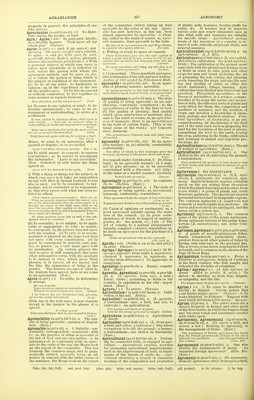
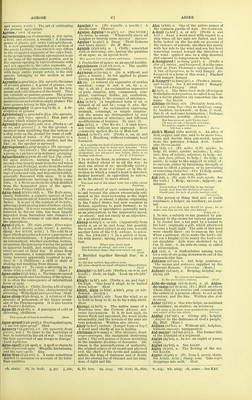
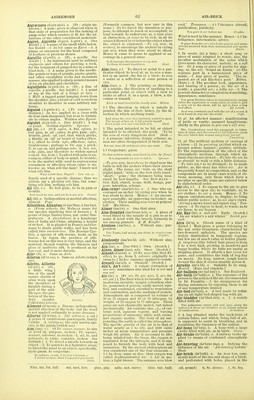
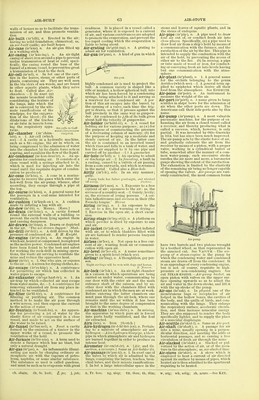
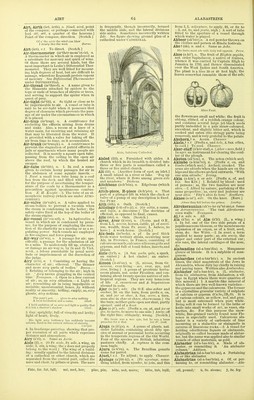
![chaste. It rises 8 or 10 feet high with spikes of fiowers, and is a native of the countries round the Mediterranean. Agnus Dei (at;'nu3 de'i). [L. ,Lamb of God. ] 1. One of thelitles of Christ. John i. 29.— Agnus Dei that belongec^ to Charlemagne.—From Ai.K-la-Chapelle Cathedral. 2. In R. Cath. Ch. (a) a medal, or more fre- quently a cake of wax, consecrated by the pope, stamped witli the figure of a lamb sup- porting the banner of the cross; supposed to possess great virtues, such as preserving tliose who carry it in faith from accidents, (tc. (!)) A prayer in the office of the mass beginning witli these words. — 3. In Greek Ch. the cloth which covers the communion service, l^earing the figure of a lamb. Agnus Scytliicus (ag'nus sith'ik-us), ti. [L.] The .Scytliian lamb, a name applied to the rhizome of the feru Cibotiuin barometz, which is covered with silky fibrous hairs, Agnus Scythicus i Ciboiium barometz). and when inverted and artificially trimmed somewhat resembles a small lamb. The plant is a native of Tartary, and was for- merly reported to have a semi-animal semi- vegetable nature. Ago (a-go'), «. or adv. (really a pp.). [Short- ened form of arjone.] Past; gone; as, a year ago. Agog (a-gog'), adv. [Prefix a, on, and gor/, ^V. gogi, to shake, of which joi; and Sc. shog seem to be forms; comp. Prov.E. gog, a bog, Sror;-mire, a quagmire.] In a state of desire; highly excited by eagerness after an object. Six precious souls, and all a^o^ To dash through thick and thin. Co-wper. Agoggled (a-gog'ld), a. Having staring eyes. 'A little agoggled in his eyes.' i«tier. [Rare.] Agoing (a-go'ing), adv. [Prefix a for on, and verbal noun going, lit. on the going.] 1. In motion: used only with transitive verbs; as, to set a mill agoing.—2. On the point of going; about to go; ready to go; as, he is agoing immediately. [Vulgar.] Agon t (a'gon), )i. [Gr. See Agony.] A con- test for a prize. Abp. Sancroft. Agone (a-gonO, pp. or adv. [A. Sax. dgdn, gone, past, from prefix A, away, and gdn, ge-gun, gone. Wedgwood and otliers, how- ever, regard this word as changed from O.E. ygone, in which the y represents the par- ticipial augment gre. ] Ago; past; since. _My master left me, because three days agone I fell sick. I Sam. xxx. 13. Agone (ag'on), n. An agonic line. See AGONIC. Agonic (a-gon'ik), a. [Gr. a, priv., and (?o)iia, an angle.] Not forming an angle.—.Xj/onic lines, the name given by Prof. August to two lines on the earth's surface, on which the magnetic needle points to the true north, or where the magnetic meridian coincides with the geographical. One of these lines, called the American agone, is in the Western Hemisphere, and the other, ov Asia tic, is in the Eastern Hemisphere. Although they extend from south to north, they do not coincide with the meridians, but intersect them under different angles. ' Agonism (ag'6-nizm), n. [Gr. agonismos. See AGONIZE.] Contention for a prize. [Rare. ] Agonist (ag'6-nist), n. [Gr. agonisUs. See Agony.] l. One who contends for the prize in public games; a combatant; a champion. Hilton has given the name ' Samson Jj/oii- istes' to his tragedy, from Samson's exploits in slaying the Philistines.—2. Eccles. a name given by Donatus to such of his disciples \ as he sent to contend for the truth by preach- ing at markets and fairs. Agonistarch (ag-on-ist'ark), n. [Gr. agon- istes, a prize-fighter, and archos, a ruler.] I One who trained persons to compete in t public games. Agonister t (ag'o-nist-er), n. One who con- tends in public games. Agonistic, Agonistical (ag-6-nist'ik, ag-o- nist'ik-al), a. [See AGONIST.] Pertaining to contests of strength, or athletic combats, or to contests of any kind, as forensic or argmiientative contests. [Rare.] As a scholar he (Dr. Parr) was brilliant, but he consumed his power in agonistic displays- i Z>e Quincey. Agonistically (ag-6-nist'ik-al-li), adv. In an agonistic manner. [Rare.] Agonistics (ag-6-nist'iks), n. The art or iiuasi-seience of contending in public games or prize-fighting. Agonize (ag'o-niz), u. i. pret. & pp. agonized; ppr. agonizing. [Gr. agonizomai, to contend for a prize. See Agony.] To writhe with extreme pain; to suffer violent anguish. To smart and ago>iize at every pore. Fofe. Agonize (ag-'o-niz), V. t. To distress with ex- treme pain; to torture. He agonized his mother by his behaviour. T/tacke?'ay. Agonizing (ag'6-niz-ing), a. Giving extreme pain; causing great agony; as, agonizing pains. Agonizingly (ag'6-niz-ing-li), adv. In an agonizing manner; with extreme anguish. Agonotliete (a-go'no-thet), n. [Gr. agono- thetes — agOn, contest, and tithemi, to ap- point.] One of the officials who presided over the public games in Greece. Agonothetic (a-g6'no-thetik), a. Pertain- ing to the office of an agonothete. Agonus (ag'on-us), n. Same as Aspido- phorus. Agony (ag'o-ni), n. [Gr. agonia, struggle, anguisli, from agOn, an assembly, specifi- cally applied to the concourse of people at the athletic games of Greece, thence to the struggle for a prize, and then to a contest or struggle of any kind, from ago, to lead, to bring together.] l.t A violent contest or striving. Till he have thus denudated himself of all these incumbrances, he is utterly unqualified for these agonies. Dr. H. More. 2. The struggle, frequently unconscious, that precedes natural death; as, the death- agony: in this sense often used in the plural; as, he is in the agonies of death. — 3. The supreme struggle for life in the immediate presence of extreme danger or violent death, accompanied with excessive mental anguish or terror. A solitary shriek, the bubbling cry Of some strong swimmer in his agony. Byron. i. Extreme bodily or mental pain; intense sufl^ering. That death were better than such agony As grief and fury unto me did bring. Spenser. Specifically—5. The sufferings of our Saviour in the garden of Gethsemane.—Agony, An- guish. Agony is pain so extreme as to cause writhing of the body, continued and excruciating general pain ; anguish is now generally used of great mental distress, though in older English such expressions as 'the anguish of a wound' were common.— Syn. Anguish, torment, throe, struggle, dis- tress, pangs, suffering. AgOOdt (a-gud'), drfi'. In earnest. 'I made her weep af/ood.' Shah. Agora (ag'o-ra), ?i. The public square and market-place of a Greek town, answering to the forum of the Romans. Agouara (a-go'a-ra), n. [Name in South America.] A species of racoon (Procyon cancrivorus), called also the crab-eating racoon, from its habit of eating all kinds of \ crustaceans and molluscs, marine and ter- restrial. It is a native of the warmer parts of America, and in size is equal to an average fox. Agouta (a-go'ta), n. [Native name.] An in- sectivorous mammal peculiar to Hayti, of the tanrec family, and belonging to the genus Solenodon. It was so puzzling to naturalists that it has received the name of S. paradoxus. It has the tail devoid of hair Agouta (So/enodon paradox/is). and covered with scales, the eyes small, and an elongated nose like the shrews. All the feet terminate in five toes, and the long claws are curved and evidently adapted for scraping in the earth. The dentition is unique, the grooving of the second incisor of the lower jaw distinguishing this genus from all others whose dental system is known. It is of the size of a I'at. Agouti (a-go'ti), n. The name of several spe- cies of rodent mammals, forming a family by themselves, genus Dasyprocta. There are eight or nine species, all belonging to S. America and the W. Indies. The com- mon agouti, or yellow-rumped cavy (D. ag- outi), is of the size of a ralibit. The upper part of the body is brownish, with a mix- ture of red and black; the belly yellowish. It burrows in the ground or in hollow trees, lives on vegetables, doing much injury to the sugar-cane, is as voracious as a pig, and makes a similar grunting noise. It holds its food in its fore-paws, like a squirrel. When scared or angry its hair is erect, and it strikes the ground with its hind-feet. Its flesh is white and well tasted, so that it is Agouti {Dasyprocta Agoitti). pursued as game in Brazil. Spelled also Agority. Agracet (a-.gras'), v.t. Same as Aggrace. Agrammatistt (a-gram'mat-ist), n. [Gr. a, priv., and gramma, a letter.] An illiterate person. Bailey. Agraphis (ag'ra-fis), n. [Gr. a, neg., and graphn, to write, from there being no mark- ings on the petals.] A genus of plants be- longing to the Liliacese, and nearly allied to the squills and hyacinths. A. nutans i.s tlie common wild hyacinth, the Ilyacintlius non-soiptus of Linnaeus. Agrarian (a-gra'ri-an), a. [L. agrarius, from agcr, a field. See Acre.] 1. Relating to lands, especially public lands; pertaining to the equitable division of public lands; as, agrarian laws. His grace's landed possessions are irresistibly in- viting to an agrarian experiment. Bitrke. 2. Growing in fields; wild: said of plants. The charlock is only an agrarian form of Brassica. Prof. Buckman. —Agrarian laws, in ancient Rome, laws for regulating the distribution of the iniblic lands among the citizens.—Agrarian mur- der, agrarian outrage, an outrage or mur- der brought about by some dispute as to the occupancy of land. Agrarian (a-gra'ri-an), n. 1. One in favour of an ecptal division of property, especially landed property, among the inhabitants of a country.—2. An agrarian law. ' An equal agrarian is a perpetual law. Harrington. [Rare.] Agrarianism (a-gra'ri-an-izm), n. The act of upholding an equal division of lands and](https://iiif.wellcomecollection.org/image/b22652000_0001_0085.jp2/full/800%2C/0/default.jpg)