Volume 1
The imperial dictionary of the English language : a complete encyclopedic lexicon, literary, scientific, and technological / by John Ogilvie.
- Ogilvie, John
- Date:
- 1885
Licence: Public Domain Mark
Credit: The imperial dictionary of the English language : a complete encyclopedic lexicon, literary, scientific, and technological / by John Ogilvie. Source: Wellcome Collection.
Provider: This material has been provided by Royal College of Physicians, London. The original may be consulted at Royal College of Physicians, London.
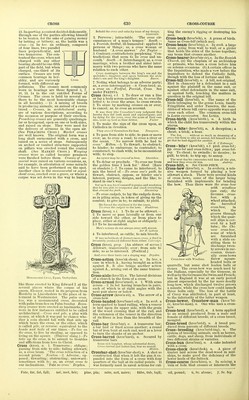
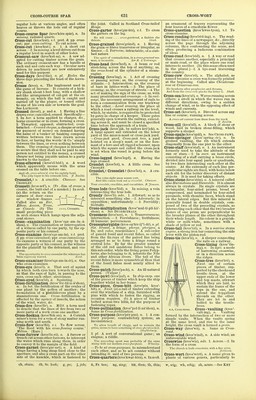
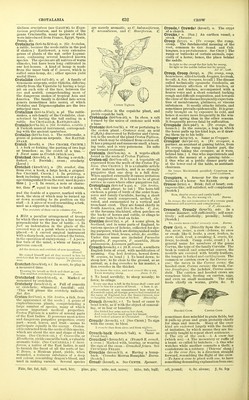
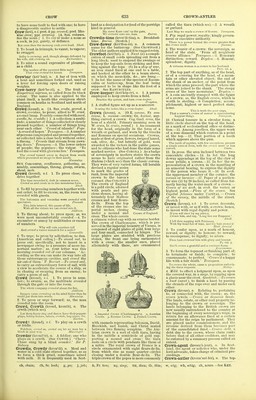
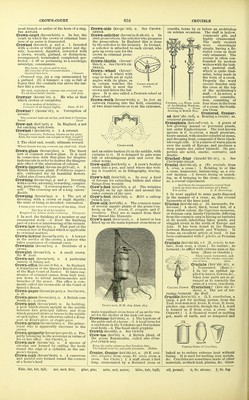
657/736 page 631
![regular lode at various angles, and often heaves or throws the lode out of regular course. Cross-course Spar (kros'kors spar), n. In mining, radiated quartz. Cross-cut (Ivros'lcut), V. t. pret. & pp. cross- cut; ppr. cross-cuttinrj. To cut across. Cross-cut (Icros'kut), n. 1. A short cut across. —2. Inmininij, a level driven out from a regular level in search of other lodes. Crosscut-saw (kros'kut-sa), n. A saw ad- apted for cutting timber across the grain. The ordinary crosscut-saw has a handle at each end and cuts each way. Circular saws driven by machinery are now extensively used for this purpose. Cross-days (kros'daz), n. pi. Eccles. the three days preceding the feast of the Ascen- sion. Crosse (kros), n. The implement used in the game of lacrosse. It consists of a hick- ory shank about 5 feet long, with a shallow net-like arrangement of cat-gut at the ex- tremity, on whicli the ball is cauglit and carried off by the player, or tossed either to one of his own side or towards the goal. See Laokos.se. Crossed (krost), p. and a. 1. Having a line drawn over; cancelled; erased. Specifically— 2. In her. a term applied to charges, &c., borne crosswise or in cross; forming a cross. 3. Thwarted; opposed; obstructed; coun- teracted. —Crossed cheque, a cheque or order for payment of money on demand liaving the name of a banker or banking company written between two lines drawn across its face, or having the words '& Co.' simply between the lines, or even nothing between them. The crossing of cheques is intended to secure tliat they sliall not be paid to any person not entitled to the money, a crossed cheque not being payable unless to a party known to the banker. Cross-elbowed (kros'el-bod), a. A word which apparently means with tlie arms crossed on the table before one. And oft, cross-elboivd, o'er his nightly bowl. The jolly toper to his comrade tells. J. Baillie. Crosselet.t n. A crucible. Chaucer. See Crosslet. Crossett (kros-sef), n. [Fr., dim. of crosse, a crosier, tlie butt-end of a musket. ] In arch, (a) the return on the corners of door-cases or window - frames. Called also an Ear, Elboic, Ancon, Truss, or Console. (6) Tlie cccc, Crossetts. small projecting piece in arch stones wliich liangs upon the adja- cent stones. Cross - examination ( kros' egz - am - In - a- shon), n. Tlie examination or interrogation of a witness called by one party, by the op- posite party or his counsel. Cross-examine (kros'egz-am-in), v.t. pret. & pp. cross-examined; ppr. cross-examining. To examine a witness of one party by the opposite party or his counsel, as tlie witness for the plaintiff by the defendant, and vice versa. The opportunity to cross-exayniite the witnesses has been expressly waived. Kent. Cross-examiner (kros'egs-am-in-er), n. One who cross-examines. Cross-eye (kros'i), n. That sort of squint by wliicli botli eyes turn towards the nose, so that the rays of light, in passing to the eyes, cross eacli otlier; strabismus. Cross-eyed (kros'id), a. Squinting. Cross-fertilisation (krosfer-til-iz-a'shon), n. In hot. the fertilisation of the ovules of one plant by the pollen of another; the fecundation of a pistilliferous plant by a staminiferous one. Cross-fertilisation is effected by the agency of insects, the action of the wind, water, &c. Cross-fire (kros'fir), n. Milit. a term used to denote tliat the lines of fire from two or more parts of a work cross one another. Cross-flookan (kros'flok-an), n. A Cornish miner's term for a vein of stony matter run- ning north and south. Cross-flow (kros'flo), v.i. To flow across. 'The flood with his cross-flowing course.' Milton. [Puare.] Cross-furrow (kros'fu-ro), n. A furrow or trench cut across other furrows, to intercept the water which runs along them, in order to convey it to the margin of the field. Cross-garnet (kros'giir-net), n. A kind of hinge having a long strap fixed close to the aperture, and also a cross part on the other side of the knuckle, which is fastened to the joint. Called in Scotland Cross-tailed Hinge. Cross-garter (kros'gar-tfer), v.t. To cross the garters on the leg. He will come . . . cress-gartered, a fashion she detests. Shak. Cross-grained (kros'griind), a. 1. Having the grain or fibres transverse or irregular, as timber.—2. Perverse; intractable; of a crab- bed nature. The spirit of contradiction, in a cross-grained wo- man, is incurable. Sir R. LEstrange. Cross-head (kros'hed), n. A beam or rod stretching across the top of anything; as, the cross-head of the cylinder of a steam- engine. Crossing (kros'ing), n. 1. Act of crossing or passing across; as, the crossing of the Atlantic—2. Intersection; as, the crossing of bars in lattice-work.—3. The place of crossing; as, tlie crossings of streets.—4. The act of making the sign of the cross; as, with many prostrations and crossings.—5. In rail- ways, the necessary arrangement of rails to form a communication from one trackway to the other.—Level crossing, the place at which a road crosses a railway on the level, which, by statute, is required to be protected by gates in charge of a keeper. These gates generally open towards the railway, extend- ing across it, and must be closed a specified time before the approach of a train. Cross-jack (kros'jak, by sailors kro'jek), 7i. A large square sail extended on the lower yard of the mizzen-mast or cross-jack yard. —Cross-jack yard. Cross-jack tree, a yard hoisted on a sloop's mast, or on the fore- mast of a fore-and-aft rigged schooner, upon which the square sail called the cross-jack is set when the vessel is going before the wind. Cross-legged (kros'legd), a. Having the legs crossed. Crosslet (kroslet), n. A little cross. See Croslet. Crosslet,! Crosselet t (kros'let), n. A cru- cible. The coles rig^ht anon weren yset. And this canon took out a crosselet. Chaucer. Your crosslets, crucibles, and cucurbites. B. yonson. Cross-lode (l^ros'lod), n. In mining, a vein intersecting the true lode. Crossly (kros'li), ado. 1. Athwart; so as to intersect something else.—2. Adversely; in opposition; unfortunately. — 3. Peevishly; fretfully. Cross-multiplication (krosmul-ti-pli-ka'- shon), n. See DUODECIMALS. Crossness (kros'nes), n. 1. Transverseness; intersection. — 2. Peevishness; fretfulness; ill humour; perverseness. CrossopterygidaB (kros-op'ter-iji-de), n. pi. [Gr. krossoi, a fringe, pteryx, pterygos, a fin, and eidos, resemblance.] A sub-order of ganoid fossil and recent fishes, so called from the fin-rays of the paired fins being arranged so as to form a fringe round a central lobe. By far the greater number of the old red sandstone fishes belong to this sub-order, while the living genus Polyp- terns, also belonging to it, inhabits the Nile and other African rivers. The tail of the recent fishes is more symmetrical than that of the fossil fishes most nearly allied to them. Cross-patch (l?ros'pach), n. An ill-natured person. [Vulgar] Cross-pawl (kros'pal), n. In ship-carp, one of the pieces of timber which keep the ship together whilst in her frame. Cross-piece, Cross-bitt (kros'pes, kros'- bit), n. Naut. (a) a rail of timber extending over the windlass of a ship, furnished with pins with which to fasten the rigging, as occasion requires, (b) A piece of timber bolted across two bitts, for the purpose of fastening ropes. Cross-pollination (krospol-li-na'shon), n. Same as Cross-fertilisation. Cross-purpose (kros'per-pus), n. 1. A con- trary purpose; contradictory system; an inconsistency. To allow benefit of cler^, and to restrain the press, seems to have something of cross-pKrposc in it. Shaftesbury. 2. pi. A sort of conversational game; an enigma; a riddle. The preceding sport was probably of the same stamp with our modern cross-pnrposes. IVhalley. —To he at a'oss-purposes, to misunderstand each other, and so to act counter without intending it: said of two persons. Cross-quarters (kros'kwar-terz), n. In arch. an ornament of tracery representing the four leaves of a cruciform flower. Cross-question (kros'kwes-tyon), v.t. To cross-examine. Cross-reading (kros'red-ing), n. The read- ing of the lines of a newspaper, &c., directly across the page through the adjoining columns, thus confounding the sense, and often producing a ludicrous combination of ideas. Cross-road (kros'rod), n. 1. A way or road that crosses another, especially a principal or main road, or the place where one road intersects another. [In this sense often used in the jjlural.]—2. A bye-road traversing the country. Cross-row (kros'ro), n. The alphabet, so named because a cross was formerly printed at tlie beginning. Called also Christcross- row or Crisscross-row. He hearkens after prophecies and dreams. And from the cross-roiu plucks the letter G. Shak. Cross-sea (kros'se), n. Waves running across others; a swell in which the waves run in dilTerent directions, owing to a sudden change of wind, or to the opposing effect of winds and currents. Cross-set (kros'set), a. Directed across any line or course; running across. A cross-set current bore them from the track J. Baillie. Cross-sill (kros'sil), n. A block of stone or wood, laid in broken stone-filling, which supports a sleeper. Cross-spale (kros'spal), n. See Cross-pawl. Cross-springer (kros'spring-fir), n. In groined vaulting, the rib which extends diagonally from the one pier to the other. Cross-staff (kros'staf), n. 1. An instrument formerly used to take the altitude of the sun or stars. — 2. In surv. an instrument consisting of a staff carrying a brass circle, divided into four equal parts or quadrants, by two lines intersecting each other at the centre. At the extremity of each line per- pendicular sights are fixed, with holes below each slit for the better discovery of distant objects. It is used for taking offsets. Cross-stone (kros'ston), n. A mineral called also Ilarmotome and Staurolite. It is almost always in crystals. Its single crystals are rectangular, four-sided prisms, broad or compressed, and terminated by four-sided pyramids, with rhombic faces, which stand on the lateral edges. But this mineral is generally found in double crystals, com- posed of two of the preceding crystals, so intersecting each other that the two broader planes of one prism are perpendicular to the broader planes of the other throughout their whole length. Its colour is a grayish- white or milk-white, sometimes with a shade of yellow or red. Cross-tail (kros'tiil), n. In a marine steam engine, a strong iron bar connecting the side lever with the piston-rod. Cross-tie (kros'ti), 71. A sleeper connecting the rails on a railway. Cross-tining (kros'tin- ing), 11. In agri. a mode of harrowing crosswise, or in a direction across the ridges. Cross-tree (kros'tre), n. Naut. one of certain pieces of timber, sup- ported by the clieeksand trestle - trees, at the upper ends of the lower and top masts, athwart which they are laid, to sustain the frame of the tops in the one, and extend the topgallant shrouds on the other. They are let in and bolted to the trestle- trees. Cross-vaulting (kros'- valt-ing), n. Vaulting formed by the intersection of two or more simple vaults. When the vaults spring at the same level, and rise to the same height, the cross vault is termed a groin. Cross-way (kros'wa), n. Same as Cross- road. Cross-wind (kros'wind), n. A side wind; an unfavourable wind. Crosswise (kros'wiz), adv. 1. Across.—2. In the form of a cross. The church is built crossTuise, with a fine spire. 'Johnson. Cross-wort (kros'wert), n. A name given to plants of various genera, particularly to A A, Cross-trees.](https://iiif.wellcomecollection.org/image/b22652000_0001_0657.jp2/full/800%2C/0/default.jpg)