Volume 1
The imperial dictionary of the English language : a complete encyclopedic lexicon, literary, scientific, and technological / by John Ogilvie.
- Ogilvie, John
- Date:
- 1885
Licence: Public Domain Mark
Credit: The imperial dictionary of the English language : a complete encyclopedic lexicon, literary, scientific, and technological / by John Ogilvie. Source: Wellcome Collection.
Provider: This material has been provided by Royal College of Physicians, London. The original may be consulted at Royal College of Physicians, London.
655/736 page 629
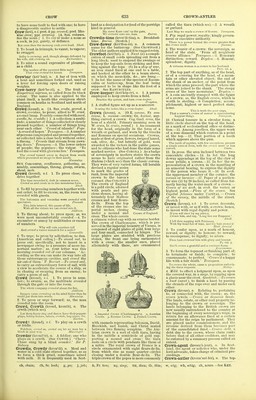
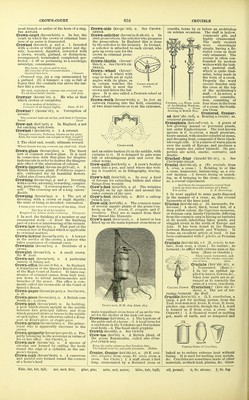
![Forthwith led unto the crooke Where he full shamefully was hanged by the hed. Spenser. 6. In music, a small curved tube applied to a trumpet, horn, &c., to change its key.— 7. An artifice; a trick. For all your bragges, hookes, and crookes, you have such a fall, as you shall never be able to stand upright again. Abp. Ci-amner. —By hook or croolc, by one means or another; by fair means or foul. They will Iiave it by hook or by crook. Mede. Crook (ki-ok), v.t. 1. To bend; to turn from a straight line; to make a curve or hook.— 2. To tui-n from rectitude; to pervert. Whatsoever affairs pass such a man's hands, he crooketh them to his own ends. Bacon. 3. + To thwart. —To croolc the mou', to distort the mouth, as if about to cry or as indicat- ing anaer or displeasure. [Scotch.] Crook (kiok), v.i. To bend or be bent; to be turned from a right line; to curve; to wind. The eaele's upper beak crookith in time over the lower, and so she faileth not with age but hunger. Gregory. Crook-back (krok'bak), n. A crooked back; one who has a crooked back or round shoul- ders. Ay, crook-back, here I sta.id to answer thee. Shak, Crooked (krok'ed),^p. or a. 1. Bent; curved; curving; winding. ' From the crook'd worm to man's imperial form.' Lamb.—2. Oblique in moral conduct; devious; froward; per- verse ; going out of tlie path of rectitude. They are a perverse and crooked generation. Deut. xxxii. 5. Syn. Curved, incurvated, curving, winding, bowed, awry, oblique, wry, deformed, per- verse, deceitful, devious, froward. Crookedly (krok'ed-li), ado. In a crooked, curved, or perverse manner. Crookedness (krolc'ed-nes), n. 1. A wind- ing, bending, or turnmg; curvity; CTirvature; inflection.—2. Perverseness; untowardness; deviation from rectitude; iniquity; obliquity of conduct. My will hath been used to crookedness and peevish morosity in all virtuous employments. Jer. Taylor. 3. Physical deformity. ' A severe search to see if there were any croolredness or spot, any uncleanness or deformity, in their sacri- lice.' Jer. Taylor. Crookent (krblc'n), «. J. To make crooked; to pervert. Images be of more force to crooken an unhappy soul, than to teach and instruct it. HoiJtilies against Idolatry. Crook-rafter (krbk'raft-er), n. See Knee- rafter. Croon, (kron), n. A low, hollow, continued moan. [Scotch.] The deil, or else an outler quey. Gat up an' gae a croon. Envois. Croon (kron), v.t. [Onomatopoetic; allied to D. kreunen, to groan, to lament; Icel. krunka, to croak.] 1. To sing in a low hum- ming tone; to hum. 'Whiles crooning o'er some auld Scots sonnet.' Burns.—2. To bring into a particular state by crooning (the state being indicated by an adjective following, as asleep, aivake, &c., without which the meaning is incomplete). The fragment of the childish hymn with which he sung and crooned himself asleep. Dickens. Croon, (kron), v. i. To utter a low continued sound approaching a moan, as cattle when ■in pain; to sing softly to one's self; to hum. Here an old grandmother was crooning over a sick child, and rocking it to and fro. Dickens. Crooner (kron'fer), n. The gray gurnard (Trigla gurnardiis), so called in Scotland from the noise it makes when taken out of the water. Crooning (kron'ing). n. The act of one who croons; a low humming or murmuring sound. Her dainty ear a fiddle charms, A bagpipe's her delight; But for the croonijtgs o' her wheel She disna' care a mite. ^. Baillie. Croop, n. See CROUP. Crop (krop), n. [A. Sax. crop, top, bunch, craw of a bird; cog. D. krop, G. kropf, a bird's crop; Icel. kroppr, a hump, bunch. The original meaning is probably that of a rounded projecting or prominent mass. Croup is really tlie same word.] 1.The first stomach of a fowl; the craw. In birds there is no mastication of the meat; but ... it is immediately swallowed into the crop or craw. Ray. 2.t The top or highest part of a thing; the end. 'Crop and root.' Chaucer.S. That which is cropped, cut, or gathered from a single field, or of a particular kind of grain or fruit, or in a single season; the corn, or fruits of the earth collected; harvest. — 4. Corn and other cultivated plants while growing: a popular use of the word.—5. Any- thing cut off or gathered. Guiltless of steel and from the razor free. It falls a plenteous cyfj* reserved for thee. Dryden. 6. The act of cutting or clipping off, as hair; as, he has given you a pretty close crop. —Neck and crop, altogether; at once; bag and baggage. I'd have had you trundled neck and crop out of this warehouse long ago if I'd thought you capable of pouching so much as a tobacconist's token. Sala. Crop (krop), v.t. pret. & pp. cropped, some- times cropt; ppr. cropping. 1. To cut off the ends of anything; to eat off; to pull off; to pluck; to mow; to reap; as, to crop flowers, trees, or grass. ' A closely cropped head of hair.' Thackeray. Pleased to the last, he crops the flowery food, And licks the hand just raised to shed his blood. Pope. 2. To pluck, as fruit; to gather before it falls. while force our youth, lilce fruits, untimely crops Denhani. 3. To cause to bear a crop; to fill with crops; to raise crops on; as, to croj} a field. Crop (krop), v.i. To yield harvest. Sliak. [Obsolete.]—To crop out, (a) in geol. to ap- pear on the surface, as a layer, bed, or stra- tum underlying another, but projecting its edge from beneath. (&) To appear inciden- tally and undesignedly; to come to light; as, his peculiarities crop out in his work; the truth cropped out in spite of him. The expression crop up is also used in this sense. Crope t (krop), n. The top of anything; a tinial. Crope.t Cropen,t pp- of crepe, to creep. Crept. Chaucer. Crop-ear (krop'er), n. l. A horse whose ears are cropped. I'll lay a thousand pounds upon my crop-ear. Bea li. &■ Fl. 2. A person whose ears have been cropped; a croppy. Crop-eared O^rop'erd), a. Having the ears cropped. 'A crop-ear'd scrivener this.' B. Jonson. Crop-full (krop'ful), a. Having a full crop or belly; satiated. Milton. Crop-ore (krop'or), n. In mining, the best ore of a parcel. Crop-out (krop-ouf), n. A term used by miners to express the rising up at the sur- face of one or more strata. Written more commonly Out-crop. Cropper (krop'6r), ?i. 1. A breed of pigeons with a large crop. See Pouter.—2. A fall, as from horseljack; hence, failure in an un- dertaking. [Slang.] Cropping (krop'ing), n. 1. The act of cut- ting off. —2. The raising of crops. Croppy (krop'i), n. 1. A person who has his hair cut very short; a Roundhead; an Irish rebel of 179S (from wearing the hair like the French revolutionaries). ' Shouts over the demolition of the croppy's dwell- ing.' Banim.—I. One who has had his hair cropped in prison. [Slang. ] Crop-sicls (krop'sik), a. Sick or indisposed from a surcharged stomach; sick with ex- cess in eating or drinking. [Rare.] Crop-sickness (ki-op'sik-nes), n. Sickness from repletion of the stomach. [Rare.] Croq.ue't (kro'ka), n. [Fr. croquer, to crack.] 1. An open-air game played with a mallet, balls, pegs or posts, and a series of iron hoops or arches. It can be played by two or more, and, in the case of several playing, they may either be divided into two parties, or play each for their own hand. The ob- ject of the players is to drive the balls be- longing to their own side through the hoops and against the pegs in a certain order, and to prevent then' opponents' balls from com- pleting the journey before their own, by playing them against those of the enemy, and driving them as far as possible from the hoop or post they have to be jjlayed for. 2. When one ball has roqueted or been made to strike another, the act of the player driving to a distance the Ijall that has been roqueted by a blow of the mallet upon his own ball. Croquet (kro'ka), v.t. In the game of cro- quet, to drive a ball wiiich is in contact with one's own to a distance with a blow of the mallet upon one's own baU. Croquette (kro-ket), 71. [Fr. croquer, to crunch.] A fried, force-meat ball, made of pounded chicken, meat, and butter, much eaten in India. Crore (kror), 71. In the East Indies, ten mil- lions; as, a crore of rupees. Crosier (kr6'zhi-6r), n. An archbishop's staff bearing a cross at the top. See Crozier. Croslet, Crosslet (kros'- let), n. [Dim. from cross.] A small cross.—Cross cross- let, in her. a cross having the three upper points ending in little crosses. Cross (kros), n. [O.E. crois, cniys, croce; 0. Fr. crois, Fr. croix, from L. crux, a cross used as a gibbet, from a root seen in E. crook, W. crog, a cross, crwg, a hook; Ir. croch- aim, to hang; Gael, crocan, a hook.] 1. A gibbet, consisting of two pieces of timber placed across each other, either in form of |-, T, or X, variously modified as exhi- bited in the annexed cut. That on which Cross crosslet. 2. 3 ' ^ ' + 5 Forms of Crosses. I, Cross of Calvary, a cross on three steps, which, by some authorities, are said to sigriify the three virtues. Faith, Hope, and Charity. 2, Latin Cross, or crux capitata; a cross the transverse beam of which is placed at one third of the distance from the top of the perpendicular portion, supposed to be the form of cross on which Christ suffered. 3, Tan Cross (so called from being- formed like the Greek letter t, taii), or cross of St. Anthony, one of the most ancient forms of the cross; tliis form was often adopted for the head of the pastoral staff. 4, Cross of Lorraine. 5, Patriaixhal C}-oss. 6, S(. Andrew's Cross, or crux decussata; the form of cross on which St. Andrew, the national saint of Scotland, is said to have suffered. 7, G}'€ek Cross, or cross of St. George, the national saint of England. Previous to the union with Scotland this was the English ensign, but since then it has been combined with the cross of St. Andrew. 8, Papal Cross. 9, Cross Jiowy quadrat. 10. Maltese Cross, formed of four arrow-heads meet- ing at the points; the badge of the knights of Malta The eig-ht points of this form of cross are said to symbolize the eight beatitudes (Mat. v.). 11, Cross foiirch^e. 12, Cross formy or form^e. 13, Cross poteiit or Jertisalem Cross. The four conjoined crosses are said tn be symbolical of the displacement of the Old Testament by the Cross. 14, Cross paton^e; called also Crossfieury, from the fleurs de lis at its ends. our Saviour suffered is represeutecl on coins and other monuments to have been of the form in figs. 1 and 2.-2. The ensign of the Christian religion; and hence,the re- ligion itself. She (the Church of England) yet shocked many rigid Protestants by marking the infant just sprinkled from the font with the sign of the cross. Macaulay. 3. An ornament in the form of a cross, used chiefly in buildings devoted to religious purposes; a monument with a cross upon it to excite devotion, such as were anciently set in market-places. Dunedin's cross, a pillared stone. Rose on a turret octagon. Sir IV. Scott. 4. Anything in the form of a cross or gibbet. 5. A line dra^vn through another.—6. Any- thing that thwarts, obstructs, or perplexes; hindrance; vexation; misfortune; opposi- tion; trial of patience. Heaven prepares good men with crosses. B. ^onso7i. 7. Money or coin stamped with the figui'e of a cross. The devil sleeps in my pocket, I have no cross to drive him from it. Alassiiiger. 8. The right side or face of a coin, stamped with a cross.—9. The mark of a cross, in- stead of a signatiue, on a deed or other document, impressed by those who cannot write.—10. t Church lands in Ireland.—11. In theol. the sufferings of Christ by crucifixion. That he might reconcile both to God in one body by the cross. Eph. ii. i6. 12. The doctrine of Christ's sufferings and of the atonement, or of salvation by Chiist. The preaching of the cross is to them that perish foolishness. i Cor. i. i8. ch, c/iain; 6h, Sc. loch: ' ]> job; n, Fr. ton; TH, thQn; thin\ w, ifig; wh, whig; zh, a^ure. —See KEY.](https://iiif.wellcomecollection.org/image/b22652000_0001_0655.jp2/full/800%2C/0/default.jpg)