Volume 1
The imperial dictionary of the English language : a complete encyclopedic lexicon, literary, scientific, and technological / by John Ogilvie.
- Ogilvie, John
- Date:
- 1885
Licence: Public Domain Mark
Credit: The imperial dictionary of the English language : a complete encyclopedic lexicon, literary, scientific, and technological / by John Ogilvie. Source: Wellcome Collection.
Provider: This material has been provided by Royal College of Physicians, London. The original may be consulted at Royal College of Physicians, London.
643/736 page 617
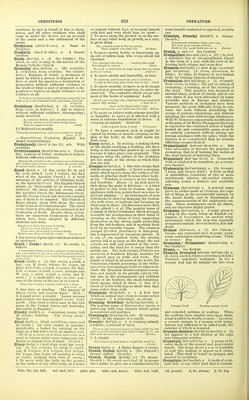
![any external work upon the upper surface, or between the beds of the stones. Called also Cramp. Crampisllt G^ramp'ish), v.t. To contract; to cramp. Chaucer. Crampit (kram'pit), n. 1. A piece of metal at the end of the scabbard of a sword.— 2. [Scotch.] (o) A cramp-iron. (6) A piece of iron made to tit the sole of tire shoe, witli small sjiikes in it, for keeping the foot firm on ice or slippery ground. Cramponee (kramp-o-ne'), n. [Fr. cram- ponne, pp. of cramponner, to affi.x with a cramp.] In her. applied to a cross, having a cramp or square piece at each end. Crampon (kram'pon), 71. In bot. an adventi- tious root wliich serves as a fulcrum or sup- port, as in the ivy. Crampoon (kram'pon), n. 1. An iron instru- ment fastened to the shoes of a storming party, to assist tliem in climbing a rampart. 2. In arch, an apparatus used in the raising of timber or stones, consisting of two liooked pieces of iron hinged together somewliat like double callipers. Cramp-ring (kramp'ring), n. A ring of gold or silver, which, after being blessed by the English sovereign, was formerly believed to cure cramp and falling-sickness. The custom of blessing great numbers on Good I'riday continued down to the time of Queen Mary. Crampy (kramp'i), a. 1. Afflicted with cramp.—2. Inducing cramp or abounding in cramp. ' This crampy country.' Howitt. Oran, Crane (kran, kran), n. [Gael, crann, a measure of fresh herrings, as many as fill a barrel. ] In Scotland, a measure of capa- city for fresh herrings, as taken out of the net. A cran contains 37|- imperial gallons, and a barrel 26J gallons; but, after they have been properly cured, it is reckoned that nearly as many fish can be packed into a barrel as are contained in a cran. The average number of herrings to the cran may be roughly set do^vn at 750. Cranage (kran'aj), 11. [From crane.} The liberty of using a crane at a wharf for raising wares from a vessel; also, the money orprice paid for the use of a crane. Cranberry (kran'be-ri), n. {Crane and bemj, from a fancied resemblance of its long slender stalks to the legs of a crane; or be- cause the berries are eaten by cranes.] The fruit of Oxijcoccus palustris, nat. order Vacciniacea;. It is also called Moss-ben-y or Moor-berry, as it grows only on peat-bogs or swampy land,usually amongmasses of sphag- num. The berry, when ripe, is globose and dark red, and a little more than J inch in diameter. These berries form a sauce of exquisite flavour, and are used for tarts. The cranberry of the United States is the 0. macrocarpas. Vaccinium Vitis idcea is often called the cranberiy in Scotland. Crance (krans), Naut. any boom iron, but particularly an iron cap attached to the outer end of the bowsprit, through which the jib-boom passes. Cranch (kranch). See Craunch. Cranck.t Crankt (krank), a. [Perhaps allied to rank, luxuriant; A. .Sax. raiic, proud.] Lusty; stout; sprightly; lively; courageous. For I was a brisk wit, a crank young boy. Dr. H. More. Used adverbially by Spenser. See extract under CRAG, tlie throat. Crane (kran), n. [A. Sax. cran; cog. D. Tcraan, G, krahn, kranich, Icel. trani. Dan. trane (both with tr for Icr), Armor, karan, W. ga- Crowned Crane {Balmrica pavo}iina). ran, Gr, geranos, L. grjis, according to Max Miiller, Pott, &c., from a root gar, seen in L. garrio, Gr. geriio, to call] 1. A migratory grallatorial or wading bird of the genus Grus, family Gruida;. ' The bill is straight, sharp, and long, with a furrow from the nos- trils toward the point; the nostrils are linear, and the feet have four toes. These fowls have long legs and a long neck, being destined to wade and seek their food among grass and reeds in marsliy grounds. The common crane is about 4 feet in length, of a slender body. It is the G. cinerea; the Siberian crane is the G. g'ujantea, and the brown crane the G. canadensis. The crowned crane, by some classed in a separate genus (Balearica), is about the size of the common crane. It receives its common name from having the occiput crowned with a tuft of slender yellow feathers.—2. A machine for raising great weights, and depositing them at some distance from their original place; for example, raising bales from the hold of a ship, and depositing them on the quay. Cranes are generally constructed on the principle of the wheel and axle, cog-wheel, or wheel and pinion. The most conmion of the many vai'ied forms consists of a vertical revolving shaft, with an arm or jib, project- ing upwards at an angle of from 40° to 50° from the shaft. At the upper extremity of the jib is a fl.xed pulley, over which is passed one end of the rope or chain to receive the weight, the other end being made fast to a cylinder fitted with a wheel and pinion, by means of which the weight can be raised to the required height. By the revolving mo- tion of the vertical shaft the weight can be placed in any spot within the sweep of the jib. Where tlie objects to be raised are of con- siderable weight, cranes are generally turned by a steam-engine; in other cases by human force. A doable crane is a crane with two jibs, one of which is employed in raising a load while the other deposits its load in posi- tion. A tra veiling crane is a crane mounted on a carriage or frame travelling on a wide- gauge railroad. It is in extensive use where heavy loads, as timlier, stone, or iron, have to be moved to some distance.—3. A machine for weighing goods on the principle of the crane for lifting weights. Such machines are common in market towns in Ireland. See Craner.—4. An iron arm or beam at- tached to the back or side of afire-place and movable horizontally, used for supporting a pot or kettle over a lire.—5. pi. Naut. pieces of iron or timber at a vessel's side for stow- ing boats or spars upon.—6. A siphon or crooked pipe for drawing liquors out of a cask. Crane (kran), v.i. pret. & pp. craned; ppr. craning. To stretch out one's neck like a crane; hence, in hunting, to look before one leaps; to pull up at a dangerous jump. But where was he, the hero of our tale? Fencing? Craningt Hitting? Missing? Is he over, or is he under? Has he killed, or is fie killed? Disraeli. Crane (kran), u. t. To cause to rise as by a crane: followed by up. [Kare. ] An upstart craned up to the height he has. Massin^er. Crane-fly (kran'fli), n. A genus of insects (Tipula), belonging to the family Tipulidse. The mouth is a prolongation of the head; the upper jaw is arched; the palpi are two, curved, and longer than the head; the proboscis short; the wings lanceolate and spreading, and the legs very long. T. oler- acea is the well-known daddy-long-legs. Craner (kran'er), n. 1, One who cranes at a fence; one who flinches before difficulty or danger; a coward.—2. An official in charge of a public crane for weighing. Some country towns of Ireland have in the market- place a Grane for the weighing of goods, produce, &c. An ofhcial, popularly the craner, has charge of the machine, who gives a certificate of weight to all concerned, a dictum uncontrovertible. This is called the eraser's note, and when any one makes an asser- tion of the ' long-bow' nature, a sceptic auditor will say, 'Very nice; but I should like the craner's note for that.' Notes and Queries. Crane's-bill (kranzTjil), n. 1. The popular name given to the species of Geranium, from the long slender beak of their fruit. They are herbs or sometimes shrubs found in temperate regions. Eleven species are found in Britain. Some of the species have beautiful flowers and a fragrant odour, and several of thera are valued for their astrin- gent properties. See Geranium. —2. A pair of long-nosed pincers used by surgeons. Crang (kraug),»(. [D. 7cre(1(7, a carcass.] The carcass of a whale. Crangon (krang'gon), n. The shrimp, a genus of macrurous or long-tailed crustaceans. Tlie common shrimp is the Crangonvulgaris; the shrimp common in the arctic regions is the Crangon Boreas. Crangonidse (krang-gon'i-de), n.pl. A family of macrurous or long-tailed crustaceans, of which the genus Crangon is the type. See Crangon. Cranial (kra'ni-al), a. Relating to or like the cranium. CraniidaB (kra-ni'i-de), n. pi. A family of brachiopod fossil and I'ecent shells, char- acterized by the absence of a hinge and peduncle, the shells being attached by the hjwer valve. Craniofacial (krani-6-fa'shal), a. [L.L. cra- nium, the skull, and L. fades, the face.] Pertaining to tlie cranium and face.—Cranio- facial angle. Same as Facial Angle (which see under Facial). Craniognomy (kra-ni-og'no-mi), n. [Gr. kraniun, the skull, and Gr. gnome, judg- ment. ] The doctrine or science which treats of the form and other characteristics of the skull. Craniological (kra'ni-o-lojik-al), a. Per- taining to craniology. Craniologist (kra-ni-ol'o-jist), n. One who treats of craniology, or one who is versed in the science of the cranium. Craniology (kra-ni-ol'o-ji), n. [Gr. kranion, the skull, and logos, discourse.] A discourse or treatise on the cranium or skull; tlie science which investigates the structure and fises of the skulls in various animals; the art of determining the intellectual and moral peculiarities of individuals by the shape of their skulls. See Phrenology. Craniometer (kra-ni-om'et-er), 71. [Gr. kranion, the skull, and metron, measure.] An instrument for measuring the skulls of animals. Craniometrical (kra'ni-o-metrik-al), a. Pertaining to craniometry. Craniometry (kra-ni-om'et-ri), 7i. The art of measuring the ci'anium or skulls of ani- mals, for discovering their specific differ- ences. Cranioscopist (krii-nl-os'kop-ist), m. One skilled or professing belief in cranioscopy; a phrenologist. It was found of equal dimensions in a literary man, whose skull puzzled the cranioscopists. Coleridge. Cranioscopy (kra-ni-os'ko-pi), n. [Gr. kra- nion, the skull, and skopeo, to view.] An examination of the skull with the view of discovering the relative prominence and size of the different organs of the brain, sup- posed to indicate the strength of particular passions and faculties; phrenology. Cranium (kra'ni-um), [G\. kranion.'\ The skull of an animal: the assemblage of bones which inclose the brain. Crank (krangk), n. [Allied to cringle, crinkle, crankle; D. krinkel, something bend- ing, a curve, krinkelen, to twist, bend; also to the adjective crank, A. Sax. cra7ic, Icel. krankr, G. krank, sick.] 1. An iron axis with the end bent like an elbow, serving as a handle for communicating circular motion; as, the crank of a grind- stone; or for changing circular into recipro- cating motion, as in a saw-mill, or recipro- cating into circular motion, as in a steam- engine. The single crank (1) can only be used on the end of an axis. The double crank (2) Is employed when it is necessary Single Crank. 2, Double Crank. 3, Bell Crank. that the axis should be extended on both sides of the point at which the reciprocat- ing motion is applied. An exemplification of this arrangement is afforded by the ma- chinery of steam-boats. The bell-crank (3), so called from its being much used in bell-hanging, is for a totally different pur- pose to the others, being used merely to change the direction of a reciprocating motion, as from a horizontal to a vertical line.—2. Any bend, turn, winding, or in- volution.](https://iiif.wellcomecollection.org/image/b22652000_0001_0643.jp2/full/800%2C/0/default.jpg)