Trypanosomes and trypanosomiasis / by A. Laveran and F. Mesnil. : Translated and much enlarged by David Nabarro.
- Charles Louis Alphonse Laveran
- Date:
- 1907
Licence: In copyright
Credit: Trypanosomes and trypanosomiasis / by A. Laveran and F. Mesnil. : Translated and much enlarged by David Nabarro. Source: Wellcome Collection.
Provider: This material has been provided by London School of Hygiene & Tropical Medicine Library & Archives Service. The original may be consulted at London School of Hygiene & Tropical Medicine Library & Archives Service.
30/568 (page 6)
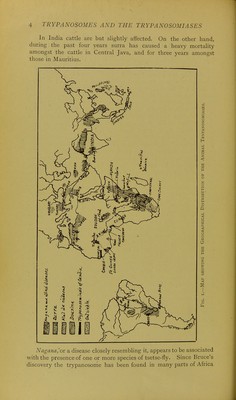
![The'researches of the past five years have clearly shown the part played by trypanosomes in human pathology. Towards the end of igoi Button discovered a new trypanosome in the blood of a European resident in the Gambia Colony who was suffering from irregular pyrexia and enlarged spleen.^ This discovery of a trypano- some pathogenic for man was soon confirmed in the Gambia Colony by Button and Todd, and elsewhere (Congo, Uganda) by others. In May, 1903 was published the important discovery by Castel- lani in Uganda of a trypanosome in the cerebro-spinal fluid of negrofes suffering from sleeping sickness. This discovery was speedily confirmed by Bruce and Nabarro, who clearly demonstrated the intimate association between this trypanosome and sleeping sickness. It has been recognised, moreover, that this trypanosome is identical with that discovered in igoi by Button [and Fordej. Sleeping sickness is merely the final stage of a blood infection with trypanosomes. This human trypanosome is conveyed by a particular species of tsetse-fly. Human trypanosomiasis has the same geographical distribution as sleeping sickness—the valleys of West Africa from the Senegal down to St. Paul de Loanda, and the northern shores of the Victoria Nyanza. (See special map. Chapter XII.) This rapid resume shows clearly the importance of the trypano- some diseases. Their elucidation is, therefore, one of the important problems of colonial expansion. The experimental study of the various trypanosomiases has already led to very important results, which will be found in detail in this book. Unfortunately, we have progressed very little so far as prevention and treatment are concerned. It is not possible to inoculate against these diseases. Graduated treatment with arsenic leads to an iniprovement in the condition of animals or human beings suffering from trypanosomiasis, but a cure has never been effected. * Trypanrot' of Ehrlich and Shiga has hitherto cured only mice inoculated with the trypanosome of mal de caderas. Serum-therapy has furnished a result interesting from a theoretical point of view, but not of practical value—namely, the action of human serum upon the animal trypanosomes. [Buring the past few years some progress has been made in the preventive inoculation of animals, and the recent investigations of Laveran upon the action of arsenic and trypanred combined, of Mesnil and Nicolle and of Thomas upon the action of various dyes and of an arsenic compound (atoxyl), mark a distinct advance in the prevention and treatment of the tr3^panosomiases. (See Chapter XIII. on 'Treatment.').] ' [It would seem that Forde first discovered the parasite in blood-fihns, but that Dutton recognised its character. (See chapter on Human Trypanosomiasis.)]](https://iiif.wellcomecollection.org/image/b21356208_0030.jp2/full/800%2C/0/default.jpg)