Trypanosomes and trypanosomiasis / by A. Laveran and F. Mesnil. : Translated and much enlarged by David Nabarro.
- Charles Louis Alphonse Laveran
- Date:
- 1907
Licence: In copyright
Credit: Trypanosomes and trypanosomiasis / by A. Laveran and F. Mesnil. : Translated and much enlarged by David Nabarro. Source: Wellcome Collection.
Provider: This material has been provided by London School of Hygiene & Tropical Medicine Library & Archives Service. The original may be consulted at London School of Hygiene & Tropical Medicine Library & Archives Service.
29/568 (page 5)
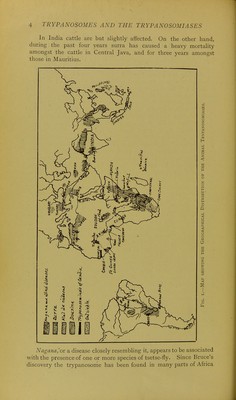
![where fly diseases are prevalent: in Northern Transvaal; amongst cattle in German East Africa; cattle and horses in British East Africa; dromedaries in Ogaden ; cattle, sheep, and donkeys in the Belgian Congo territory; various mammals in the Cameroons ; horses and cattle in Togoland ; horses in Nigeria, French Guinea, and the valley of the River Shari; and amongst the dromedaries and cattle in Timbuctoo, Perhaps there are several distinct diseases in the areas just enumerated. In the Gambia Colony there is also a trypanosome disease affecting horses, discovered in 1903 by Button and Todd, which is undoubtedly distinct from the nagana of Zululand. In 1894 Rouget found a trypanosome in the blood of a horse suffering from dourine in Constantine, in Algeria. This discovery was confirmed in 1899 by Schneider and Buffard, who proved con- clusively the causal relation of the trypanosome to the disease. This trypanosomiasis, known also by the name of mal du co'it (for so far as is known it is conveyed only by coitus)^ attacks only stallions and brood mares. It occurs along the African and Asiatic shores of the Mediterranean, in Persia, and in Turkey ;i cases are still occasionally met with in Hungary and the North of Spain. It occurs also in the United States, in the region of the Illinois, and possibly, too, in Java. In Algeria dourine is apparently not the only trypanosome disease which attacks animals. Quite recently trypanosomiases amongst horses and dromedaries have been described) differing from dourine both in their mode of propagation, which is not by coitus, and by the characters of their respective trypanosomes. In 1901 Elmassian, director of the Bacteriological Institute at Asuncion, Paraguay, discovered a trypanosome in the blood of horses with mal de caderas (disease of the hind-quarters). This disease is prevalent over the whole of the Gran Chaco, the hunting and cattle-rearing district, and over the adjacent parts of the Argentine, Uruguay, Paraguay, and Bolivia. Mal de caderas has also been recognised further north, in the Brazilian province of Matto-Grosso. In 1902 Theiler discovered in the Transvaal a disease peculiar to cattle—galziekte, or gall-sickness, due to a trypanosome which Bruce and Laveran have described, at the same time drawing attention to its unusually large size. [This disease has since been described in other parts of Africa and in Transcaucasia.] Until igae it was thought that the trypanosome diseases were confined to the lower animals, and that man was immune. In support of this hypothesis, nagana and other allied fly diseases of horses and cattle were frequently cited as having never attacked man, although he had often been bitten by. the fly. 1 [Dourine occurs also in India, where it has recently been studied by Lingard and others. (See Chapter X.)] ■ ^ n](https://iiif.wellcomecollection.org/image/b21356208_0029.jp2/full/800%2C/0/default.jpg)