Trypanosomes and trypanosomiasis / by A. Laveran and F. Mesnil. : Translated and much enlarged by David Nabarro.
- Charles Louis Alphonse Laveran
- Date:
- 1907
Licence: In copyright
Credit: Trypanosomes and trypanosomiasis / by A. Laveran and F. Mesnil. : Translated and much enlarged by David Nabarro. Source: Wellcome Collection.
Provider: This material has been provided by London School of Hygiene & Tropical Medicine Library & Archives Service. The original may be consulted at London School of Hygiene & Tropical Medicine Library & Archives Service.
27/568 (page 3)
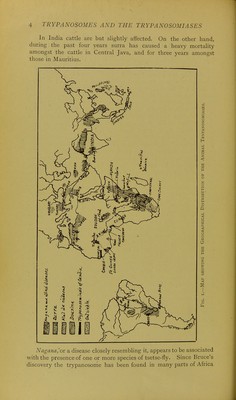
![Next should be mentioned the work of Rabinowitsch and Kempner, pubHshed in 1899, on the trypanosome of rats. Here for the first time the cytological study of a trypanosome was made. These authors showed that satisfactory results are obtained only by employing those methods which had just been shown to succeed so well with the intracorpuscular haematozoa—namely, a suitably combined mixture of eosin and methylene blue.^ It is true Rabi- nowitsch and Kempner from their earlier work did not arrive at unassailable conclusions ; and the researches carried out in 1900, first by Wasielewski and Senn and later by ourselves, have intro- duced corrections into the morphological work of Rabinowitsch and Kempner. But to these investigators undoubtedly must be given the credit of having inaugurated the cytological study of the trypanosomes. We believe we were the first to give a precise cytological account of the pathogenic trypanosomes, and to describe in detail their mode of longitudinal division into equal parts, with figures illustrating these changes. Our results have all been confirmed and extended by our own further researches and by the work of others on the pathogenic trypanosomes, as well as upon the non-pathogenic trypanosomes of the Batrachia, fishes, reptiles, and birds. During the progress of our researches we discovered in the blood of a fresh- water fish—the rudd or red-eye—a trypanosome having, amongst other peculiarities, a flagellum at each extremity of its body. In Chapter III. we shall dwell more fully upon its morphological interest. We may add that closely-allied organisms have recently been found in the blood of the carp and minnow,^ and that they appear to be pathogenic for these fishes. Finally, in connection with the trypanosomes themselves, we have the interesting discovery made in 1903 by Novy and McNeal, who obtained pure cultures in a blood-agar medium, first of the rat trypanosome and later of the nagana parasite. But it is especially in the discovery of the trypanosome diseases in man and the lower animals that the last decade was so prolific. We shall enumerate in the chronological order of the discovery of their causal agent all the trypanosomiases known at present, with a general survey of their geographical distribution (for the Animal Trypanosomiases, see Fig. i). Sierra, the trypanosome of which was discovered in 1880 by Evans, is very prevalent among the Equida; and Camelida; of the provinces of Northern India, Bombay, Burmah, Southern China, and various parts of French Indo-China. It has also been described in Sumatra, Java, and the Philippines. [Trypanosomiases identical with, or closely allied to, surra have been found to occur in various parts of Africa.] ' Ziemann, since 1898, had thus stained the two chromatic masses in the trypanosome of the frog. ^ [In Chapter XVII. will be found the names of other fishes in which similar parasites occur.]](https://iiif.wellcomecollection.org/image/b21356208_0027.jp2/full/800%2C/0/default.jpg)