[Report 1971] / Medical Officer of Health, Market Drayton R.D.C.
- Market Drayton (England). Rural District Council.
- Date:
- 1971
Licence: Attribution 4.0 International (CC BY 4.0)
Credit: [Report 1971] / Medical Officer of Health, Market Drayton R.D.C. Source: Wellcome Collection.
23/36 (page 14)
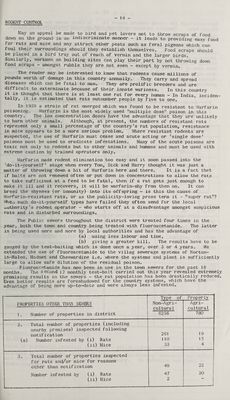
![RODENT CONTROL May an appeal be made to bird and pet lovers not to throw scraps of food down on the ground in an indiscriminate manner - it leads to providing easy food for rats and mice and may attract other pests such as feral pigeons which can foul their surroundings should they establish themselves. Food scraps should be placed in a bird tray out of reach of vermin and the larger birds. Similarly, workmen on building sites can play their part by not throwing down food scraps - amongst rubble they are not seen - except by vermin. The reader may be interested to know that rodents cause millions of pounds worth of damage in this country annually. They carry and spread diseases which can be fatal to man. They are prolific breeders and are difficult to exterminate because of their innate wariness. In this country it is thought that there is at least one rat for every human - In India, inciden¬ tally, it is estimated that rats outnumber people by five to one0 In 1959 a strain of rat emerged which was found to be resistant to Warfarin poisoning. Warfarin is the most widely used multiple dose poison in this country. The low concentration doses have the advantage that they are unlikely to harm other animals. Although, at present, the numbers of resistant rats represent only a small percentage of the country's rat population, resistance in mice appears to be a more serious problem. Where resistant rodents are suspected, the use of Warfarin must cease and acute acting or 'single dose’ poisons must be used to eradicate infestations. Many of the acute poisons are toxic not only to rodents but to other animals and humans and must be used with extreme caution by trained operators only. Warfarm made rodent elimination too easy and it soon passed into the 'do-it-yourself® stage when every Tom, Dick and Harry thought it was just a matter of throwing down a bit of Warfarin here and there. It is a fact that if baits are not renewed often or put down in concentrations to allow the rats to take sufficient at a feed to be fatal, then if a rat gets just enough to make it ill and it recovers, it will be warfarin-shy from then on. It can breed the shyness (or immunity) into its offspring - is this the cause of Warfarin-resistant rats, or as the publicity-loving press term it - super rat? Whe.i such do-it-yourself types have failed they often send for the local authority’s rodent operator - who starts off at a disadvantage amongst suspicious rats and in disturbed surroundings. The Public sewers throughout the district were treated four times in the year, both the town and country being treated with fluoroacetamide. The latter is being used more and more by local authorities and has the advantage of (a) using less labour and time, (b) giving a greater kill. The results have to be gauged by the test-baiting which is done once a year, over 3 or 4 years. We extended the use of fluoroacetamide to the villag sewerage systems of Norton- in-Hales, Hodnet and Cheswardine i.e. where the systems and plant is sufficiently large to allow safe dilution of the residual poison. Fluoroar'etamide has now been in use in the town sewers for the past 18 months. The second ] 2 monthly test-bait carried out this year revealed extremely promising results in the sewers - the rat population has been drastically reduced. Even better results are foreshadowed for the country systems, which have the advantage of being more up-to-date and were always less infested. Type of Property | PROPERTIES OTHER THAN SEVERS Non-Agri- Agri- cultural cultural 10 Number of properties in district 6256 780 2. Total number of properties (including nearby premises) inspected following notification 261 1 9 (a) Number infested by (i) Rats 110 1 5 (ii) Mice 33 4 3. Total number of properties inspected for rats and/or mice for reasons other than notification 49 22 Number infested by (i) Rats 47 20 (ii) Mice 2](https://iiif.wellcomecollection.org/image/b29789369_0023.jp2/full/800%2C/0/default.jpg)