Modified cinchona alkaloids. Pt. 1, Apoquinine and apoquinidine / by T.A. Henry and W. Solomon.
- Thomas Anderson Henry
- Date:
- [1934]
Licence: Public Domain Mark
Credit: Modified cinchona alkaloids. Pt. 1, Apoquinine and apoquinidine / by T.A. Henry and W. Solomon. Source: Wellcome Collection.
3/12
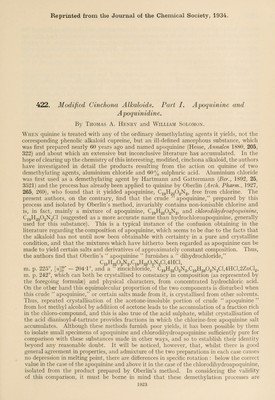
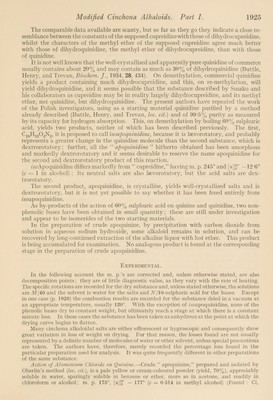
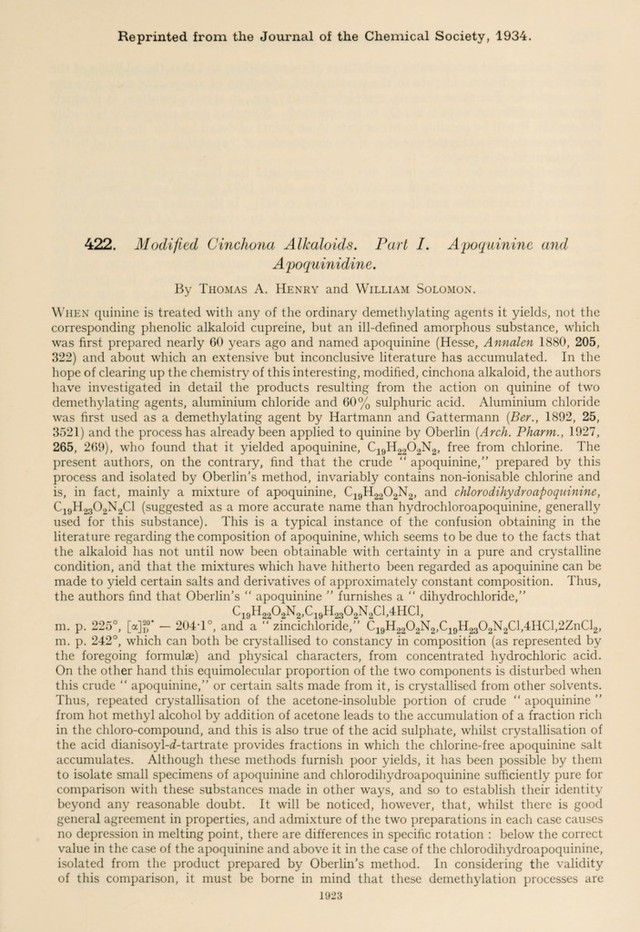
![Reprinted from the Journal of the Chemical Society, 1934. 422. Modified Cinchona Alkaloids. Part I. Apoquinine and Apoquinidine. By Thomas A. Henry and William Solomon. When quinine is treated with any of the ordinary demethylating agents it yields, not the corresponding phenolic alkaloid cupreine, but an ill-defined amorphous substance, which was first prepared nearly 60 years ago and named apoquinine (Hesse, Annalen 1880, 205, 322) and about which an extensive but inconclusive literature has accumulated. In the hope of clearing up the chemistry of this interesting, modified, cinchona alkaloid, the authors have investigated in detail the products resulting from the action on quinine of two demethylating agents, aluminium chloride and 60% sulphuric acid. Aluminium chloride was first used as a demethylating agent by Hartmann and Gattermann (Ber., 1892, 25, 3521) and the process has already been applied to quinine by Oberlin (Arch. Pharm., 1927, 265, 269), who found that it yielded apoquinine, C19H2202N2, free from chlorine. The present authors, on the contrary, find that the crude “ apoquinine,” prepared by this process and isolated by Oberlin’s method, invariably contains non-ionisable chlorine and is, in fact, mainly a mixture of apoquinine, C19H2202N2, and chloro dihydro apoquinine, C19H2302N2C1 (suggested as a more accurate name than hydrochloroapoquinine, generally used for this substance). This is a typical instance of the confusion obtaining in the literature regarding the composition of apoquinine, which seems to be due to the facts that the alkaloid has not until now been obtainable with certainty in a pure and crystalline condition, and that the mixtures which have hitherto been regarded as apoquinine can be made to yield certain salts and derivatives of approximately constant composition. Thus, the authors find that Oberlin’s “ apoquinine ” furnishes a “ dihydrochloride,” CigHg^N^C^HgsOgNgCljJHCl, m. p. 225°, [a]jf - 204*1°, and a “ zincichloride,” C19H2202N2,C19H2302N2Cl,4HCl,2ZnCl2, m. p. 242°, which can both be crystallised to constancy in composition (as represented by the foregoing formulae) and physical characters, from concentrated hydrochloric acid. On the other hand this equimolecular proportion of the two components is disturbed when this crude “ apoquinine,” or certain salts made from it, is crystallised from other solvents. Thus, repeated crystallisation of the acetone-insoluble portion of crude “ apoquinine ” from hot methyl alcohol by addition of acetone leads to the accumulation of a fraction rich in the chloro-compound, and this is also true of the acid sulphate, whilst crystallisation of the acid dianisoyl-d-tartrate provides fractions in which the chlorine-free apoquinine salt accumulates. Although these methods furnish poor yields, it has been possible by them to isolate small specimens of apoquinine and chlorodihydroapoquinine sufficiently pure for comparison with these substances made in other ways, and so to establish their identity beyond any reasonable doubt. It will be noticed, however, that, whilst there is good general agreement in properties, and admixture of the two preparations in each case causes no depression in melting point, there are differences in specific rotation : below the correct value in the case of the apoquinine and above it in the case of the chlorodihydroapoquinine, isolated from the product prepared by Oberlin’s method. In considering the validity of this comparison, it must be borne in mind that these demethylation processes are](https://iiif.wellcomecollection.org/image/b30629950_0003.jp2/full/800%2C/0/default.jpg)