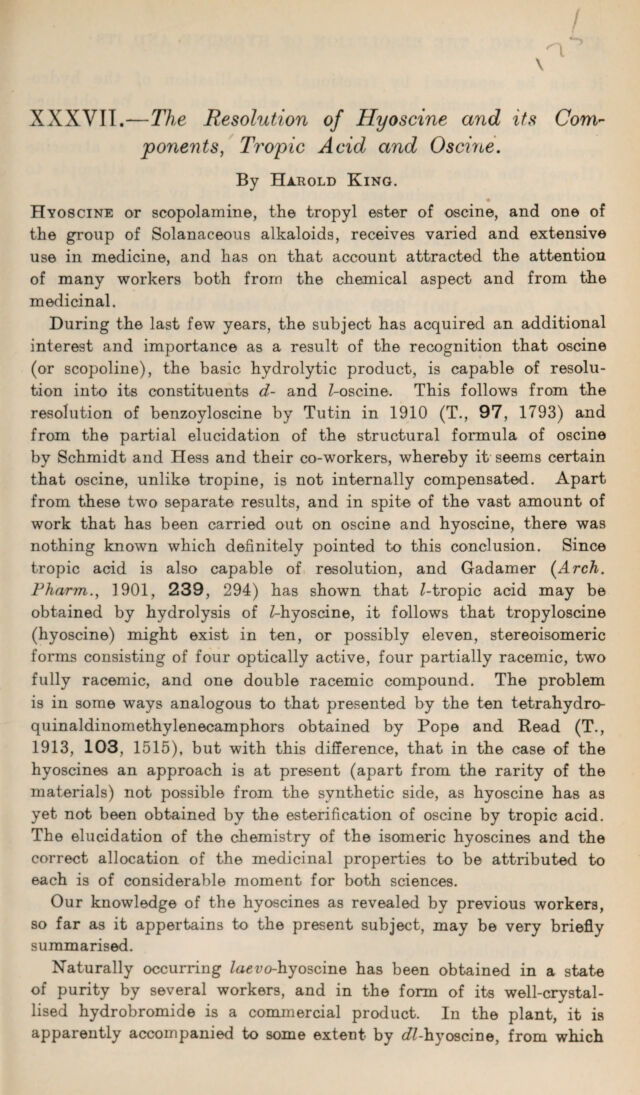
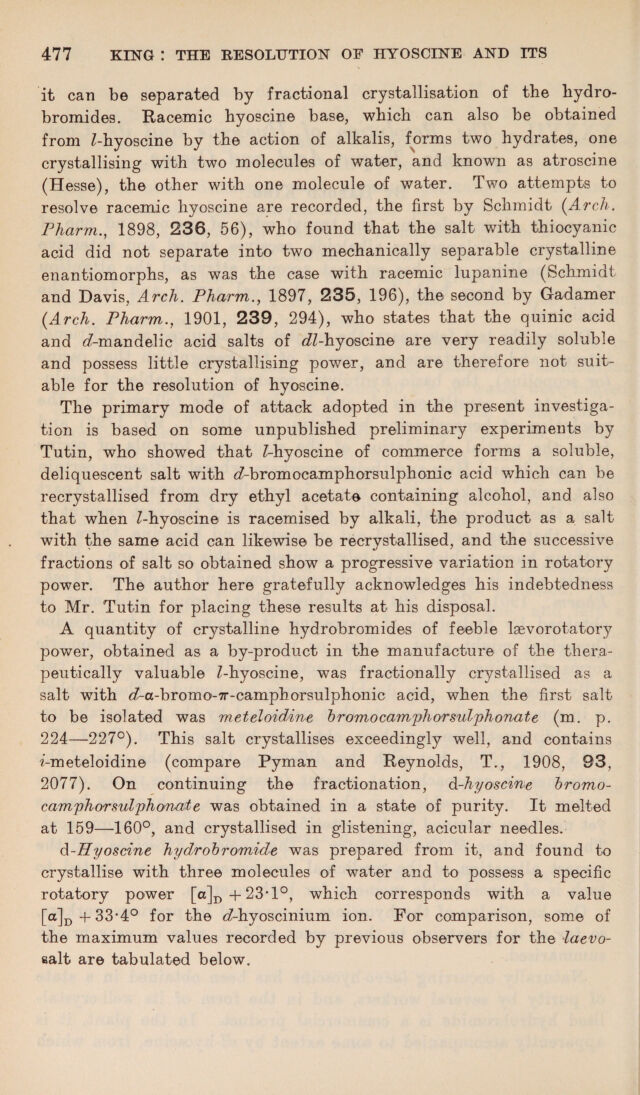
The resolution of hyoscine and its components, tropic acid and oscine / by Harold King.
- King, Harold
- Date:
- 1919]
Licence: Public Domain Mark
Credit: The resolution of hyoscine and its components, tropic acid and oscine / by Harold King. Source: Wellcome Collection.
8/34 page 483
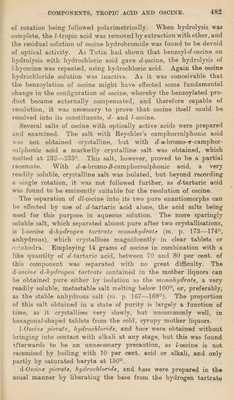
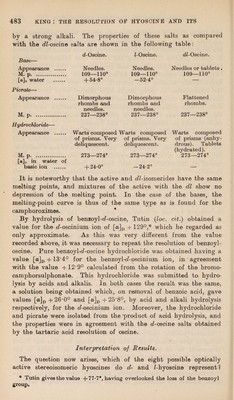
![by a strong alkali. The properties of these salts as compared with the d7-oscine salts are shown in the following table: Base— d-Oscine. Z-Oscine. cZZ-Oscine. Appearance . Needles. Needles. Needles or tablets . M. p. 109—110° 109—110° 109—110° [a]D water . + 54-8° -52-4° — Picrate— Appearance . Dimorphous rhombs and needles. Dimorphous rhombs and needles. Flattened rhombs. M. p. 237—238° 237—238° 237—238° Hydrochloride— Appearance . Warts composed Warts composed of prisms. Very of prisms. Very deliquescent. deliquescent. Warts composed of prisms (anhy¬ drous). Tablets (hydrated). M. p. [a]D in water of 273—274° 273—274° 273—274° basic ion . + 24-0° -24-2° — It is noteworthy that the active and cZZ-isomerides have the same melting points, and mixtures of the active with the dZ show no depression of the melting point. In the case of the bases, the melting-point curve is thus of the same type as is found for the camphoroximes. By hydrolysis of benzoyl-eZ-oscine, Tutin (loc. cit.) obtained a value for the cZ-oscinium ion of [a]D +129°,* which he regarded as only approximate. As this was very different from the value recorded above, it was necessary to repeat the resolution of benzoyl- oscine. Pure benzoyl-cZ-oscine hydrochloride was obtained having a value [a]D+13’4° for the benzoyl-cZ-oscinium ion, in agreement with the value +12*9° calculated from the rotation of the bromo- camphorsulphonate. This hydrochloride was submitted to hydro¬ lysis by acids and alkalis. In both cases the result was the same, a solution being obtained which, on removal of benzoic acid, gave values [a]D +26’0° and [a]D +25'8°, by acid and alkali hydrolysis respectively, for the cZ-oscinium ion. Moreover, the hydrochloride and picrate were isolated from the 'product of acid hydrolysis, and the properties were in agreement with the cf-oscine salts obtained by the tartaric acid resolution of oscine. Interpretation of Results. The question now arises, which of the eight possible optically active stereoisomeric hyoscines do d- and Z-hyoscine represent ? * Tutin gives the value +77*7®, having overlooked the loss of the benzoyl group.](https://iiif.wellcomecollection.org/image/b30622074_0008.jp2/full/800%2C/0/default.jpg)