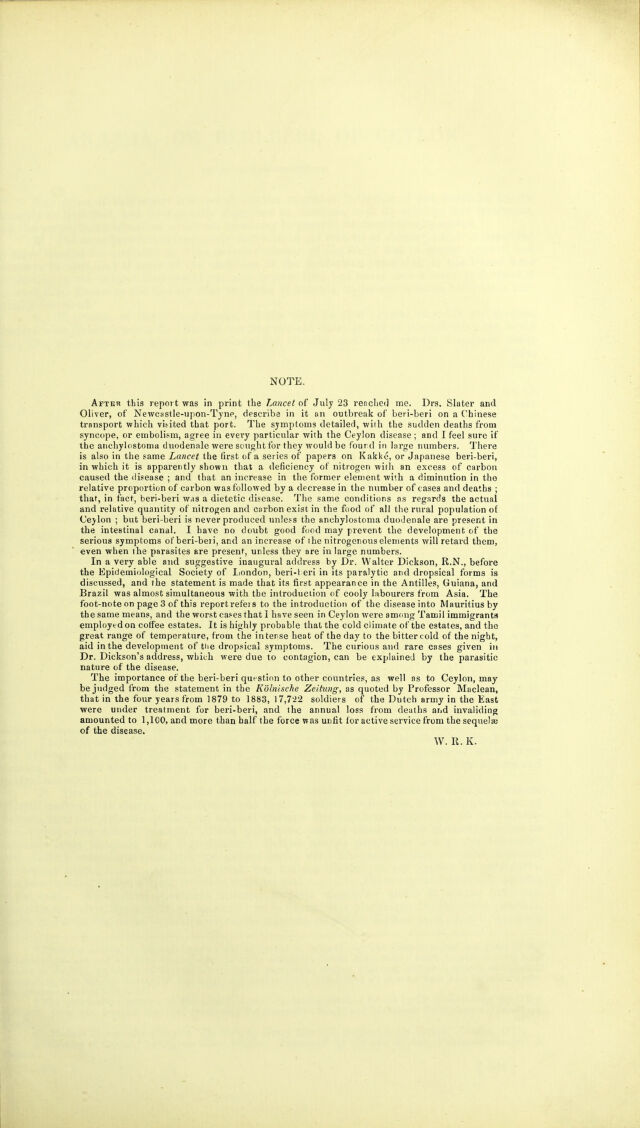
Report on anaemia, or beri-beri, of Ceylon / by W.R. Kynsey.
- Ceylon. Civil Medical Officer.
- Date:
- 1887
Licence: Public Domain Mark
Credit: Report on anaemia, or beri-beri, of Ceylon / by W.R. Kynsey. Source: Wellcome Collection.
Provider: This material has been provided by Royal College of Physicians, London. The original may be consulted at Royal College of Physicians, London.
17/64 page 11
![A regular occurrence of this nature can scarcely be imagined (Leuckart), unless, as a rule, the one sex goes in quest of the other, and apparently this rule, as usual, falls to the male sex. The discovery of free living worms ia the iutesfiues after death speaks ia favour of a spontaneous separation from the mucous membrane, when there is no nourishment for them there ; and even by expulsion tlie separation is forcibly effected. An observation which I made of the Physaloptera semilauceolata of the Nasuasocialis may perhaps be of interest here. In the stomach of a recently-killed animal there were found seven females and three males, all deeply imbedded in the tissues. In addition, there were found a number of recent and old bites exceeding the number of animals present eight or tenfold. This seems to point to a frequent change of place (on aa average once in twenty-four hours). Duration of Life. — The duration of life of the anchylostoma is not yet determined with, certainty, notwithstanding that numerous observations speak in favour of several years' duration. Spontaneous expulsion of dead(?) animals was oltserved by Grassi and others, yet this is neither frequent, nor easily demonstrated, nor of consequence in practice. (In reference to the resistence of the anchylostoma to chemical and thermic influences, we refer to the section on therapeutics.) Development.— Whilst the contents of the ovarium consist of ova germs, which are grouped round a rhachis, there are found in the oviducts isolated yolks in closely-pressed rows : they already attain the full size, but are somewhat elongated (length -05 mm., breadth '028 mm.— Leuckart). Within the uterus, after impregnation, the ova are surrounded with a translucent capsule. The segmentatiou begins only after they enter the vagina, by which they are divided into two or four segments, and then expelled. Usually they are divided into from four to eight segments when found in the intestines. Possibly unsegmented ova may be found after the exhibition of drastics, and by abnormally low position of the parasite in the intestine.* A further development of segmentation only occurs outside the intestines, and goes on, as usual, to the formation of a Morula, prominent upon the one side. The newly-formed embryo has a short cylindrical form, which graiiually increases in length, due possibly to the contractions necessitated by the smalluess of the shell in which the animal is developed. As soon as the embryo has attained to complete development, it makes this manifest by its movements within the shell. Finally, it bursts its covering, usually in tlie neighbourhood of one of its poles, and slips out head first, rarely the tail end. (Perroncito. ) Description of the Embryo.—The newly-formed worm is very different from the adult, and shows a typical rhabditis form. The head end is rounded, and behind this rounding is the broadest part. The cylindrical body diminishes in size, at first gradually, then suddenly, forming an awl-like pointed tail. The more slender and flexible posterior portion efi'ectuates the movements, and is therefore seen usually bent in the form of a sickle. A short, narrow mouth- tube, a spindle-shaped pharynx, and at the posterior extremity of the latter a bulging stomach, ia which three posteriorly concave chitiaous plates, Y shaped, or of an anchor-form, appear, are easily recognised. To these succeed the intestine lined with darkly granular epithelium, in a zig-zag course. Further may be recognised, somewhat backwards from the middle point and ventral surface, between the intestines and the body wall, a small body ('006 mm. long, -004 mm. broad— Perroncito) which represents the undeveloped genital organs. Growth of the Embryo.—The growth at first is exclusively in length, so that the worm becomes more slender and flexible, and is able to fold the body up in coils, amounting to from three to four. The intestines are stretched thereby, and become more translucent. After some time growth takes place in the breadth, so that the normal proportion is soon reached. Imme- diately after emerging from the shell the larva, according to Perroncito, has an average length of •02 mm. and breadth of -014 mm. The fully developed larva measures from -55 to '56 mm. in length and -024 in breadth. In order to attain this size from four to eight days are required, under favourable conditions, so that the daily increase ia length is about 04 to '08 mm., and in breadth •001 to -002 mm. Encapsullng of the Parasite.—During this period of growth the organisation of the larva undergoes scarcely any change, but at its close various remarkable phenomena are observed. Jv'umerous parasites are met with, which seem enclosed in a kind of case or capsule, which has the exact shape of the body, and looks like a second transparent skin. Very often the worm fills this capsule completely, so that the latter is only recognised by the double contour of the worm. At other times the capsule is longer than the parasite, so that it projects either beyond the tail end or head end, or both, very considerably, whilst the larva moves inside. If the worm coils itself, the capsule is wrinkled into very fine folds.J The mode of origin of this capsule has not yet been sufficiently investigated. It seemed probable that the capsule was the original skin of the animal, and that the internal layer of it developed into the second skin ; and this was the view taken by the earlier authorities who saw iu the process only a transition of the skin into the capsule. Perroncito is opposed to this view of it. From my own observations I am in favour of Perroncito's views, that in the process a capsule is really formed enclosing the whole worm. This covering serves the purpose of protecting the worm during a comparatively long period, and is, according to Perroncito, not the old skin, but a secondary product of secretion, and the whole is a process of encysting during life, in which the * I found unspgrnented ova very often after the exhibition of drastics, but as a rule the ova are fouad in the faeces in two or four Sffrments.—Trans. t In some cases I found both head and tail attempting to pass through the opening. Clearly a mal-presentation. — Trans. % In cultivating the parasite from ova, I was, over and over again, enabled to demonstrate this to my class. — Trans. [ 549 ]](https://iiif.wellcomecollection.org/image/b23982305_0019.jp2/full/800%2C/0/default.jpg)