Three lectures embodying "A survey of modern inorganic chemistry" / by Gilbert Thomas Morgan.
- Gilbert Thomas Morgan
- Date:
- 1933
Licence: In copyright
Credit: Three lectures embodying "A survey of modern inorganic chemistry" / by Gilbert Thomas Morgan. Source: Wellcome Collection.
105/112 page 103
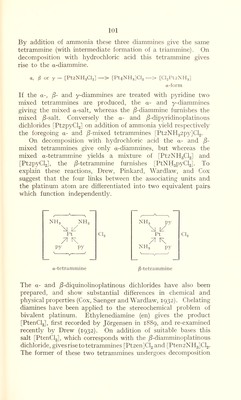
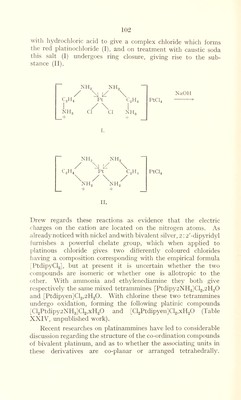
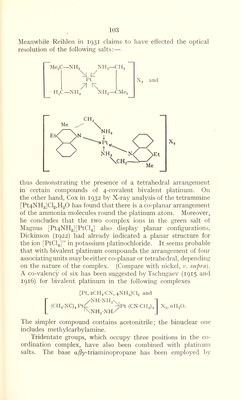
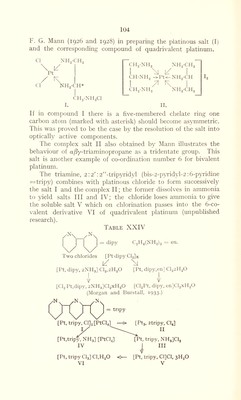
![Meanwhile Reihlen in 1931 claims to have effected the optical resolution of the following salts:— Me2C—NH, NH..-CH, \ 1/ Pt • HgC—NH2 NH,—CMe2 X, and thus demonstrating the presence of a tetrahedral arrangement in certain compounds of 4-covalent bivalent platinum. On the other hand, Cox in 1932 by X-ray analysis of the tetrammine [Pt4NH3]Cl2,H20 has found that there is a co-planar arrangement of the ammonia molecules round the platinum atom. Moreover, he concludes that the two complex ions in the green salt of Magnus [Pt4NH3][PtCl4] also display planar configurations. Dickinson (1922) had already indicated a planar structure for the ion [PtClJ in potassium platinochloride. It seems probable that with bivalent platinum compounds the arrangement of four associating units may be either co-planar or tetrahedral, depending on the nature of the complex. (Compare with nickel, v. supra). A co-valency of six has been suggested by Tschugaev (1915 and 1916) for bivalent platinum in the following complexes [Pt, 2CH3-CN, 4NH3]C12 and r /NH'NHa ' 1 (CH3-NC)4Pt/ ^Pt (CN CH3)4 X2,nH20. L '\nh2-nh/ J The simpler compound contains acetonitrile; the binuclear one includes methylcarbylamine. Tridentate groups, which occupy three positions in the co- ordination complex, have also been combined with platinum salts. The base a/3y-triaminopropane has been employed by](https://iiif.wellcomecollection.org/image/b29808066_0105.jp2/full/800%2C/0/default.jpg)
 No text description is available for this image
 No text description is available for this image
 No text description is available for this image