Three lectures embodying "A survey of modern inorganic chemistry" / by Gilbert Thomas Morgan.
- Gilbert Thomas Morgan
- Date:
- 1933
Licence: In copyright
Credit: Three lectures embodying "A survey of modern inorganic chemistry" / by Gilbert Thomas Morgan. Source: Wellcome Collection.
104/112 page 102
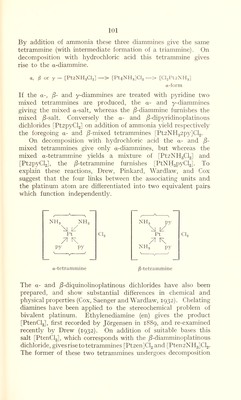
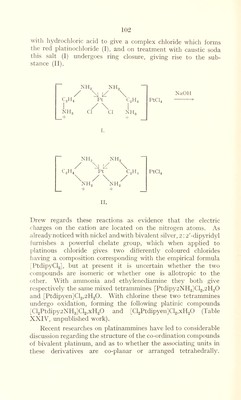
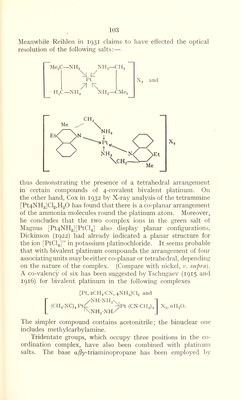
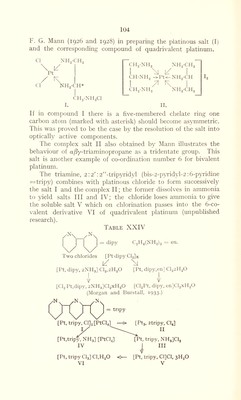
![with hydrochloric acid to give a complex chloride which forms the reel platinoehloride (I), and on treatment with caustic soda this salt (I) undergoes ring closure, giving rise to the sub- stance (II). NH, NH, / \ c2H4 Pt c2h4 NH, Cl Cl NH, NaOH PtCl4 NH, NH, / \J t/ Pt + PtCl4 II. Drew regards these reactions as evidence that the electric charges on the cation are located on the nitrogen atoms. As already noticed with nickel and with bivalent silver, 2:2'-dipvridvl furnishes a powerful chelate group, which when applied to platinous chloride gives two differently coloured chlorides having a composition corresponding with the empirical formula [PtdipyClJ, but at present it is uncertain whether the two •compounds are isomeric or whether one is allotropic to the other. With ammonia and ethylenediamine they both give respectively the same mixed tetrammines [Ptdipy2NH3]Cl2,2H20 and [Ptdipyen]Cl2,2H,0. With chlorine these two tetrammines undergo oxidation, forming the following platinic compounds [Cl2Ptdipy2NH3]Cl2,xH20 and [Cl2Ptdipyen]Cl2,xH20 (Table XXIV, unpublished work). Recent researches on platinammines have led to considerable discussion regarding the structure of the co-ordination compounds of bivalent platinum, and as to whether the associating units in these derivatives are co-planar or arranged tetrahedrally.](https://iiif.wellcomecollection.org/image/b29808066_0104.jp2/full/800%2C/0/default.jpg)
 No text description is available for this image
 No text description is available for this image
 No text description is available for this image