Licence: In copyright
Credit: [Pauperism in Poplar]. Source: Wellcome Collection.
Provider: This material has been provided by London School of Hygiene & Tropical Medicine Library & Archives Service. The original may be consulted at London School of Hygiene & Tropical Medicine Library & Archives Service.
8/550 page 4
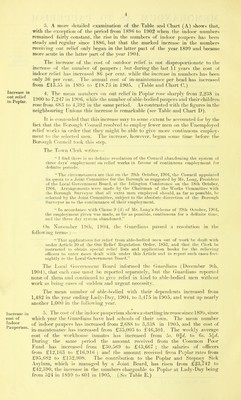
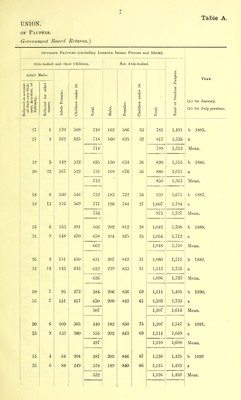
![Increase in out relief .in Poplar. Increase in cost of Indoor Pauperism. 3. A more detailed examination of the Table and Chart (A) shows that, with the exception of the period from 1896 to 1902 when the indoor numbers remained fairly constant, the rise in the numbers of indoor paupers has been steady and regular since 188(), but that the marked increase in the numbers receiving out relief only began in the latter pait of the year 1899 and became more acute in the latter part of the year 1904. The increase of the cost of outdoor relief is not disproportionate to the increase of the number of paupers ; but during the last 11 years the cost of indoor relief has increased 86 per cent, while the increase in numbers has been only 36 per cent. The annual cost of in-maintenance per head has increased from £13.55 in 1895 to ;£l8.7o in 1905. (Table and Chart C.) 4. The mean numbers on out relief in Poplar rose sharply from 2,238 in 1900 to 7,247 in 1906, while the number of able-bodied paupers and their children rosefi-om 683 to 4,392 in the same period. As contrasted with the figures in the neighbouring Unions this increase is remarkable (see Table and Chart D). It is contended that this increase may to some extent be accounted for by the fact that the Borough Council resolved to em])loy fewer men on the Unemployed relief works in order that they might be able to give more continuous employ- ment to the selected men. The increase, howev^er, began some thne before the Borough Council took this step. The Town Clerk writes— I find there is no definice resolution of the Council abandoning the system of three days' employment on relief works ia favour of continuous employment for definite periods. The circumstances are that on the 20th October, 1904, the Council appointed its quota to a Joint Committee for the Borough as suggested by Mr. Long, President of the Local Government Board, at the Islington Conference on the 18th October, 1904. Arrangements were made by the Chairman of the Works Committee with the Borough Surveyor that all extra men employed should, as far as possible, be selected by the Joint Committee, subject to the absolute discretion of the Borough Surveyor as to the continuance of their employment. In accordance with Clause 9 (d) of Mr, Long's Scheme of 29th October, 1901, the employment given was made, as far as possible, continuous for a definite time, and the thi'ee day system abandoned. On November 19tli, 1904, the Guardians passed a resolution in the followino- terms :— That applications for relief from able-bodied imen out of work be dealt with under Article 10 of the Out Relief Regulation Order, 1852, and that the Clerk be instructed to obtain special relief lists and application books for the relieving officers to enter cases dealt with under this Article and to rejjort such cases fort- nightly to the Local Government Board. The Local Government Board informed the Guardians (December 9th, 1904), that each case must be reported separately, but the Guardians reporterl none of them and continued to give relief in kind to able-bodied men without work as being cases of sudden and urgent necessity. The mean number of able-bodied with their dependents increased from 1,482 in the year ending Lady-Day, 1904, to 3,475 in 1905, and went up nearly another 1,000 in the following year. 5. The cost of the indoor pauperism shows a startling increase since 1899, since which year the Guardians have had schools of their own. The mean number of indoor paupers has increased from 2,688 to 3,338 in 1905, and the cost of in-maintenance has increased from ,^35,003 to fi46,301. The weekly average cost of the workhouse inmates has increased from 5^. 0|rf. to 6s. 5.2<:/. During the same period the amount received from the Common Poor Fund has increased from £30,569 to £43,667 ; the salaries of officers from £12,163 to £16,916 ; and the amount received from Poplar rates from £95,682 to £152,908. The contribution to the Poplar and Stepney Sick Asylum, which is managed by a Joint Board, has risen from £23,742 to £42,390, the increase in the numbers chargeable to Poplar at Lady-Day being from 524 in 1899 to 601 in 1905. {See Table E.)](https://iiif.wellcomecollection.org/image/b21359350_0008.jp2/full/800%2C/0/default.jpg)




 No text description is available for this image
 No text description is available for this image
 No text description is available for this image