Temperance and teetotalism : an inquiry into the effects of alcoholic drinks on the human system in health and disease.
- William Benjamin Carpenter
- Date:
- 1848
Licence: Public Domain Mark
Credit: Temperance and teetotalism : an inquiry into the effects of alcoholic drinks on the human system in health and disease. Source: Wellcome Collection.
Provider: This material has been provided by The University of Glasgow Library. The original may be consulted at The University of Glasgow Library.
9/32 page 9
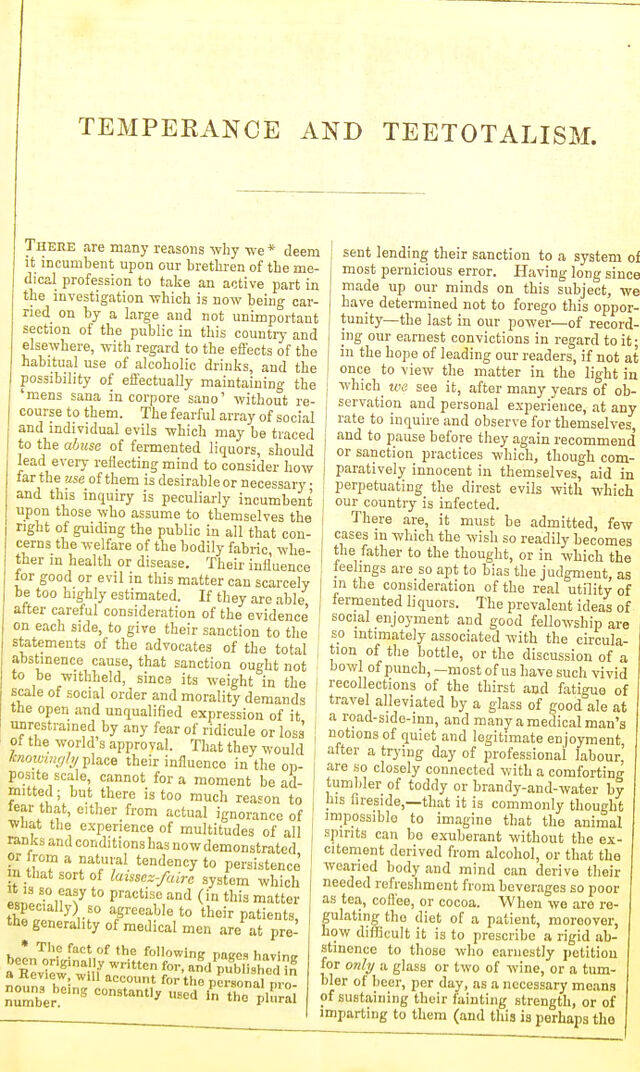
![having received such numerous signatures of medical practitioners, including those of many of our most distiilguished physi- cians and surgeons:— ' We, the undersigned, are of opinion— ' 1. That a very large proportion of human misery, including poverty, disease, and crime, is induced hy the use of alco- holic or fermented liquors as beverages. ' 2. That the most perfect health is compatible with total abstinence from all such intoxicating beverages, whether in the form of ardent spirits, or as wine, beer, ale, porter, cider, etc., etc. ' 3. That persons accustomed to such drinks may, with perfect safety, discon- tinue them entirely, either at once, or gradually after a short time. ' 4. That total and universal abstinence from alcoholic beverages of all sorts would greatly contribute to the health, the pros- perity, the morality, and the happiness of the human race.' Let us say, however, in limine, that whilst taking upon ourselves the earnest advocacy of these doctrines, we by no means wish to identify ourselves with all that has been written and uttered by the disciples of the total abstinence system. Too often their intemperance has passed from their cups to their language; the finger of pharisaical scorn has been pointed at the ' moderate drinkers,' whose con- sciences have not yet told them that there is any harm in the temperate use of fer- mented lifjuors ; and even those who agree with them in their leading principles, and who join with them in their practice, but who hesitate at sanctioning all that ignor- ant enthusiasts think fit to assert, have been stigmatised as enemies rather than as friends to the great cause of emancipation. Now we most fully recognise the impor- tance of earnest and awakening appeals to those who are sunk in the lethargic slavery of one of the most brutalisingof all sensual indulgences; but we are ceitain that ex- aggeration never ultimately serves the in- terests of truth. No words can depict too strongly the evils of intemperance. No appeals can be too urgent or awakening to the blunted feelings of those who are ruin- ing themselves both for time and eternity by an habitual indulgence in this over- powering propensity; but surely there is plenty of matter for the advocates of ab- stmence, without going out of their way to condemn those who maintain that ferment- ed liquors are the gifts of God, to be used I in moderation hut not ahiised. We are quite sure that the manner in which their public proceedings have been conducted has kept many aloof, who would have been ' most valuable and influential advocates of this great cause of social and individual ' reformation. The fact we believe to be, that a large proportion of the intemperate j denunciations and rash statements to which I we allude have been put forth by men who j have themselves felt all the tyranny of this dreadful slavery ; and (as we have been informed by some most competent ob- servers) they feel, on their emancipation from it. a sort of excitement tliat is almost uncontrollable, urging them to bear public teatiraony to the evils from which they have escaped, and infusing into that testi- mony a strength that makes it operate powerfully on the minds of those whom j they desire to awaken, whilst it leads them j (with the want of discrimination natural to j men of imperfect education) to express the \ mostunmitigatedreprobation of those more ! especially who profess themselves friends of temperance, but who do not feel called upon to preach or to practise total abstin- ence. Now we are quite content to brave their condemnation for the sake of what we consider to be truth; and, feeling i satisfied, as we just now said, that the ; interests of truth cannot be served bv ex- aggeration, we think it right fearlessly to state that we cannot, with them, affirm that we consider alcohol in all its forms to be nothing else than a poison. We [ cannot conscientiously go the length of I denying that, under any circumstances, whether of health or disease, the adminis- I tration of alcohol can be justified. We I believe that, if the whole world could he really temperate in the use of fermented liquors, there would be no ne^d of total abstinence societies. But we advocate their principles, because sad experience i i has shown that a lar^e proportion of man- ] ■ kind cannot be temperate in the use of ! fermented liquors, and that nothing short 1 of total abstinence can prevent the con- ' , tinuance, in the rising generation, of the ! terrible evils wtiich wo have at present to j deplore ;—because experience has further ; shown that the reformation of those who ! j are already habitually intemjierate cannot i I 1)0 accomplished by any means short of I I entire abstinence from fermented liquors; j i —and because experience has also proved j that this reformation cannot be carried to i](https://iiif.wellcomecollection.org/image/b21450742_0011.jp2/full/800%2C/0/default.jpg)


 No text description is available for this image
 No text description is available for this image
 No text description is available for this image