Mr. Spear's report to the Local Government Board on the continued prevalence of diphtheria in the Aylesbury urban sanitary district.
- Spear, John.
- Date:
- 1888
Licence: Public Domain Mark
Credit: Mr. Spear's report to the Local Government Board on the continued prevalence of diphtheria in the Aylesbury urban sanitary district. Source: Wellcome Collection.
6/18 page 6
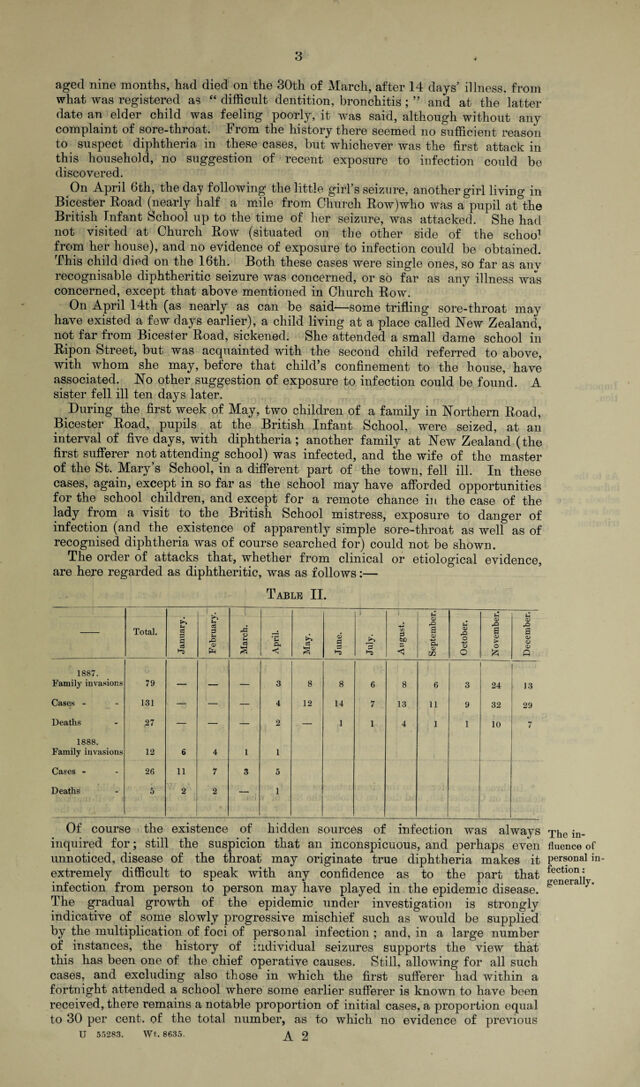
![necessary to subdivide the cases further than is done in the preceding table to show how suddenly the infection became active at various points. It is worthy of remark that the “ explosive ” force of the 1885-86 epidemic was also manifested in November. The 37 household invasions included in Dr. Gresswell’s inquiry were thus distri¬ buted:—in October, 5; in November, 15; in December, 11; in January, 4; first half of It is to'be noted also that the increased fatality of the disease in November 1887 did not appear to be associated with any particular strain of cases, or with school attendance. Four of the British School children, infected during that month, died ; two of the St.John s children; two of the St. Mary’s; two of those attending private schools; and (exclusive of the country case) three “ non-attendants.” Table Y. Daily .Record of initial attacks and of deaths during November. Class. November. Dec. School, &c. 11. 12. 13. 14. 15. 16.1 17. 18.j 19. 20. 21. 22. 23. 24. 25. 26. 27. 28. 29. 30. 1. 2. British - -< St. John’s (no J Boys’ School). \ St. Mary’s -< r i Private Schools - Non-attendants - Total family in • vasions. Deaths (amongst No¬ vember cases.) Note._The returns up to November 29th as to school children give the date of leaving school through illness. a. Case at Oving infected from town. [The two deaths resulting from this extension to the rural district are not included above.] A classification of these November cases according to habitation gives a result, some idea of which may be gathered from the following statement:— It would seem that the grouping observed is greater in amount than can be accounted for by influence of school attendance, and somewhat different in kind. The large incidence, however, upon the infants of St. John’s school will have been noticed. Within so short a time that a round of personal infection could scarcely have brought it about, various individuals—children at different schools and “ non-attendants ”—have appeared to become infected in the same localities. Table VI. Boys (163) - Girls (168) - - 1 1 - Infants (136)- 1 1 — 1 — - — — Girls (120) - 1 Infants (151)- - - 2 1 ~ 1 Boys (113) - - - - - - - - - - - - - - - - - - 1 - - - - Girls (73) Infants (116) - - - - - - i 1 • J Collegiate Miss Cole’s - Miss Wadam’s — - - al - - - i 1 - 1 - 1 - - — - - - - 1 1 1 30 1 1 i i - 3 2 - 2 - 1 1 2 4 - 1 1 2 2 3 2 11 1 2 1 1 1 i 1 1 1 1 - - 1 - Localities comprising Cambridge Street, with short cross streets—Eastern Street, St. John's Road, and Mill Street (about 200 houses). Families School attendance, &c. (respecting initial invaded. sufferer). J 8 f 6, St. John’s School. < 1, British ,, bl, Non-attendant. Walton Street (town end), with Great Western Street, Market Square, and Market Street (about 100 houses). f 3, Different private schools. < 1, St. Mary’s. l_ 4, *Non-attendants. [* In one of these, the sufferer (the only one of his family) lived in the suburbs, but attended his place of business daily in Market Square; another was the case at Oving (page 4), in which infection had apparently been contracted during an afternoon and evening spent at the Corn Ex¬ change, Market Square.]](https://iiif.wellcomecollection.org/image/b30557136_0006.jp2/full/800%2C/0/default.jpg)