The causes of asthenopia / by D. B. St. John Roosa.
- Daniel Bennett St. John Roosa
- Date:
- [1891]
Licence: Public Domain Mark
Credit: The causes of asthenopia / by D. B. St. John Roosa. Source: Wellcome Collection.
Provider: This material has been provided by UCL Library Services. The original may be consulted at UCL (University College London)
1/6
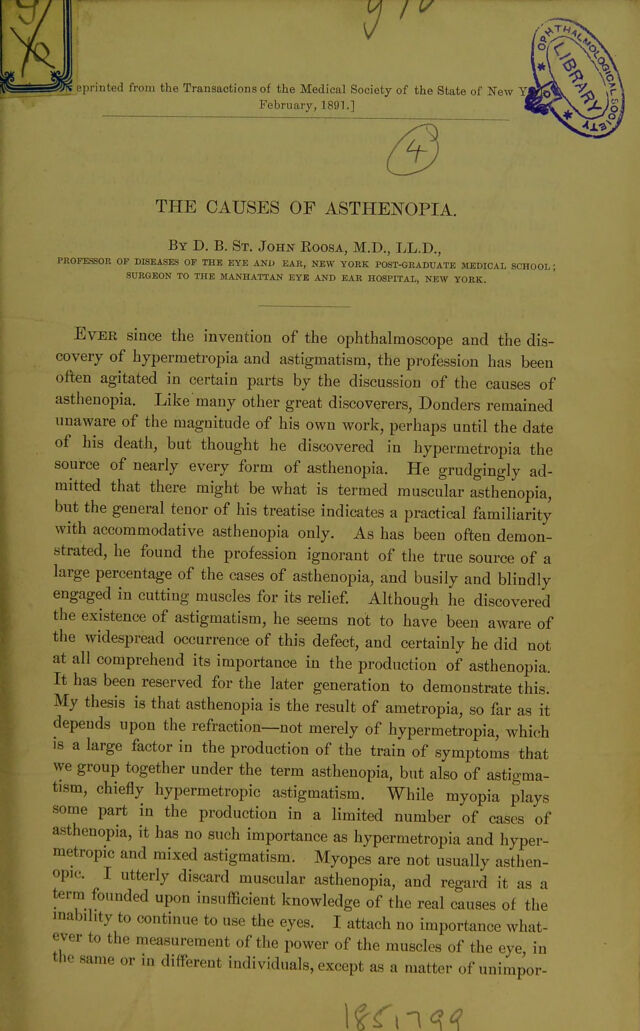
![sprinted from the Transactions of the Medical Society of the State of New Y February, 1891.] THE CAUSES OF ASTHENOPIA. By D. B. St. Johjst Eoosa, M.D., LL.D., PROFESSOR OP DISEASES OF THE EYE ANi> EAR, NEW YORK POST-GRADUATE MEDICAL SCHOOL ; SURGEON TO THE MANHATTAN EYE AND EAR HOSPITAL, NEW YORK. Ever since the invention of the ophthalmoscope and the dis- covery of hypermetropia and astigmatism, the profession has been often agitated in certain parts by the discussion of the causes of astlienopia. Like many other great discoverers, Donders remained unaware of the magnitude of his own work, perhaps until the date of his death, but thought he discovered in hypermetropia the source of nearly every form of asthenopia. He grudgingly ad- mitted that there might be what is termed muscular asthenopia, but the general tenor of his treatise indicates a practical familiarity with accommodative asthenopia only. As has been often demon- strated, he found the profession ignorant of the true source of a large percentage of the cases of asthenopia, and busily and blindly engaged in cutting muscles for its relief. Although he discovered the existence of astigmatism, he seems not to have been aware of the widespread occurrence of this defect, and certainly he did not at all comprehend its importance in the production of asthenopia. It has been reserved for the later generation to demonstrate this. My thesis is that asthenopia is the result of ametropia, so far as it depends upon the refraction—not merely of hypermetropia, which is a large factor in the production of the train of symptoms that we group together under the term asthenopia, but also of astigma- tism, chiefly hypermetropic astigmatism. While myopia plays some part in the production in a limited number of cases of asthenopia, it has no such importance as hypermetropia and hyper- metropic and mixed astigmatism. Myopes are not usually asthen- opic. I utterly discard muscular asthenopia, and regard it as a term founded upon insufficient knowledge of the real causes of the inability to continue to use the eyes. I attach no importance what- ever to the measurement of the power of the muscles of the eye, in the same or in different individuals, except as a matter of unimpor-](https://iiif.wellcomecollection.org/image/b21648128_0003.jp2/full/800%2C/0/default.jpg)