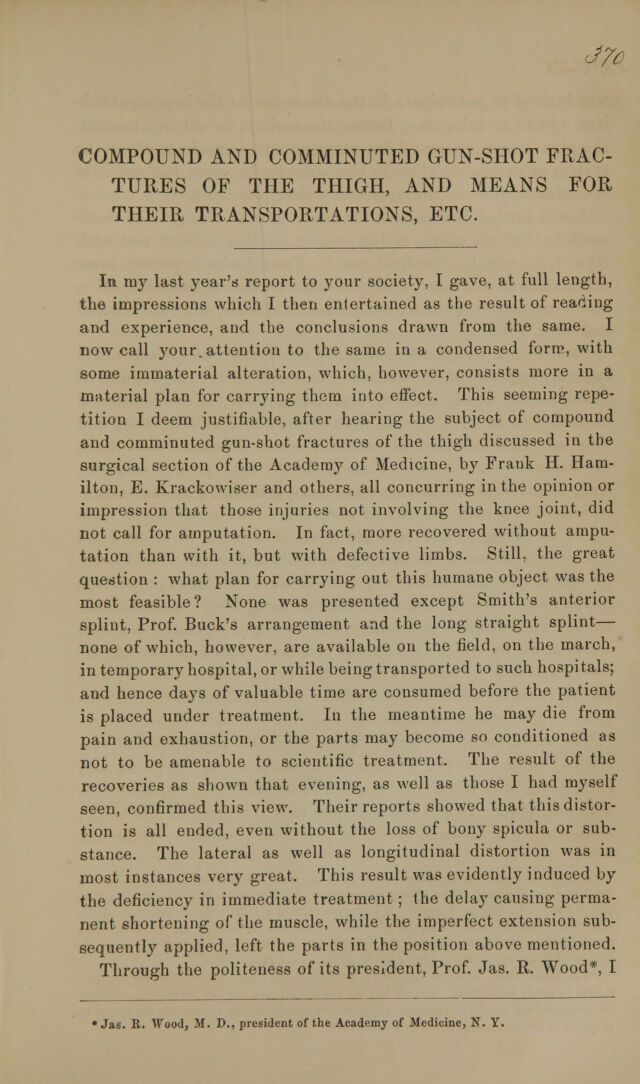
Compound and comminuted gun-shot fractures of the thigh and means for their transportations, etc / John Swinburne.
- John Swinburne
- Date:
- 1864
Licence: Public Domain Mark
Credit: Compound and comminuted gun-shot fractures of the thigh and means for their transportations, etc / John Swinburne. Source: Wellcome Collection.
Provider: This material has been provided by the National Library of Medicine (U.S.), through the Medical Heritage Library. The original may be consulted at the National Library of Medicine (U.S.)
17/18
![388 15 the case in partial excision. If the comminution extends to the shaft of the humerus or radius and ulna, remove its loose spiculae and leave the rest to nature. 4th. In comminuted compound fracture of the carpel end of the radius or radius and ulna, excision of the articulating ends affords the most reasonable prospect of success. Leaving it to nature is far preferable to amputation. Never amputate for this injury. 5th. Compound gunshot injuries of the carpus or metacarpus/ seldom if ever require either excision or amputation. Remove the loose bones and treat as a simple wound. 6th. In compound gunshot injuries of the phalanges, excision can be practiced only with varying success, owing to the size of the bullet and the smallness of the member. The rule is to save as much as possible. Injuries to these parts, sustained by buck- shot or pistol balls, do not, as a rule, require amputation. On the contrary, most of them can be saved. 7th. In compound and comminuted injuries of the humeral shaft, excision or amputation should never be performed. The loose spiculae should be removed, and the case treated as an ordi- nary compound fracture. If, however, the comminution extends to the articulation, it (the articulation end) should be excised with the loose spiculee, while the fragments of the shaft, which still retain their periosteum, should not be disturbed. 8th. The same rule applies to the shaft of either or both bones of the forearm. In all cases avoid constriction by bandaging. 9th. Cases of compound fracture of any portion of the femur not involving the knee-joint ought not to be treated as hereinaf- ter detailed, i.e., by simple extension and counter-extension. Making the stretcher the splint, [see diagram.] 10th. Cases of compound and comminuted gunshot fractures of the tibia, or tibia and fibula, not involving the knee or ankle- joint, should be treated as above stated for the femur, [see dia- gram.] 11th. Simple gunshot injuries of the ankle-joint do not necessi- tate amputation, while compound and comminuted fracture of this joint, and particularly when the arteries are much injured, may require amputation. Though with proper support, water dres- sings, irrigation, free incisions, &c, a great majority will recover without operative interference. The same rule is applicable to gunshot wounds of the foot as of the hand, and I can safely say that there is scarcely a bullet](https://iiif.wellcomecollection.org/image/b21157741_0017.jp2/full/800%2C/0/default.jpg)