On the elephant seal (Macrorhinus leoninus, Linn.) / by William H. Flower.
- William Henry Flower
- Date:
- 1881
Licence: Public Domain Mark
Credit: On the elephant seal (Macrorhinus leoninus, Linn.) / by William H. Flower. Source: Wellcome Collection.
Provider: This material has been provided by The Royal College of Surgeons of England. The original may be consulted at The Royal College of Surgeons of England.
11/18 (page 155)
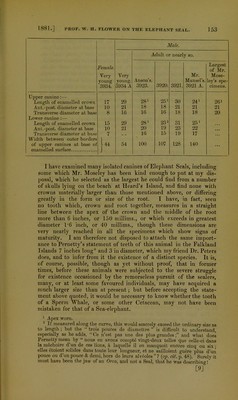
![be of the same number as the permanent set, and the milk-molars of all Seals, and indeed of the Carnivora generally, are §> corresponding to the second, third, and fourth prcmolars of the second dentition. There was, in addition, in the upper jaw a small cap of dentine, in the situation of the apex of the first permanent premolar—a tooth which, in its development, is almost coeval with the milk-teeth, and has no predecessor. The permanent dental formula of the Elephant Seal is thus determined to he i. f, c. -j-, p. i-, m. ]- = 30, as given above. The incisors and canines are cylindrical, with rounded, rather truncated crowns, and are open at the base. The upper canine, which is the largest tooth, and of which the whole of the crown and greater part of the root are calcified, measure 3 millims. in length and 1 millim. in greatest thickness. The second upper incisor is about half this size, and the first still smaller. The molars consist only of a rounded crown, scarcely more than 1 millim. in diameter, with the commencement of a single root, which, however, is not calcified. As the crowns of teeth, once calcified, never enlarge in diameter, we may presume that these rudimentary teeth had attained their full dimensions, except, perhaps, as to the length of the root in some of them. They therefore, in contrast to the size of the animal and of the permanent teeth, represent one of the most rudimentary con- ditions in which it is possible to imagine the existence of a set of milk-teeth complete as to number ; and they form the last term known at present of a series, beginning with the ordinary terrestrial Carnivora, such as the Canidae, and passing through the Bears, the Otariidse, and the other known members of the Phocidse. The step from this condition to the completely monophyodont state of the Cetacea is not very great. These teeth probably disappear long be- fore birth ; but foetal Elephant Seals at later stages of development are greatly required, in order to trace the progress of dentition. Auditory Ossicles.—The auditory ossicles of the Elephant Seal have been described and figured in the elaborate memoir by Mr. Alban l)oran on these structures', which merit more attention than they have hitherto received as guides to affinity. Before the pub- lication of this memoir, or the formation of such a collection as that now to be seen in the Museum of the College of Surgeons, it was impossible to appreciate their value, as it is only by studying the modifications of any part in a tolerably extensive series of forms that its essential characters can be deduced and separated from those that are variable and comparatively unimportant, and the true relative value assigned to the different modifications met with. The auditory ossicles of the Seals generally differ from those of i their allies, the terrestrial Carnivora, in their large size and the massive and exuberant growth of the bone composing them. It is very remarkable, and may perhaps indicate some, though not yet under- stood, relation to the conditions under which these animals live, that ’ in this respect they resemble the other aquatic mammalia, the Cetacea and the Sirenia. But it is only in this, perhaps an adaptive character, that the ‘ 1 Trans. Linn. Soc. 2nd series, Zoology, vol. i.](https://iiif.wellcomecollection.org/image/b22455772_0013.jp2/full/800%2C/0/default.jpg)