Oxygen gas as a remedy in disease.
- Smith, Andrew H. (Andrew Heermance), 1837-1910
- Date:
- 1870
Licence: Public Domain Mark
Credit: Oxygen gas as a remedy in disease. Source: Wellcome Collection.
Provider: This material has been provided by The Royal College of Surgeons of England. The original may be consulted at The Royal College of Surgeons of England.
7/62 (page 5)
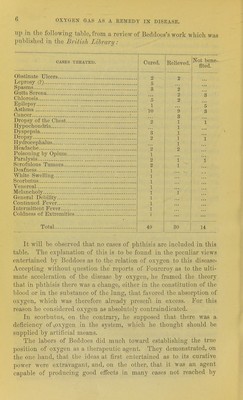
![In 1789 Beddoes pnblished his book entitled Considerations on the Factitious Airs. He was at that time Professor of Chem- istry at Oxford, but none the less devoted to the practice of medi- cine, in Avhich he had already attained a high position. To him belongs the credit of being the first to approach the subject without a theory to sustain. It was not until he had accumulated a large number of facts that he attempted to arrange and classify them. His attempts at generalization were not ahvays attended with the happiest results; but the readiness with which he relinquishes a theory the moment it is found to conflict with fact, gives a rare im- pression of candor and impartiality to his work. The scope of the work includes observations upon several gases besides oxygen, especially carbonic acid and hydrogen. His physiological experiments are of great interest. The prin- cipal results which he arrived at were the following: Oxygen produces a remarkable power of resisting asphyxia. It appears that, when the blood contains an unusual amount of oxy- gen, the animal is better able to support a deficiency of respirable air, or even the presence of an irrespirable gas. Animals which have respired oxygen resist longer the action of frigorific mixtures. The action of oxygen seems to be localized principally in the muscular svstem. Oxygen is in the highest degree a stimulus to the irritability of the heart and blood-vessels. The last conclusion is one which succeeding observers will scarcely indorse to the fullest extent. As a stimulant to the circu- lation, oxygen is certainly far inferior to alcohol; indeed in many cases, its stimulating effect is scarcely ]oreceptible. A few isolated cases of success in the therapeutic use of different gases encouraged Beddoes to set on foot the project of a Pneumatic Institute, in which this mode of treatment could be tested on an ex- tensive scale. The pla^i enlisted the cooperation of Sir H. Davy, who gave himself with ardor to the chemical part of the Avork, and of the eminent engineer James Watt, whose genius left nothing to be desired in the mechanical appliances for administering the gas. Probably a more brilliant triumvirate was never confined in the furtherance of a scientific object. In pursuance of their plan, a building was erected by public sub- scriptions. It contained small compartments, the atmosphere of which could be charged with any desired gas. In these rooms the patients were allowed to pass a certain time daily. The principal results obtained by the use of oxygen are summed](https://iiif.wellcomecollection.org/image/b22268054_0007.jp2/full/800%2C/0/default.jpg)