On the pathology and treatment of delirium and coma : the Lumleian lectures for 1850 / by R.B. Todd.
- Date:
- 1850
Licence: Public Domain Mark
Credit: On the pathology and treatment of delirium and coma : the Lumleian lectures for 1850 / by R.B. Todd. Source: Wellcome Collection.
Provider: This material has been provided by the Royal College of Physicians of Edinburgh. The original may be consulted at the Royal College of Physicians of Edinburgh.
12/72 page 12
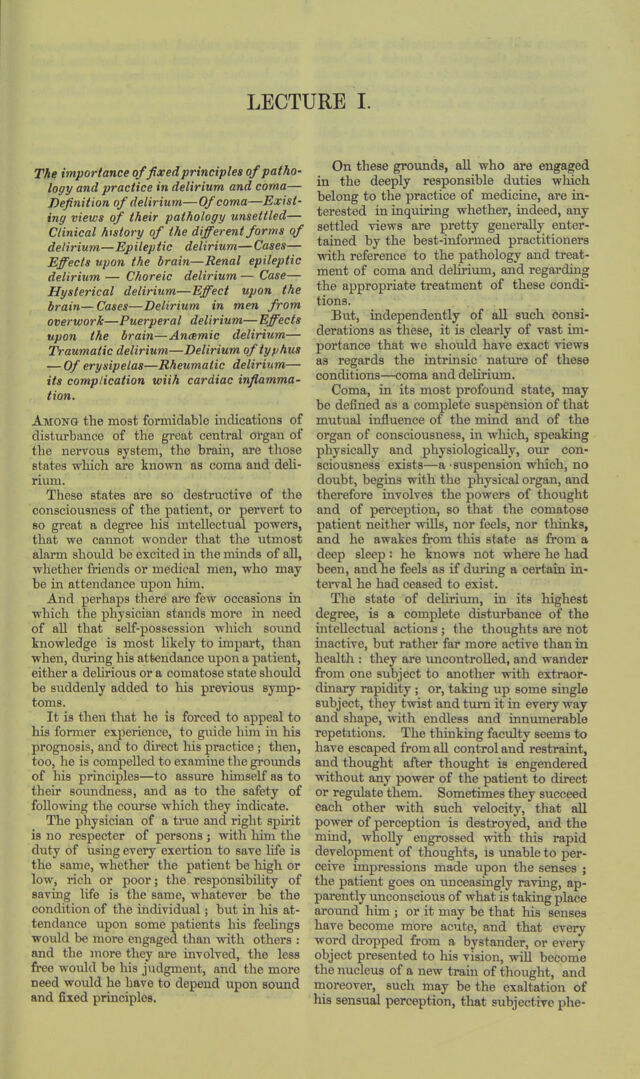
![in others the fluid is absent: never is tliero any sign of an active morbid process, like inflammation, cither in the brain or its membranes, tending to generate new mat- ter, as lymph and pus, and to destroy exist- ing tissue. This form of delirium is of much shorter duration than most of those wliich I have ah’cady described ; nor has it any tendency to degenerate into a chronic state, as is the case with tlie hysterical and with the puer- poi'al delu'ium. Like the traumatic deli- rium, it seldom lasts many days, either killing the patient by exliaustion, -with more or less of coma, or ending in reco- very. Erysipelatous delirium.—The deluiiun of eiysipelas resembles very closely that of typhus, excepting in tins pomt, that it is perhaps more frequently of the more active and violent, than of the low and muttering kind. It commonly comes on with more or less of sud- denness : you leave your patient going on well; on your next visit, a few hours afterwards, you find liim talkative, ram- bhng, attemptmg to get out of bed, noisy, and soon he becomes so violent as to re- quu’e the constant watchfulness of one or two attendants, or the restraint of the strait-waistcoat, to prevent him from in- juring himself or others. It ocem’s in both idiopatliic and trauma- tic erysipelas ; and is not confined to that of the head or neck, but will take ]3lace in cases in which the erysipelas is confined to tlie trunk, and never reaches the head. It seems more apt to occur in debihtated subjects—in patients after operations which liave caused much loss of blood—and in the low and decidedly typhoid forms of ei’ysipelas. Patients die in it, just as in the delirium of typhus : they die suddenly in an effort, or they become much exhausted, or they fall into deep coma; but more frequently they recover, especially if care be taken to prevent them from making violent exer- tions, and to give them a proper amount of support. The duration of tliis dehrium is not in general above a few days, and it very rarely degenerates into a chronic state. The inspection of the brains in these cases shows no sign of active disease, nor any evidence, as might not uiueasonably bo supposed, of a state of brain similar to that of the extcnial parts. The ei-ysipelas does not fly from the exterior to the interior: tliei’e is no metastasis, although I should not be prepared to say that the brain is not atfected by the poison of erysipelas. It is certain, liowevcr, from numerous post-mortem examinations, that the brain and its membranes of patients dying under this form of delirium, exhibit no morbid alteration of any kind sufliciont to account for the phenomena. What 1 liave most frequently seen in this, as in other forms of delirium, has been a state of pallor of the grey matter, and an increased number of bloody points in the white matter of the hemispheres. Rheumatic delirium,—That form of de- lirium which accompanies inflammation of the lung, or of the heart, occurs so com- monly, if not uniformly, in the rheumatic state, that I shall describe it in connection with that dclfrium wliich arises in tlic coxuse of rheumatic fever, under the name of rheumatic delirium. The following description of this form of delirium accords with what I have my- self seen, and wliat I find recorded by others:— A patient is seized with aU the ordi- nary symptoms of rhemnatic fever, and he goes on without any untoward symptoms, —it may be for only tliree or four days, it may be for a week, or even later,—when the nurse having perhaps reported that he passed a restless night or two, and wan- dered more or less, w'e find him delirious, raving, talking w'Udly, and, as in the trau- matic delii'ium, entfrely disregarding his hitherto exquisitely pauiful, and stfll swollen joints. The tendency in these cases is to the acute maniacal state, and to wakefulness ; so that frequently the patient requii’cs restraint, and always the closest watchfulness. As in the other acute fonns of delirium, patients often die suddenly in this, evi- dently from exhaustion. Sometimes they quickly fall into a state of jirofound coma, wliich lasts from one to twenty-four hours, and terminates in the death of the patient. I suspect that moving patients from one place to another in rheumatic fever is apt to bring on tins mode of teimination ; for I have had several cases in wdiieh a patient was brought into the hospital late in the afternoon, having been three or four days ill of rheumatic fever, and in the course of the night he became delirious, and then comatose, and died. This delii’imn is sometimes ushered in by other symptoms, wliich denote a more extensive disturbance of the neiwous sys- tem than delirium would do. Thus, a pa- tient will be seized with chorea-like jactita- tions affecting the upper extremities, and the muscles of the face; and sometimes a condition almost tetanic is present, and more or less of rigidity and oposthotoiios are produced. Coineident with the first appearance of these symptoms, tliat is, either of the de- lirium or the jactitations, we frequently find, but by no moans always, the iirat signs of inflammation of the pcricardiiuii, or of the](https://iiif.wellcomecollection.org/image/b21955566_0014.jp2/full/800%2C/0/default.jpg)