Volume 1
Elementary text-book of zoology / by C. Claus ; translated and edited by Adam Sedgwick ; with the assistance of F.G. Heathcote.
- Carl Friedrich Wilhelm Claus
- Date:
- 1889-1891
Licence: Public Domain Mark
Credit: Elementary text-book of zoology / by C. Claus ; translated and edited by Adam Sedgwick ; with the assistance of F.G. Heathcote. Source: Wellcome Collection.
17/624 page 13
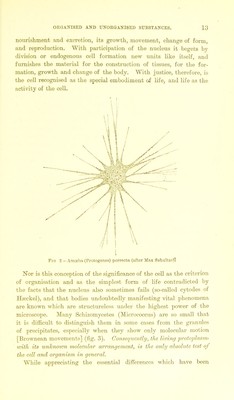
![nonrishment and excretion, its growth, movement, change of form, and reproduction. With participation of the nucleus it begets by division or endogenous cell formation new units like itself, and fumishes the material for the construction of tissues, for the for- mation, growth and change of the body. With justice, therefore, is the cell recognised as the special embodiment of life, and life as the activity of the cell. Fig 2 — Amceba (Protogenes) porrecta (after Max Sehultzc)! Nor is this conception of the significance of the cell as the criterion of Organisation and as the simplest form of life contradicted by the facts that the nucleus also sometimes fails (so-called cytodes of Haeekel), and that bodies undoubtedly manifesting vital phenomena are known which are structureless under the highest power of the microscope. Many Schizomycetes (Micrococcus) are so small that it is difficult to distinguish them in some cases from the granules of precipitates, especially when they show only molecular motion [Brownean movements] (fig. 3). Consequently, the living protoplasmi vrith its unknown molecular a/rrangement, is the only absolute test of the cell and organism in general. While appreciating the essential differences which liave been](https://iiif.wellcomecollection.org/image/b28121831_0001_0017.jp2/full/800%2C/0/default.jpg)