General report of the Commission appointed for improving the sanitary condition of barracks and hospitals.
- Great Britain. Barrack and Hospital Improvement Commission.
- Date:
- 1861
Licence: Public Domain Mark
Credit: General report of the Commission appointed for improving the sanitary condition of barracks and hospitals. Source: Wellcome Collection.
Provider: This material has been provided by King’s College London. The original may be consulted at King’s College London.
26/350 (page 20)
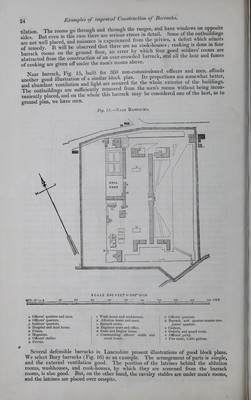
![Figure 10 gives a plan of one flat of the new barracks in Edinburgh Castle, which exhibits one of the most objectionable instances of inner corridors in existence. Fig. 10.—New Barrack, Edinburgh Castle. - 1 1. ])<cp surk areas ficm wh'cli pait of li e lower Barrack Booms c’trive their light an cventilation. ?’ 2. Scklieis’ iccirs bivirg w n£ovs cnly tn one side; oieuing cut of— ?, 3. Dark, unventilated ins'de corridors. o’ o. Officers’ quarters and mess establishment, &c. The corridor abuts at the ends on the officers’ quarters and mess establishment, and is closed by doors at each end, so that no thorough draft can take place in it. It is dark and gloomy, receives no direct light, and the air stagnates throughout the building in consequence of want of thorough draught. This barrack, notwithstanding its elevated airy position, is unhealthy, and furnishes a large mortality from consumption and fever, and troops stationed in it arc more than usually liable to attacks of small-pox. Another objectionable form of the corridor arrangement, though of course not so objectionable as the former, consists in carrying the corridor along one face of the barrack. This arrangement may be seen in part of the Wellington barrack, in the Iloyal barrack, Dublin, and in the new Kensington barrack. It gives an apparent facility of access to the rooms at the expense of their light and ventilation, both of which are cut off along one side, or at one end if the rooms are deep from front to back. It is shown in Fig. 11. Fig. 11.—Wellington Barracks. Showing a com lor covering one side of the range of rooms, which have consequently windows to the open air only at one end. The time which barrack room floors take to dry after having been washed affords a useful indication of the freedom, or otherwise, of the ventilation provided in the construc- tion and arrangement of the rooms. In barracks with corridors covering one side of some of the rooms, and where other rooms in the same block have windows to the open air on two opposite sides, it is observed that the floors of the latter class of rooms dry much more speedily than the floors of the former class. In many barracks, even of recent construction, no sufficient accommodation has been proviued for non-commissioned officers, and to supply this deficiency, a wooden bunk is generally placed in one corner of each barrack room. The result of this arrangement is, that if there be a window where the bunk is placed, the light of the window is taken from the barrack room; and if there be no window, as sometimes happens, the bunk is snnply a large dark unventilated box, in which the serjeant sleeps. rig. 12 shows how these bunks are generally placed in the rooms. The instance we have selected is from Bury barracks, in which rooms, otherwise good, have their light and ventilation injuriously interfered with by this defective construction.](https://iiif.wellcomecollection.org/image/b2130905x_0026.jp2/full/800%2C/0/default.jpg)