Remarks on the employment of the waters of Kreuznach / by E. H. Sieveking.
- Sieveking, Edward H. (Edward Henry), 1816-1904.
- Date:
- 1853
Licence: Public Domain Mark
Credit: Remarks on the employment of the waters of Kreuznach / by E. H. Sieveking. Source: Wellcome Collection.
Provider: This material has been provided by Royal College of Physicians, London. The original may be consulted at Royal College of Physicians, London.
7/16 page 7
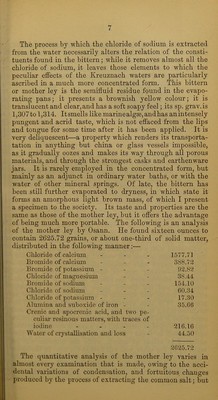
![The process by which the chloride of sodium is extracted from the water necessarily alters the relation of the consti- tuents found in the bittern; while it removes almost all the chloride of sodium, it leaves those elements to which the peculiar effects of the Kreuznach waters are particularly ascribed in a much more concentrated form. This bittern or mother ley is the semifluid residue found in the evapo- rating pans; it presents a brownish yellow colour; it is translucent and clear, and has a soft soapy feel; its sp. grav.is 1,307 to 1,314. It smells like marine algse, and has an intensely pungent and acrid taste, which is not effaced from the lips and tongue for some time after it has been applied. It is very deliquescent—a property which renders its transporta- tation in anything but china or glass vessels impossible, as it gradually oozes and makes its way through all porous materials, and through the strongest casks and earthenware jars. It is rarely employed in the concentrated form, but mainly as an adjunct in ordinary water baths, or with the water of other mineral springs. Of late, the bittern has been still further evaporated to dryness, in which state it forms an amorphous light brown mass, of which I present a specimen to the society. Its taste and properties are the same as those of the mother ley, but it offers the advantage of being much more portable. The following is an analysis of the mother ley by Osann. He found sixteen ounces to contain 2625.72 grains, or about one-third of solid matter, distributed in the following manner:— Chloride of calcium ... 1577.7] Bromide of calcium - - - 388.72 Bromide of potassium - 92.82 Chloride of magnesium - - 38.44 Bromide of sodium ... 154.10 Chloride of sodium ... 60.34 Chloride of potassium ... 17.30 Alumina and suboxide of iron - - 35.06 Crenic and apocrenic acid, and two pe- culiar resinous matters, with traces of iodine .... 216.16 Water of crystallisation and loss - 44.50 2025.72 The quantitative analysis of the mother ley varies in almost every examination that is made, owing to the acci- dental variations of condensation, and fortuitous changes produced by the process of extracting the common salt; but](https://iiif.wellcomecollection.org/image/b2840760x_0009.jp2/full/800%2C/0/default.jpg)


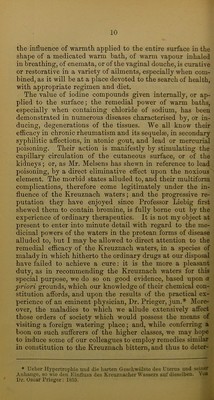
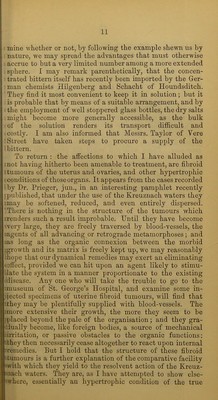

 No text description is available for this image
 No text description is available for this image
 No text description is available for this image