Remarks on the employment of the waters of Kreuznach / by E. H. Sieveking.
- Sieveking, Edward H. (Edward Henry), 1816-1904.
- Date:
- 1853
Licence: Public Domain Mark
Credit: Remarks on the employment of the waters of Kreuznach / by E. H. Sieveking. Source: Wellcome Collection.
Provider: This material has been provided by Royal College of Physicians, London. The original may be consulted at Royal College of Physicians, London.
11/16 page 11
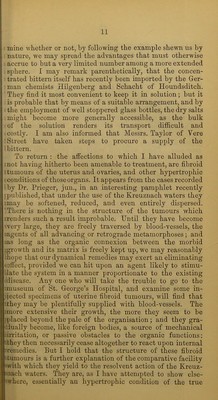
![mine whether or not, by following the example shewn us by nature, we may spread the advantages that must otherwise accrue to but a very limited number among a more extended sphere. I may remark parenthetically, that the concen- trated bittern itself has recently been imported by the Ger- man chemists Hilgenberg and Schacht of Houndsditch. They find it most convenient to keep it in solution; but it is probable that by means of a suitable arrangement, and by ; the employment of well stoppered glass bottles, the dry salts might become more generally accessible, as the bulk of the solution renders its transport difficult and costly. I am also informed that Messrs. Taylor of Yere Street have taken steps to procure a supply of the i bittern. To return : the affections to which I have alluded as not having hitherto been amenable to treatment, are fibroid t tumours of the uterus and ovaries, and other hypertrophic conditions of those organs. It appears from the cases recorded by Dr. Prieger, jun., in an interesting pamphlet recently ] published, that under the use of the Kreuznach waters they imay be softened, reduced, and even entirely dispersed. There is nothing in the structure of the tumours which rreuders such a result improbable. Until they have become 'very large, they are freely traversed by blood-vessels, the ;agents of all advancing or retrograde metamorphoses; and has long as the organic connexion between the morbid -growth and its matrix is freely kept up, we may reasonably I hope that our dynamical remedies may exert an eliminating eeffect, provided we can hit upon an agent likely to stimu- llate the system in a manner proportionate to the existing disease. Any one who will take the trouble to go to the 1 museum of St. George’s Hospital, and examine some in- jected specimens of uterine fibroid tumours, will find that ithey may be plentifully supplied with blood-vessels. The unore extensive their growth, the more they seem to be i placed beyond the pale of the organisation; and they gra- dually become, like foreign bodies, a source of mechanical iirritation, or passive obstacles to the organic functions: 'they then necessarily cease altogether to react upon internal rremedies. But I hold that the structure of these fibroid 5 tumours is a further explanation of the comparative facility with which they yield to the resolvent action of the Kreuz- i each waters. They are, as I have attempted to show else- where, essentially an hypertrophic condition of the true](https://iiif.wellcomecollection.org/image/b2840760x_0013.jp2/full/800%2C/0/default.jpg)



 No text description is available for this image
 No text description is available for this image
 No text description is available for this image