Report by Professor W.J. Simpson on sanitary matters in various West African colonies and the outbreak of plague in the Gold Coast.
- William Simpson
- Date:
- 1909
Licence: In copyright
Credit: Report by Professor W.J. Simpson on sanitary matters in various West African colonies and the outbreak of plague in the Gold Coast. Source: Wellcome Collection.
Provider: This material has been provided by London School of Hygiene & Tropical Medicine Library & Archives Service. The original may be consulted at London School of Hygiene & Tropical Medicine Library & Archives Service.
14/174
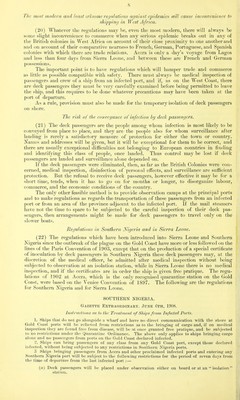
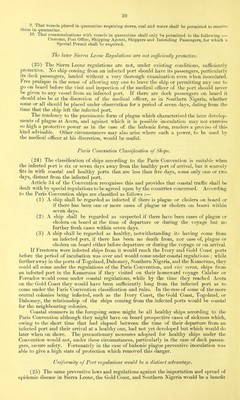
![The most modern and least irksome ret/ulations against epidemics will cause inconvenience to shippiny in JVest Africa. (20) Whatever the regulations may be, even the most modern, there will always be some slight inconvenience to commerce when any serious epidemic breaks out in any of the British colonies in West Africa on account of their close proximity to one another and and on account of their comparative nearness to French, German, Portuguese, and Spanish colonies with which there are trade relations. Accra is only a day's voyage from Lagos and less than four days from Sierra Leone, and between these are French and German • possessions. The important point is to have regulations which will hamper trade and commerce as little as possible compatible with safety. There must always be medical inspection of passengers and crew of a ship from an infected port, and if, as on the West Coast, there are deck passengers they must be very carefully examined before being permitted to leave the ship, and this requires to be done whatever precautions may have been taken at the port of departure. As a rule, provision must also be made for the temporary isolation of deck passengers on shore. The risk of the conveyance of infection by deck passenyers. (21) The deck passengers are the people among whom infection is most likely to be conveyed from place to place, and they are the people also for whom surveillance after landing is rarely a satisfactory measure of protection for either the town or country. Names and addresses will be given, but it will be exceptional for them to be correct, and there are usually exceptional difficulties not belonging to European countries in finding and identifying this class of people, once landed. Thus control may be lost if deck passengers are landed and surveillance alone depended on. If the deck passengers were eliminated, then, as far as the British Colonies were con- cerned, medical inspection, disinfection of personal effects, and surveillance are sufficient protection. But the refusal to receive deck passengers, however effective it may be for a short time, tends, when it has to go on for months or longer, to disorganize labour, commerce, and the economic conditions of the country. The only other feasible method is to provide observation camps at the principal ports and to make regulations as regards the transportation of these passengers from an infected port or from an area of the province adjacent to the infected port. If the mail steamers have not the time to spare to be subjected to the careful inspection of their deck pas- sengers, then arrangements might be made for deck passengers to travel only on the slower boats. Reyulations in Southern Nigeria and in Sierra Leone. (22) The regulations which have been introduced into Sierra Leone and Southern Nigeria since the outbreak of the plague on the Gold Coast have more or less followed on the lines of the Paris Convention of 1903, except that on the production of a special certificate of inoculation by deck passengers in Southern Nigeria these deck passengers may, at the discretion of the medical officer, be admitted after medical inspection without being subjected to observation at an isolation station, while in Sierra Leone there is no medical inspection, and if the certificates are in order the ship is given free pratique. The regu- lations of 1902 at Accra, which is the only recognised quarantine station on the Gold Coast, were based on the Venice Convention of 1897. The following are the regulations for Southern Nigeria and for Sierra Leone. SOUTHERN NIGERIA. Gazette Extraordinary. June 6th, 1908. Instructions as to the Treatment of Ships from Infected Ports. 1. Ships that do not go alongside a wharf and have no direct communication with the stiore at Gold Coast ports will be relieved from restrictions as to the bringing of cargo and, if on medical inspection they are found free from disease, will be at once granted free pratique, and be subjected to no restrictions under the Quarantine Ordinance. The above only applies to ships bringing cargo alone and no passengers from ports on the Gold Coast declared infected. 2. Ships can bring passengers of any class from any Gold Coast port, except those declared infected, without being subjected to any restrictions in Southern Nigeria ports. 3 Ships bringing passengers from Accra and other proclaimed infected ports and entering any Southern Nigeria ])ort will be subject to the following restrictions for the period of seven days from the time of departure from the last infected port :— (rt) Deck passengers will be placed tinder observation either on board or at an isolation station.](https://iiif.wellcomecollection.org/image/b21365398_0014.jp2/full/800%2C/0/default.jpg)



 No text description is available for this image
 No text description is available for this image
 No text description is available for this image