Improvements in treating, purifying, and sterilizing water or contaminated liquids, and an apparatus therefor / [William Lawrence].
- Lawrence, William
- Date:
- 1895
Licence: Public Domain Mark
Credit: Improvements in treating, purifying, and sterilizing water or contaminated liquids, and an apparatus therefor / [William Lawrence]. Source: Wellcome Collection.
1/16
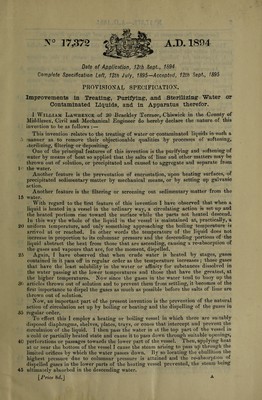
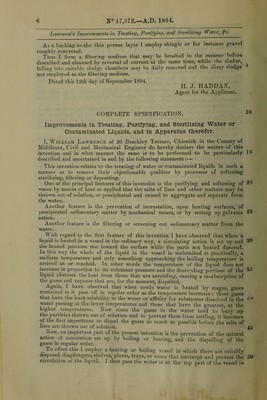
![N° 37,372 A.D. 1894 Date of Application, 12lh Sept., 1894 Complete Specification Left, 12th July, 1895—Accepted, 12th Sept., 1895 PROVISIONAL SPECIFICATION. Improvements in Treating, Purifying, and Sterilizing Water or Contaminated Liquids, and in Apparatus therefor. I William Lawrence of 20 Brackley Terrace, Chiswick in the County of Middlesex, Civil and Mechanical Engineer do hereby declare the nature of this invention to be as follows :— This invention relates to the treating of water or contaminated liquids in such a ') manner as to remove their objectionable qualities by processes of softening, sterilizing, filtering or depositing. One of the principal features of this invention is the purifying and softening of water by means of heat so applied that the salts of lime and other matters may be thrown out of solution, or precipitated and caused to aggregate and separate from the water. Another feature is the preventation of encrustation, upon heating surfaces, of precipitated sedimentary matter by mechauical means, or by setting up galvanic action. Another feature is the filtering or screening out sedimentary matter from the 15 water. With regard to the first feature of this invention I have observed that when a liquid is heated in a vessel in the ordinary way, a circulating action is set up and the heated portions rise toward the surface while the parts not heated descend. In this way the whole of the liquid in the vessel is maintained at, practically, a 20 uniform temperature, and only something approaching the boiling temperature is arrived at or reached. In other words the temperature of the liquid does not increase in proportion to its columnar pressure and the descending portions of the liquid abstract the heat from those that are ascending, causing a re-absorption of the gases and vapours that are, for the moment, dispelled. 25 Again, I have observed that wyhen crude water is heated by stages, gases contained in it pass off in regular order as the temperature increases ; those gases that have the least solubility in the water or affinity for substances dissolved in the water passing at the lower temperatures and those that have the greatest, at the higher temperatures. Now since the gases in the water tend to buoy up the 30 articles thrown out of solution and to prevent them from settling, it becomes of the first importance to dispel the gases as much as possible before the salts of lime are thrown out of solution. Now, an important part of the present invention is the prevention of the natural action of circulation set up by boiling or heating and the dispelling of the gases in 35 regular order. To effect this I employ a heating or boiling vessel in which there are suitably disposed diaphragms, shelves, plates, trays, or cones that intercept and prevent the circulation of the liquid. I then pass the water in at the top part of the vessel in a cold or partially heated state and cause it to pass down through suitable openings, 40 perforations or passages towards the lower part of the vessel. Then, applying heat at or near the bottom of the vessel I cause the steam arising to pass up through the limited orifices by which the water passes down. By so locating the ebullition the highest pressure due to columnar pressure is attained and the re-absorption of dispelled gases in the lower parts of the heating vessel prevented, the steam being 45 ultimately absorbed in the descending water. [Price 8<L] A](https://iiif.wellcomecollection.org/image/b30737394_0001.jp2/full/800%2C/0/default.jpg)