Struma exopththalmica (vascular bronchocele and exophthalmos ) / by Professor Virchow ; translated, with notes and observations, by J. Warburton Begbie.
- Date:
- [1868]
Licence: Public Domain Mark
Credit: Struma exopththalmica (vascular bronchocele and exophthalmos ) / by Professor Virchow ; translated, with notes and observations, by J. Warburton Begbie. Source: Wellcome Collection.
3/16
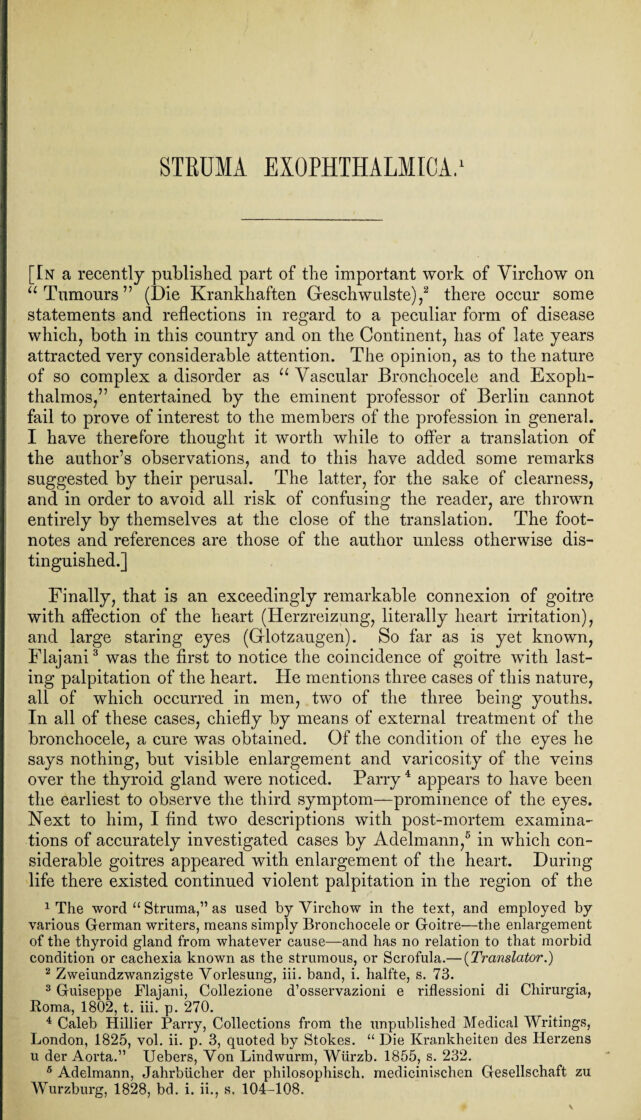
![STRUMA EXOPHTHALMIC!.1 [In a recently published part of the important work of Virchow on u Tumours ” (Die Krankhaften Geschwülste),2 there occur some statements and reflections in regard to a peculiar form of disease which, both in this country and on the Continent, has of late years attracted very considerable attention. The opinion, as to the nature of so complex a disorder as u Vascular Bronchocele and Exoph¬ thalmos,” entertained by the eminent professor of Berlin cannot fail to prove of interest to the members of the profession in general. I have therefore thought it worth while to offer a translation of the author’s observations, and to this have added some remarks suggested by their perusal. The latter, for the sake of clearness, and in order to avoid all risk of confusing the reader, are thrown entirely by themselves at the close of the translation. The foot¬ notes and references are those of the author unless otherwise dis¬ tinguished.] Finally, that is an exceedingly remarkable connexion of goitre with affection of the heart (Herzreizung, literally heart irritation), and large staring eyes (Glotzaugen). So far as is yet known, Flajani3 was the first to notice the coincidence of goitre with last¬ ing palpitation of the heart. He mentions three cases of this nature, all of which occurred in men, two of the three being youths. In all of these cases, chiefly by means of external treatment of the bronchocele, a cure was obtained. Of the condition of the eyes he says nothing, but visible enlargement and varicosity of the veins over the thyroid gland were noticed. Parry4 appears to have been the earliest to observe the third symptom—prominence of the eyes. Next to him, I find two descriptions with post-mortem examina¬ tions of accurately investigated cases by Adelmann,5 in which con¬ siderable goitres appeared with enlargement of the heart. During life there existed continued violent palpitation in the region of the 1 The word “ Struma,” as used by Virchow in the text, and employed by various German writers, means simply Bronchocele or Goitre—the enlargement of the thyroid gland from whatever cause—and has no relation to that morbid condition or cachexia known as the strumous, or Scrofula.— (Translator.) 2 Zweiundzwanzigste Vorlesung, iii. band, i. halfte, s. 73. 3 Guiseppe Flajani, Collezione d’osservazioni e riflessioni di Chirurgia, Roma, 1802, t. iii. p. 270. 4 Caleb Hillier Parry, Collections from the unpublished Medical Writings, London, 1825, vol. ii. p. 3, quoted by Stokes. “ Die Krankheiten des Herzens u der Aorta.” Uebers, Von Lindwurm, Würzb. 1855, s. 232. 6 Adelmann, Jahrbücher der philosophisch, medicinischen Gesellschaft zu Wurzburg, 1828, bd. i. ii., s. 104-108.](https://iiif.wellcomecollection.org/image/b30569084_0003.jp2/full/800%2C/0/default.jpg)