Biographia Britannica literaria; or, biography of literary characters of Great Britain and Ireland. Anglo-Saxon period / arranged in chronological order.
- Thomas Wright
- Date:
- 1842
Licence: Public Domain Mark
Credit: Biographia Britannica literaria; or, biography of literary characters of Great Britain and Ireland. Anglo-Saxon period / arranged in chronological order. Source: Wellcome Collection.
22/582 (page 10)
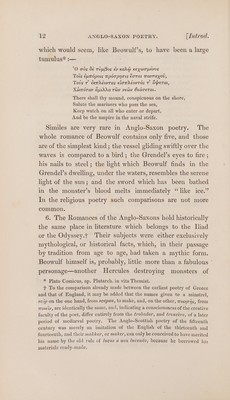
![he tears the monster’s arm from the shoulder, the poet dwells on the momentary act of separation till we seem to feel the crash :—- him on eaxle wear’d On his shoulder became syn-dolh swedtol ; a mighty gash evident, seonowe on-sprungon, the sinews sprang asunder, burston ban-locan. the juncture of the bones burst. (Beowulf, v. 1626.) The metaphors also often possess much original beauty. Thus, an enemy is not slain—he is put to sleep with the sword. So it was with the nicors whom Beowulf had destroyed in the sea; and they were found not on the shore—but near the leavings of the waves :— ac on mergenne But in the morning mecum wunde wounded with blades be y'5-lafe beside the leavings of the waves uppe le!gon, they lay aloft, swe[ordum] a-swefede. put to sleep with swords. (v. 1124.) When a hero died in peace, he went on his way. So Beowulf’s father— ge-bad wintra worn, he abode for many a year, z'r he on weg hwurfe ere he went on his way, gamol of geardum. old, from his dwellings. (v. 525.) Men’s passions and feelings are sometimes depicted with great beauty. What can be more simple and elegant, and at the same time more natural and pathetic, than Hrothgar’s lamentation over his old and faithful coun- seller, whom unexpectedly the Grendel’s mother had slain ?— Hr6d-gér mapelode, Hrothgar spake, helm Scyldinga : the protector of the Scyldings: ne frin bt efter see’/lum,— ‘‘ Ask not thou after happiness,— sorh is ge-niwod sorrow is renewed Denigea leddum ; to the Danish people ; dead is Aisc-here dead is Auschere](https://iiif.wellcomecollection.org/image/b33096740_0022.jp2/full/800%2C/0/default.jpg)